Избранное сообщение

среда, 31 декабря 2025 г.

ГА ООН приняла резолюцию "Международное десятилетие действий "Вода для жизни"


2014-12-25 09:50:55 | Russian.News.Cn


Душанбе, 24 декабря /Синьхуа/ -- На 69-й сессии Генеральной Ассамблеи ООН единогласно принята резолюция "Международное десятилетие действий "Вода для жизни", 2005–2015 годы, и дальнейшие усилия по обеспечению устойчивого освоения водных ресурсов".

Как сообщили сегодня в МИД Таджикистана, данная резолюция была подготовлена и вынесена на обсуждение по инициативе Таджикистана. В соответствии с ней планируется проведение двух мероприятий - диалога высокого уровня в ходе 69-й сессии ГА ООН в марте 2015 года и международной конференции высокого уровня в Душанбе в июне 2015 года.

Резолюция является продолжением глобальных инициатив Таджикистана, нацеленных на устойчивое управление водными ресурсами.


http://russian.news.cn/world/2014-12/25/c_133877234.htm
http://creativecommons.org/licenses/by/3.0/legalcode

понедельник, 1 декабря 2025 г.

Cyclone Ditwah brings worst flooding in decades to Sri Lanka, killing hundreds


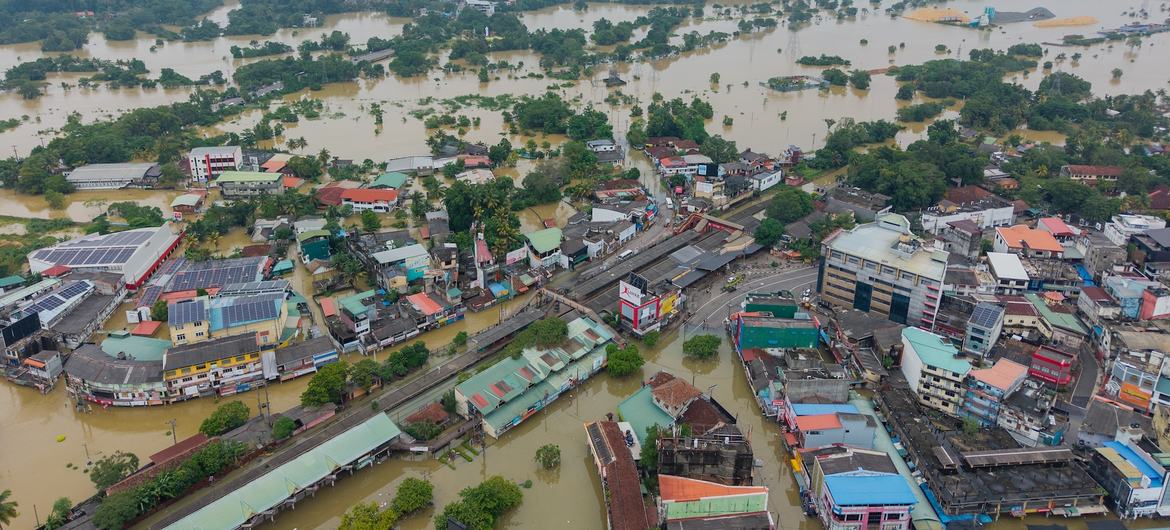
Gampaha (pictured), a district on Colombo's outskirts, has been among the areas hardest hit by flooding after Cyclone Ditwah.© UNICEF/InceptChange
 
Gampaha (pictured), a district on Colombo's outskirts, has been among the areas hardest hit by flooding after Cyclone Ditwah.


By Vibhu Mishra
30 November 2025 
Humanitarian Aid

Sri Lanka is facing one of its worst flood disasters in two decades, with nearly one million people affected and more than 400 reported dead or missing after Cyclone Ditwah unleashed catastrophic flooding and landslides across the island.

According to the UN relief coordination office, OCHA, 998,918 people across all 25 districts have now been affected, with 212 deaths reported and 218 people missing. More than 180,000 people from over 51,000 families are sheltering in 1,094 government-run safety centres as search and rescue efforts continue.

Cyclone Ditwah made landfall on 28 November before moving back over the Bay of Bengal, triggering some of the most severe flooding Sri Lanka has seen since the early 2000s.

The hardest-hit districts include Gampaha, Colombo, Puttalam and Mannar, as well as Trincomalee and Batticaloa, while deadly landslides in the central hill country have devastated Kandy, Badulla and Matale.

Tweet URL

Homes destroyed, infrastructure shattered

Initial assessments indicate that more than 15,000 homes have been destroyed. Over 200 roads remain impassable, at least 10 bridges have been damaged, and sections of the rail network and national power grid affected.

Flooding along the Kelani River, which runs through Colombo and surrounding low-lying areas, continues to hamper access and disrupt information flow from affected communities, complicating rescue and relief operations.

Severe disruption to electricity, mobile and communications, and transport networks are reported in northern districts such as Jaffna, with entire villages isolated

Access to clean water also remains a major concern, with several areas reporting little or no supply.

Health system under strain, food insecurity looms

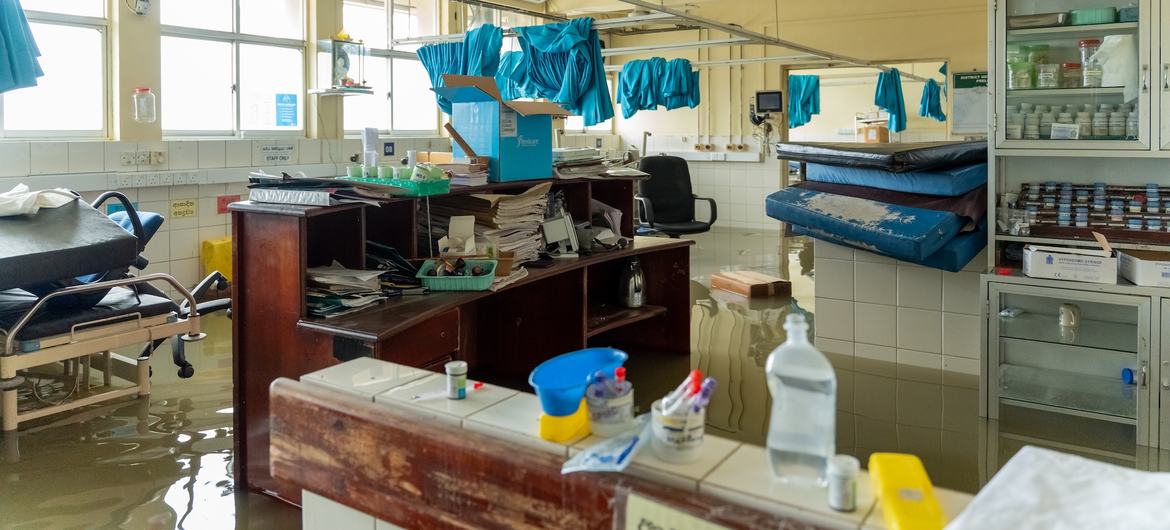
Sri Lanka’s already fragile health system is under severe pressure, OCHA said. Several district hospitals remain flooded and are receiving only limited supplies, with critically ill patients being airlifted to functioning facilities.

Response is further hindered by recurring landslides and the breach of multiple tank bunds (embankments or barriers), including at Mavilaaru, heightening risks in Trincomalee and Batticaloa.

Authorities have also warned of rising food insecurity, as submerged farmland, damaged storage facilities and severed supply routes threaten shortages and price increases in the weeks ahead.

The World Health Organization (WHO) warned that floods significantly raise the risk of vector-borne, food-borne and water-borne diseases, urging communities to prevent mosquito bites, ensure food safety and use safe drinking water wherever possible.

Floodwaters have entered several hospitals across Sri Lanka, further straining the health system.
© UNICEF/ InceptChange
 
Floodwaters have entered several hospitals across Sri Lanka, further straining the health system.

UN mobilises coordinated response

The United Nations in Sri Lanka activated its emergency coordination system on Sunday to scale up a unified response with government agencies and humanitarian organizations.

Sector coordination has been set up across food security, health, water and sanitation (WASH), education, protection, shelter and early recovery, while a multi-sector needs assessment is under way with disaster management authorities to identify the most urgent gaps.

“The UN in Sri Lanka is mobilising its teams across the system to support national rescue and early recovery efforts, in coordination with authorities. We stand in solidarity with all affected communities,” said UN Resident Coordinator Marc-André Franche.

Despite access challenges, the UN Children’s Fund (UNICEF) has delivered portable water to 25 safety centres in Badulla in the central hills, which had been cut off from the rest of the country by floods and infrastructure damage.

To support government-led efforts, India and Pakistan have deployed emergency teams to work alongside Sri Lanka’s armed forces in the worst-hit districts.

Meanwhile, in the wider Asian region

Severe monsoon flooding continues across Thailand and Malaysia, affecting more than two million people in southern Thailand alone and displacing nearly 25,000 people in Malaysia, according to OCHA. People have been evacuated in several hard-hit Thai provinces, while the rainfall is expected to ease in coming days.

In Indonesia, media reports cite at least 440 deaths from floods and landslides, with more than 400 people missing, particularly in parts of Sumatra, where thousands remain stranded without access to food and water.


https://creativecommons.org/licenses/by/4.0/legalcode

https://news.un.org/en/story/2025/11/1166474

воскресенье, 23 ноября 2025 г.

Belém COP30 delivers climate finance boost and a pledge to plan fossil fuel transition


Civil Society Actions


Civil Society Actions


By Felipe de Carvalho, in Belém
22 November 2025 Climate and Environment

In a pivotal outcome at COP30 in Belém, Brazil, countries agreed on a sweeping package to scale up climate finance and accelerate implementation of the Paris Agreement – but without a clear commitment to move away from fossil fuels.

A new economy is rising, while the old polluting one is running out of road.

That was the message from UN climate chief Simon Stiell as COP30 wrapped up following marathon talks on Friday night which stretched into sunrise Saturday – signaling a turning point for climate ambition and global solidarity. 

What was decided:

  • Finance at scale: Mobilise $1.3 trillion annually by 2035 for climate action.
  • Adaptation boost: Double adaptation finance by 2025 and triple by 2035.
  • Loss and damage fund: Operationalisation and replenishment cycles confirmed.
  • New initiatives: Launch of the Global Implementation Accelerator and Belém Mission to 1.5°C to drive ambition and implementation.
  • Climate disinformation: Commitment to promote information integrity and counter false narratives.

The final decision emphasises solidarity and investment, setting ambitious financial targets while leaving energy transition for later discussion. The burning of fossil fuels emits greenhouse gases that are by far the largest contributors to global warming, making this omission a point of concern for many nations, including negotiators from South America and the EU, as well as civil society groups.

Expectations were high that COP30's final decision would include explicit reference to phasing out fossil fuels. More than 80 countries backed Brazil’s proposal for a formal ‘roadmap.’

A draft text had included it – until the final hours of talks. The adopted outcome refers only to the ‘UAE Consensus’, the COP28 decision calling for “transitioning away from fossil fuels.”

Before the final plenary, Brazilian scientist Carlos Nobre issued a stark warning: fossil fuel use must fall to zero by 2040 – 2045 at the latest to avoid catastrophic temperature rises of up to 2.5°C by mid-century. That trajectory, he said, would spell the near-total loss of coral reefs, the collapse of the Amazon rainforest and an accelerated melt of the Greenland ice sheet.

A closer look

After two weeks of intense negotiations, the adopted text calls for mobilizing at least $1.3 trillion per year by 2035 for climate action, alongside tripling adaptation finance and operationalizing the loss and damage fund agreed at COP28.  

It also launches two major initiatives – the Global Implementation Accelerator and the Belém Mission to 1.5°C – to help countries deliver on their nationally determined contributions (NDCs) and adaptation plans.

For the first time, the decision acknowledges the need to tackle climate disinformation, pledging to promote information integrity and counter narratives that undermine science-based action.  

Last week, Brazil’s President, Luiz Inácio Lula da Silva, opened the summit declaring it would be known as “the COP of truth,” and this landmark decision marks a significant step toward safeguarding public trust in climate policy – even as the absence of fossil fuel transition language underscores the complexity of energy negotiations.

Two new roadmaps

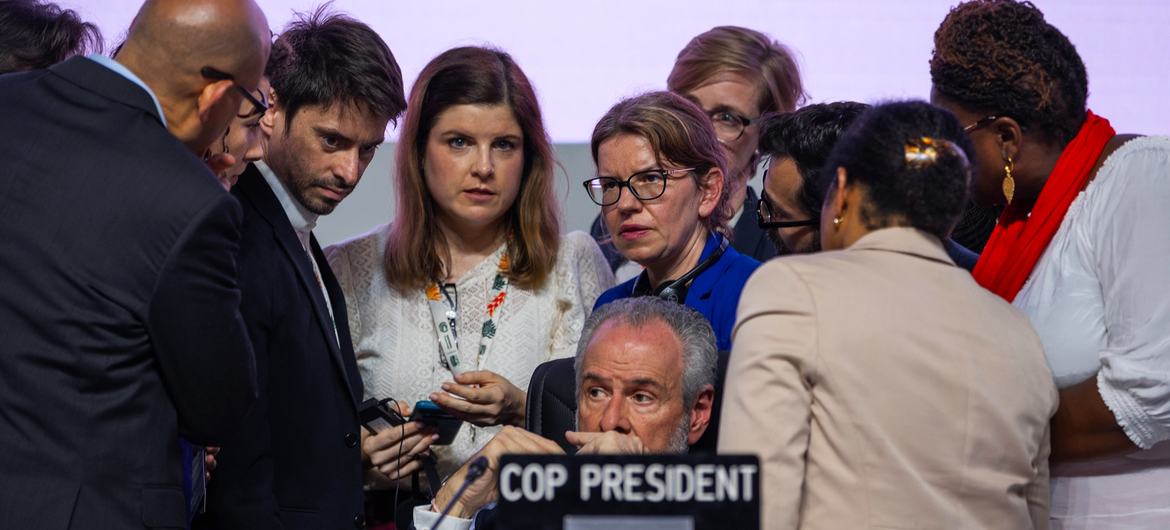
In the closing meeting, COP30 President André Corrêa do Lago acknowledged what was left out of the deal:  

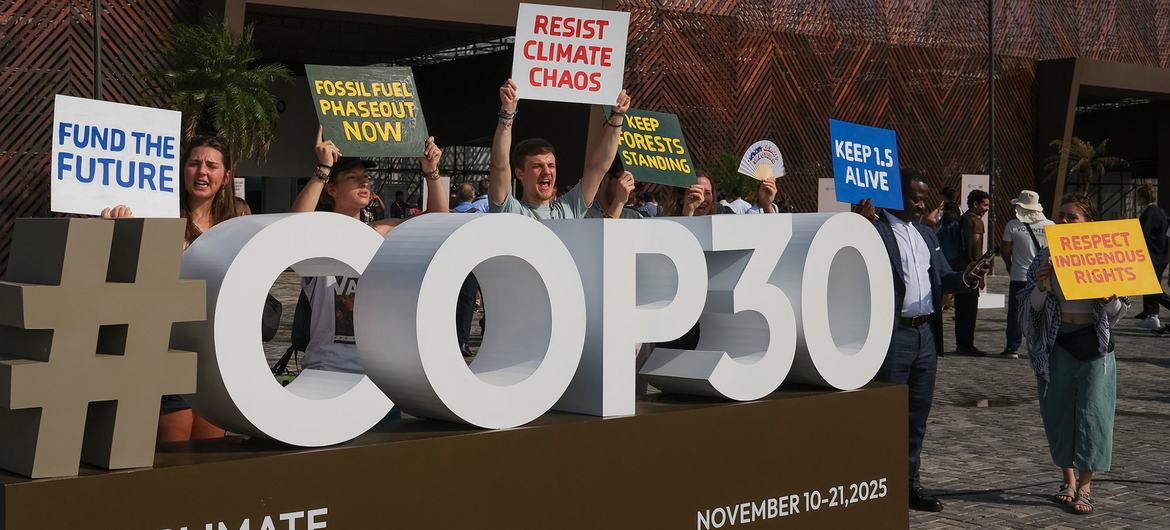
“We know some of you had greater ambitions for some of the issues at hand,” he said, adding, “I know the youth civil society will demand us to do more to fight climate change. I want to reaffirm that I will try not to disappoint you during my presidency.”  

Reflecting on President Lula’s call at the opening of COP30 for ambition, Mr. do Lago announced plans to create two roadmaps: one to halt and reverse deforestation; and another to transition away from fossil fuels in a just, orderly and equitable manner, mobilizing resources for these purposes in a “just and planned manner.”

COP30 President André Corrêa do Lago (centre) confers with his team at the closing of the UN Climate Conference.
© UNFCCC/Kiara Worth
 
COP30 President André Corrêa do Lago (centre) confers with his team at the closing of the UN Climate Conference.

The road to consensus

The road to consensus at the latest Conference of the Parties to the UN Framework Convention on Climate Change (UNFCCC), as the annual COPs are formally known, was anything but smooth.  

Late last week, Indigenous groups staged blockades demanding stronger protections for the Amazon, and late Thursday afternoon, a fire at the conference venue disrupted talks during a critical phase. 

Negotiators worked through the night on Friday – to bridge gaps on finance and ambition, with Brazil’s presidency steering discussions toward a politically workable outcome focused on support and implementation of agreements from past COPs.

‘Multilateralism is alive’

From the G20 Summit in Johannesburg, UN Secretary-General António Guterres sent a clear message to COP30: At the gateway of the Amazon, Parties reached an agreement that shows nations can still unite to confront challenges no country can solve alone.  

The UN chief said that COP30 delivered progress, such as the launch of the Global Implementation Accelerator to close ambition gaps and reaffirmed the UAE Consensus, including a just, orderly and equitable transition away from fossil fuels.

“But COPs are consensus-based – and in a period of geopolitical divides, consensus is ever harder to reach. I cannot pretend that COP30 has delivered everything that is needed.” Overshoot of 1.5°C is a stark warning: deep, rapid emission cuts and massive climate finance are essential. “COP30 is over, but the work is not,” he said.  

Tweet URL

The UN Secretary-General vowed to keep pushing for higher ambition and solidarity, urging all who marched, negotiated and mobilized: “Do not give up. History – and the United Nations – are on your side.

Holding the line at 1.5 in ‘turbulent geopolitical waters’

UN climate chief Simon Stiell pointed to a series of major gains as COP30 closed in Belém: new strategies to accelerate Paris Agreement implementation, a push to triple adaptation finance, and commitments toward a just energy transition.

And despite what he called “turbulent geopolitical waters” – marked by polarization and climate denial – 194 nations stood together, “keeping humanity in the fight for a livable planet, determined to hold the line at 1.5°C.”

At the heart of this momentum is COP30’s flagship outcome: the Mutirão text, a sweeping deal that bundles four contentious negotiation tracks – from mitigation to finance and trade barriers – into a single, consensus-based agreement. Seventeen additional decisions were adopted alongside it.

The final document declares that the global shift toward low-emissions and climate-resilient development is “irreversible and the trend of the future.” It reaffirms that the Paris Agreement is working – and must “go further and faster” – strengthening the role of multilateral climate cooperation.

The text also recognizes the economic and social benefits of climate action, from growth and job creation to improved energy access, security and public health. Stiell pointed to a decisive trend: investments in renewable energy now outpace fossil fuels two to one – “a political and market signal that cannot be ignored,” he said.

A robust action agenda beyond negotiations

The Brazilian Presidency underscored that COP30’s success extends beyond negotiated agreements, highlighting a wave of voluntary commitments under the Action Agenda.

Among them:

  • Tropical Forests Forever Fund: Raised $5.5 billion and now includes 53 participating countries; at least 20 per cent of resources go directly to Indigenous Peoples and local communities.
  • Belém Health Action Plan: The first global initiative targeting climate-related health threats, launched with $300 million from 35 philanthropic organizations.
  • UNEZA Alliance: Public utility companies pledged $66 billion annually for renewable energy and $82 billion for transmission and storage.
  • Cities, regions and companies: A coalition spanning 25,000 buildings reported cutting over 850,000 tons of CO₂ in 2024.

Climate justice at the forefront

Countries also agreed to develop a just transition mechanism, enhancing cooperation, technical support and capacity-building.


https://creativecommons.org/licenses/by/4.0/legalcode

https://news.un.org/en/story/2025/11/1166433

воскресенье, 9 ноября 2025 г.

COP30 kicks off with urgent call to deliver on climate promises and scale up finance


The Belém Climate Summit opens on 10 November 2025.


By Felipe de Carvalho
8 November 2025 
Climate and Environment

Thousands of diplomats and climate experts are heading to Belém, in Brazil’s Amazon, for COP30 – the latest round of UN climate talks. Their task couldn’t be clearer: turn promises into action and agree on tougher plans to cut greenhouse gas emissions. 

After decades of pledges and annual summits from Kyoto to Sharm el-Sheikh, the planet keeps getting hotter and pressure on governments and big business to act – not just talk – has never been greater.

Holding COP30 in Belém, at the edge of the world’s largest tropical rainforest, underscores the stakes: the Amazon region is both a vital carbon sink and a frontline in the fight against deforestation and climate change.

So, this year’s meeting aims to shift gears. Delegates will review national climate plans, push for $1.3 trillion a year in climate finance, adopt new measures to help countries adapt, and advance a ‘just transition’ to cleaner economies.

‘It’s time for implementation’

COP30 has been billed as a turning point – a moment of truth and a test of global solidarity. The summit opens on Monday in Belém against a stark backdrop: scientists say the planet is on course to temporarily breach the 1.5°C warming limit set by the Paris Agreement.

That overshoot could still be short-lived, experts warn, but only if countries act fast to ramp up efforts on cutting emissions, adapting to climate impacts, and mobilizing finance.

Speaking at the Leaders’ Summit, UN Secretary-General António Guterres was blunt: “It’s no longer time for negotiations. It’s time for implementation, implementation and implementation.”

Under Brazil’s presidency, COP30 will revolve around an action agenda of 30 key goals, each driven by an ‘activation group’ tasked with scaling up solutions. 

The effort has been dubbed a mutirão – an Indigenous word meaning “collective task” – reflecting Brazil’s push to spotlight Indigenous leadership and participation at the conference and in the global fight against climate change.

The government says it wants all sectors – from Indigenous communities to business leaders – to help deliver on past climate promises.

Financing the transition

Action agendas at COPs are built on voluntary pledges rather than binding law. But the scale of change needed is enormous: at least $1.3 trillion in climate investments every year by 2035.

Without urgent action, scientists warn global temperatures could climb between 2.3°C and 2.8°C by the end of the century, leaving vast regions uninhabitable through flooding, extreme heat and ecosystem collapse.

At the heart of talks in Belém will be the Baku-to-Belém Roadmap Report for $1.3 Trillion, prepared by the COP29 and COP30 presidencies. It sets out five priorities for mobilizing resources, including boosting six multilateral climate funds, strengthening cooperation on taxing polluting activities, and converting sovereign debt into climate investment – a move that could unlock up to $100 billion for developing countries.

The report also calls for dismantling barriers such as investment treaty clauses that let corporations sue governments over climate policies. Those disputes have already cost governments $83 billion across 349 cases.

Delegates ae gathering for the Climate Summit which is taking place in Belém, Brazil.
© UNFCCC/Diego Herculano
 
Delegates ae gathering for the Climate Summit which is taking place in Belém, Brazil.

What else is on the agenda at COP30?

Another key focus in Belém is the latest round of Nationally Determined Contributions (NDCs) – national climate plans that spell out how countries intend to cut emissions. To keep warming below 1.5°C, global emissions must fall by 60 per cent by 2030. Current NDCs would deliver only a 10 per cent cut.

Of the 196 Parties to the Paris Agreement, just 64 had submitted updated NDCs by the end of September. At preparatory talks in Germany in June, many countries warned that this ambition gap must be closed at COP30.

Delegates are also expected to approve 100 global indicators to track progress on climate adaptation, making results measurable and comparable across nations. 

Today, 172 countries have at least one adaptation policy or plan, though 36 are outdated. The new indicators should help shape more transparent and effective policies.

With the planet heating faster than ever, adaptation is now a central pillar of climate action. But the UN Environment Programme (UNEP) warns adaptation finance must rise twelvefold by 2035 to meet developing countries’ needs.

COP30 will also push forward the Just Transition Work Programme – aimed at ensuring climate measures don’t deepen inequality. Civil society groups are calling for a “Belém Action Mechanism” to coordinate just transition efforts and expand access to technology and finance for the most vulnerable nations.

Why COPs matter

The Conference of the Parties to the UN Framework Convention on Climate Change (UNFCCC) – known simply as COP – remains the world’s leading forum for tackling the climate crisis. Decisions are made by consensus, driving cooperation on mitigation, adaptation and finance.

Over the years, COPs have delivered landmark deals. In 2015, the Paris Agreement set the goal of keeping global temperature rise “well below 2°C” while striving for 1.5°C. 

At COP28 in Dubai, countries agreed to transition away from fossil fuels “in a just, orderly and equitable manner” and to triple renewable energy capacity by 2030. Last year in Baku, COP29 raised the annual climate finance target for developing nations from $100 billion to $300 billion, with a roadmap to scale up to $1.3 trillion.

Taken together, the legal framework built over three decades under the UNFCCC has helped avert a projected 4°C temperature rise by the end of this century.

COP30 opens Monday, 10 November, and runs through Friday, 21 November.

https://news.un.org/en/story/2025/11/1166313

https://creativecommons.org/licenses/by/4.0/legalcode

четверг, 6 ноября 2025 г.

2025 set to be second or third warmest year on record, continuing exceptionally high warming trend


06 November 2025

The alarming streak of exceptional temperatures continued in 2025, which is set to be either the second or third warmest year on record, according to the State of the Global Climate Update from the World Meteorological Organization (WMO). 


The past 11 years, 2015 to 2025, will individually have been the eleven warmest years in the 176-year observational record, with the past three years being the three warmest years on record. The mean near-surface temperature in January-August 2025 was 1.42 °C ± 0.12 °C above the pre-industrial average, said the WMO report.

Concentrations of heat-trapping greenhouse gases and ocean heat content, which both reached record levels in 2024, continued to rise in 2025. Arctic sea ice extent after the winter freeze was the lowest on record, and Antarctic sea ice extent tracked well below average throughout the year. The long-term sea level rise trend continued despite a small and temporary blip due to naturally occurring factors, said the report.

Weather and climate-related extreme events to August 2025 – ranging from devastating rainfall and flooding to brutal heat and wildfires - had cascading impacts on lives, livelihoods and food systems. This contributed to displacement across multiple regions, undermining sustainable development and economic progress.

"This unprecedented streak of high temperatures, combined with last year's record increase in greenhouse gas levels, makes it clear that it will be virtually impossible to limit global warming to 1.5 °C in the next few years without temporarily overshooting this target. But the science is equally clear that it’s still entirely possible and essential to bring temperatures back down to 1.5 °C by the end of the century.” said WMO Secretary-General Celeste Saulo.

“Each year above 1.5 degrees will hammer economies, deepen inequalities and inflict irreversible damage. We must act now, at great speed and scale, to make the overshoot as small, as short, and as safe as possible – and bring temperatures back below 1.5°C before the end of the century,” said UN Secretary-General António Guterres, who cited the WMO report in his statement to the Belém Climate Summit.

WMO released the State of the Global Climate Update 2025 for the Summit at the UN Climate Change Conference, COP30, in Belem, Brazil. It is a science-based reference to anchor COP negotiations in authoritative evidence. It highlights key climate indicators and their relevance to support policymaking and is a bridge to more detailed but less frequent scientific reports.

The report also provides a snapshot of how the WMO community is supporting decision-makers with weather and climate intelligence.

Since 2015, the number of countries reporting multi-hazard early warning systems (MHEWSs) has more than doubled – from 56 to 119 in 2024. However, 40% of countries still lack MHEWSs, and urgent action is needed to close these remaining gaps.

National Meteorological and Hydrological Services (NMHSs) have a growing role in climate action plans which increasingly recognize the importance of climate services such as seasonal outlooks in key sectors like agriculture, water, health and energy. Nearly two thirds of NMHSs now provide some form of climate services – varying from essential to advanced level – compared to approximately 35% just five years ago.

As climate-related drivers shape renewable energy supply and demand, it is essential to anticipate these influences to build reliable and flexible clean energy systems. 


https://wmo.int/media/news/2025-set-be-second-or-third-warmest-year-record-continuing-exceptionally-high-warming-trend


https://creativecommons.org/licenses/by/4.0/legalcode

четверг, 30 октября 2025 г.

Hurricane Melissa: Devastation in Jamaica at levels ‘never been seen before’

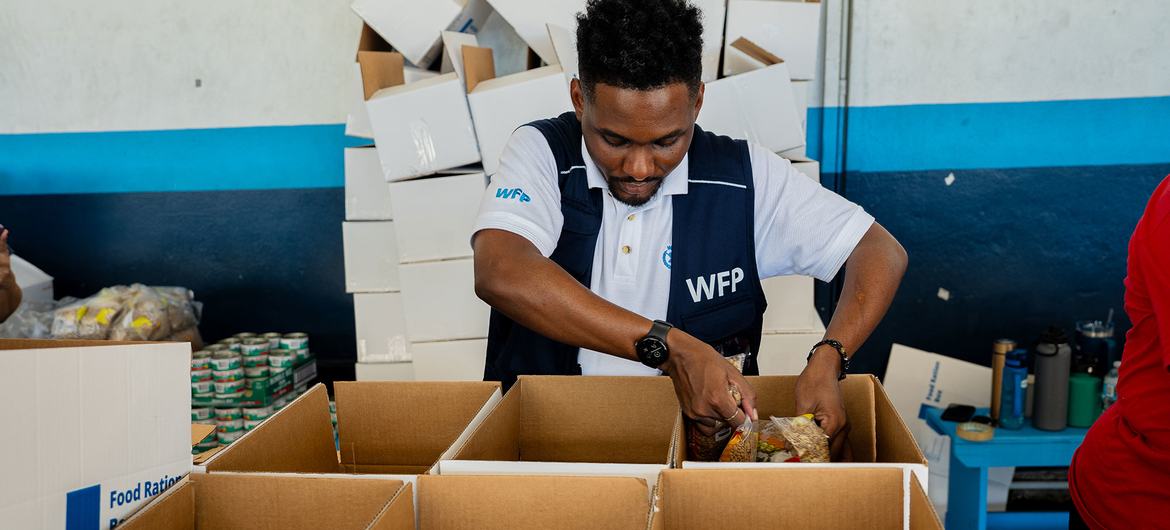
Food is packed for distribution to people affected by Hurricane Melissa in Jamaica.
© UN/Lovell
 
Food is packed for distribution to people affected by Hurricane Melissa in Jamaica.


By Charlotte Frantz
29 October 2025
 Climate and Environment

As Hurricane Melissa moved north of Jamaica on Wednesday, the head of the UN team there said that preliminary damage assessments from the category 5 storm showed a level of devastation “never seen before” on the Caribbean island.

As Hurricane Melissa moved north of Jamaica on Wednesday, the head of the UN team there said that preliminary damage assessments from the category 5 storm showed a level of devastation “never seen before” on the Caribbean island.

UN Resident Coordinator Dennis Zulu emphasised the UN remains closely engaged with governments across the region, on-the-ground UN agencies, and the Caribbean Disaster Emergency Management Agency (CDEMA), noting the “tremendous and unprecedented destruction of infrastructure,” across Jamaica where Melissa made landfall on Tuesday.

Tweet URL

Looking to the months-long reconstruction and recovery effort ahead, he told correspondents in New York via video conference that it would take “a lot of resources” to rebuild and put the thriving economy back on its feet.

“I don't think there's any single soul on this island that was not affected by Hurricane Melissa", highlighted the resident coordinator.

‘Terrible tragedy’

UN World Food Programme (WFP) Director for the Caribbean Multi-Country Office, Brian Bogart, told UN News from the capital, Kingston: “This is a terrible tragedy and there is a real sense of urgency here on the ground. What we're really focused on now is trying to get food and logistics support to enable the entire humanitarian community to respond in coordination with the government”. 

Mr. Bogart said the agency’s primary focus is to deliver 2,000 emergency food boxes which are ready to be airlifted from Barbados as soon as the airport reopens, which would be enough to support 6,000 people for a week. 

As the leading logistical agency, WFP is also loading a vessel in Barbados from the Logistics Hub run alongside the CDEMA, with essentials – such as hygiene kits, shelter, generators – and other items from UN agencies and partners to support the humanitarian effort in Jamaica.

Hurricane barrels on

Early Wednesday morning, Hurricane Melissa crossed into Cuba, bringing 120 mph winds, heavy rain, and a warning of “life-threatening” storm surges, according to news reports. It’s due to move on to The Bahamas, followed by Bermuda.

The storm weakened to a category 2 reaching Cuba, but the National Hurricane Centre (NHC) there said Melissa would “remain a powerful hurricane when it moves across the Bahamas later today.”

The UN Deputy Secretary-General Amina Mohammed said the slow-moving storm was “yet another demonstration of climate science and why we must fight for a world at 1.5 degrees Celsius.”

Data from the UN aid coordination office (OCHA) shows Melissa ranks among the most intense storms to strike Cuba in recent decades, with maximum sustained winds near 138 mph (222 km/h) and two-day rainfall totals approaching 145 millimetres. 

On Wednesday, the UN allocated $4 million each to Haiti and Cuba from its Central Emergency Fund to help communities prepare for the storm and reduce its impact. 

According to news reports, at least 20  Haitians – including 10 children – died due to river flooding as Melissa barrelled across the region. 

UN working ‘hand in hand’ with authorities

Conveying his heartfelt condolences to the families of those who have lost their lives, the UN Secretary-General António Guterres reiterated his solidarity with the governments and communities affected by the hurricane. 

“Guided by Resident Coordinators on the ground, the UN is working hand in hand with authorities and humanitarian partners to assess needs, assist those impacted, and prepare in areas that may yet face the storm’s impact,” he said. 

UN General Assembly President Annalena Baerbock tweeted that for small island developing States “the climate crisis is a lived reality, and the cost of inaction is measured in lives and livelihoods. Adaptation isn’t optional, it’s survival. Solidarity must become sustained, scaled-up climate action.”


https://news.un.org/en/story/2025/10/1166217

https://creativecommons.org/licenses/by/4.0/legalcode

четверг, 16 октября 2025 г.

World Food Day 2025: Building Sustainable Food Systems for All


  • Author : Shoba Suri
  • Expert Speak Health Express
    Published on Oct 15, 2025

    As FAO marks 80 years, World Food Day 2025 highlights the urgent need for inclusive, sustainable partnerships to end hunger and strengthen food security.

    World Food Day 2025: Building Sustainable Food Systems for All

    Image Source: Getty Images

    On 16 October 2025, as the world observes World Food Day, organised by the United Nations’ Food and Agriculture Organization (FAO), the need to eliminate hunger and advance sustainable food systems becomes ever more urgent, especially as FAO marks 80 years of commitment to this mission. The theme for this year, "Hand in Hand for Better Foods and a Better Future," highlights the FAO’s Hand-in-Hand Initiative, which fosters evidence-driven, country-led partnerships aimed at transforming agri-food systems and strengthening food security. Amid climate crises, conflicts, and economic instability, the theme highlights the urgent need for collective action in bringing together governments, farmers, businesses, and communities to build resilient, nutritious, and sustainable food systems.

    Although the world produces enough food to nourish 8.2 billion people, 673 million individuals dealt with hunger at some point during 2024. Progress, however, remains uneven; Africa and Western Asia continue to face significant setbacks due to conflicts and extreme weather conditions. According to the World Food Programme, regions such as Gaza, Sudan, and Haiti are home to 1.9 million people facing catastrophic hunger. Worldwide, 733 million people suffer from undernourishment, while 2.8 billion are unable to afford a healthy diet due to rising prices and the increasing cost of living.

    The theme for this year, "Hand in Hand for Better Foods and a Better Future," highlights the FAO’s Hand-in-Hand Initiative, which fosters evidence-driven, country-led partnerships aimed at transforming agri-food systems and strengthening food security.

    Agrifood systems, which provide livelihoods for 1 billion people, contribute a third of global greenhouse gas (GHG) emissions, and are under increasing pressure from climate change, economic instability, and resource constraints. Climate change has already impacted crop yields in parts of South Asia, contributing to declines in productivity, shifts in planting and harvest dates, and increased vulnerability to pests and extreme weather, according to  Intergovernmental Panel on Climate Change (IPCC) assessments. The 2022 Ukraine crisis further exacerbated the situation, driving a 14 percent surge in food prices and pushing an additional 71 million people into poverty.

    Sustainable practices offer a promising path toward transforming food systems. Regenerative agriculture, for instance, enhances soil health and biodiversity while improving yields and reducing emissions. However, building sustainable food systems depends on effective governance and collaboration across multiple stakeholders. A 2024 review of 34 governance models emphasised that participatory and hybrid approaches combining public-private partnerships with active community engagement tend to deliver more inclusive and durable outcomes than siloed strategies. Such “polycentric” governance arrangements strengthen adaptive resilience, enabling food systems to withstand shocks such as pandemics or floods more effectively.

    bibliometric analysis also reveals growing academic attention to sustainability and collaboration in food supply chains. A recent review of over 500 studies on sustainable food supply chains reported a marked post-2020 rise in research on collaboration, digital traceability, and circular economy strategies. Innovations such as blockchain technology are resulting in improved transparency and traceability, curbing food losses and waste. Additionally, circular models are increasingly repurposing agricultural by-products into animal feed or bioenergy. Yet, much of this research remains concentrated in high-income regions, although the Global South continues to bear nearly 80 percent of the global hunger burden.

    “Polycentric” governance arrangements strengthen adaptive resilience, enabling food systems to withstand shocks such as pandemics or floods more effectively.

    Recent interdisciplinary studies underscore the importance of systems-thinking approaches in fostering sustainable and equitable food systems. A 2025 study published in Frontiers in Sustainable Food Systems advocates for using systems-thinking visualisations to map interconnections within food systems, identifying leverage points such as agroecological transitions that can enhance biodiversity and nutrition. Additionally, a meta-analysis, examining over 120 frameworks, found that collaborative indicators, such as partnership density, correlate with a 25 percent increase in sustainability scores. This highlights the significance of collaboration in achieving sustainable food systems. Furthermore, another study emphasises the role of co-creation in value-sharing partnerships, which have been shown to increase incomes through fair-trade premiums.

    Together, these insights underscore that sustainable food systems require both scientific rigour and inclusive partnerships. This is a central principle of the FAO’s Hand-in-Hand Initiative (HIH). A flagship global programme designed to accelerate the transformation of agrifood systems in ways that are inclusive, climate-resilient, and sustainable. The core aims are to eradicate poverty (Sustainable Development Goal 1), end hunger and malnutrition (SDG 2), reduce inequalities (SDG 10), and strengthen resilience to climate change. Launched in 2019, the HIH Initiative supports 80 countries across Africa, Asia, Latin America, and the Middle East. Its strength lies in the use of advanced geospatial analysis, socioeconomic data, and investment modelling to identify regions where agricultural interventions can have the highest impact on poverty and hunger reduction. Through its Investment Forums, the initiative mobilises public and private financing for food system transformation by promoting innovation in value chains, climate adaptation, and nutrition-sensitive agriculture. Across continents, HIH projects have helped smallholders diversify crops, enhance resilience to climate shocks, and integrate into fairer markets. In countries such as PeruEthiopia, and the Pacific Islands, HIH has enabled new investments that link small-scale producers, many being women and youth, to sustainable market opportunities while safeguarding biodiversity and reducing post-harvest losses.

    Global evidence, literature, and experiences unite in a single message-collaborative efforts can halve hunger by 2030, advancing the vision of SDG 2.

    The evidence and case studies underscore the essence of this year’s theme of hand-in-hand collaboration as key to building better foods and a better future for all. World Food Day 2025      serves as a clarion call for policymakers investing in inclusive initiatives to help consumers choose sustainable produce. Global evidence, literature, and experiences unite in a single message-collaborative efforts can halve hunger by 2030, advancing the vision of SDG.


    https://www.orfonline.org/expert-speak/world-food-day-2025-building-sustainable-food-systems-for-all


    https://creativecommons.org/licenses/by/4.0/legalcode

    вторник, 14 октября 2025 г.

    Учение заявили о расширении Южно-Атлантической магнитной аномалии


    Область слабого магнитного поля Земли, известная как Южно-Атлантическая аномалия, резко выросла с 2014 года. За прошедшие годы ее площадь увеличилась до размера, равного половине территории континентальной Европы, сообщило Европейское космическое агентство (ЕКА).

    Слабое магнитное поле Южно-Атлантической аномалии было впервые обнаружено еще в XIX веке к юго-востоку от Южной Америки. Сегодня эта аномалия является важным фактором при обеспечении космической безопасности, поскольку пролетающие над этим регионом спутники подвергаются повышенным дозам радиации. Это может привести к сбоям в работе, повреждению критически важного оборудования и даже к отключению электроэнергии, поясняет ЕКА.

    «Южно-Атлантическая аномалия — это не просто единый блок. Она меняется иначе по направлению к Африке, чем вблизи Южной Америки. В этом регионе происходит нечто особенное, что приводит к более интенсивному ослаблению поля»,— заявил Крис Финли, профессор геомагнетизма в Датском техническом университете. Он считает, что такое поведение аномалии связано со странными закономерностями в магнитном поле на границе между внешним ядром Земли и ее мантией.


    https://creativecommons.org/licenses/by/4.0/legalcode

    https://www.kommersant.ru/doc/8119494

    понедельник, 29 сентября 2025 г.

    Екатеринбург готов принять ЭКСПО в 2025 году


    Фото Службы новостей ООН/ А.Успенский


    Делегация России провела в ООН презентацию заявки на проведение ЭКСПО-2025 в Екатеринбурге


    28 сентября 2018


    Культура и образование


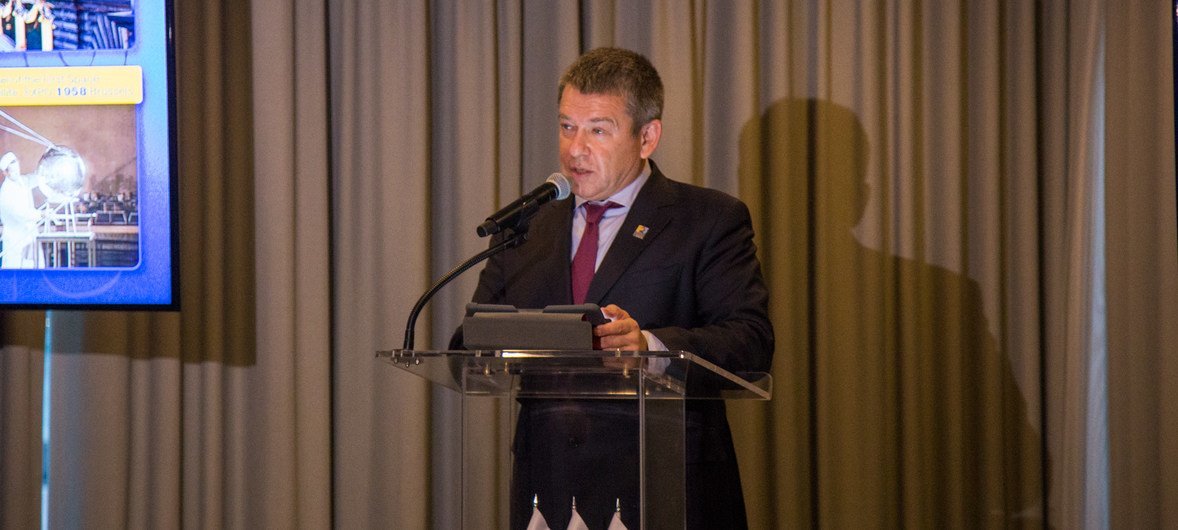
    Екатеринбург и Баку оказались конкурентами в борьбе за проведение международной выставки ЭКСПО. Россияне на 99 процентов уверены, что победят. Поддержать екатеринбуржцев на презентацию в ООН пришел министр иностранных дел России Сергей Лавров. А председатель заявочного комитета «ЭКСПО – 2025» Александр Чернов рассказал Елене Вапничной о том, что дает ему уверенность в успехе.


    ЕВ: Почему Екатеринбург?

    АЧ: Набор городов России велик, и определиться с кандидатом на ЭКСПО от нашей страны было не так просто. Есть блестящая Москва, есть изумительно красивый Петербург, есть восхитительная Казань…

    ЕВ: И замечательный Нижний Новгород, в котором проходили игры чемпионата мира по футболу…

    Да, прекрасный ярмарочный город. И в Екатеринбурге тоже были игры Чемпионата.

    Кстати, в последнем отборочном туре «финальный забег» проходил как раз между Екатеринбургом и Нижним Новгородом. В пользу «Еката» сыграло то, что он уже прежде выдвигался на эту позицию. То есть существует команда, отношения, а главное – возможность показать, тем, кто голосует, что город этого хочет. А мы действительно хотим поместить себя на мировую выставочную карту.

    ЕВ: Как я понимаю, в России никогда ЭКСПО не проводились. У каждого ЭКСПО своя тема. Какую тему предлагаете вы?

    АЧ: Тема у нас «Инновации и развитие для будущих поколений». Эта тема достаточно общая, с одной стороны, а с другой – позволяет всем «выплеснуть» в свои павильоны, в свои решения, в свои предложения, в свое продвижение максимум наработок – научных, культурных, общественных, социальных – которые присущи той или иной стране. Это же выставка всех стран мира. То есть нет такой темы, которая не могла бы стать элементом обсуждения и решения в рамках этого заявленного слогана.

    ЕВ: Мы еще не знаем решения… С кем вы, кстати, конкурируете?

    АЧ: Очень некстати мы конкурируем с очень сильными претендентами, которых мы очень уважаем, с которыми мы дружим. Это Осака – японский город – я там был: красивый, динамичный, молодой. Но Япония уже пять раз проводила ЭКСПО. И Баку – сумасшедше красивый город, куда хочется возвращаться. И та борьба, которую нам навязывает Азербайджан, заставляет меня уважать их еще больше. Молодцы.

    ЕВ: То есть Вам нужно противопоставить что-то такое уникальное, ради чего всем захотелось бы приехать в Россию, и я понимаю, планы уже какие-то есть. Немного можете рассказать? Там что-то интересное у Вас происходит.

    АЧ: Во-первых, сам город. Это подарок Петра I своей жене Екатерине. Мало где в мире, наверное, могут похвастаться такими подарками. Во-вторых, конечно, сама история России – необъятна, восхитительна, глубока, многомерна. В-третьих, наша приверженность ценностям ЭКСПО. Мы участвовали в самой первой выставке в 1851 году в Лондоне, когда половины стран, которые сейчас конкурируют и голосуют, не существовало, а вторая половина не являлась членами этого движения. Мы уже были его приверженцами. На нашем «боевом счету» – участие в выставках в Париже, когда был представлен шедевр Веры Мухиной [скульптура «Рабочий и колхозница»], но мало кто знает, что еще один шедевр является подарком России движению ЭКСПО – это мост Александра III в Париже. Это был наш подарок Парижской выставке 1900 года, под понятием «наш подарок» я имею в виду, Россию.

    Но есть у нас один очень хороший аргумент – это Чемпионат мира по футболу, который прошел в России. И всех, с кем я встречаюсь сейчас, я спрашиваю: «Вам надо рассказывать, что мы умеем проводить большие мероприятия?» «Нет, не надо, мы не могли оторваться, мы знаем - мой друг приехал, моя жена там была, мой брат, мой сын и так далее». Это бронебойный аргумент, которым, конечно, успешно надо воспользоваться, и мы надеемся, что у нас это получится. Тем более, что в «Екате» проходили матчи чемпионата мира по футболу, и французы, японцы, и сенегальцы, и мексиканцы знают, что такое Екатеринбург с его гостеприимством и умением принимать гостей.

    ЕВ: Успехов!

    АЧ: Спасибо большое.

    Фото Службы новостей ООН/ М.Баранюк
    Александр Чернов рассказал в ООН о заявке Екатеринбурга на проведение в городе выставки ЭКСПО в 2025 году


    https://news.un.org/ru/story/2018/09/1339382

    http://creativecommons.org/licenses/by/3.0/legalcode

    воскресенье, 21 сентября 2025 г.

    UN ‘high seas’ treaty clears ratification threshold, to enter into force in January

    A sea lion swims past a starfish, highlighting the vibrant biodiversity of marine ecosystems.
    © Ocean Image Bank/Hannes Klost
     
    A sea lion swims past a starfish, highlighting the vibrant biodiversity of marine ecosystems.


    By Vibhu Mishra
    20 September 2025
     Climate and Environment

    A landmark UN treaty to safeguard marine biodiversity on the high seas has now met the required 60 ratifications for entry into force, clearing the way for it to take effect in January 2026.

    Morocco and Sierra Leone joined the list of States ratifying on Friday, becoming the 60th and 61st parties to the pact.

    The treaty, formally known as the Agreement under the United Nations Convention on the Law of the Sea on the Conservation and Sustainable Use of Marine Biological Diversity of Areas beyond National Jurisdiction (BBNJ agreement), was adopted by UN Member States in June 2023 after nearly two decades of negotiations.

    A historic achievement

    Secretary-General António Guterres welcomed the development, calling it a “historic achievement for the ocean and for multilateralism.

    “In two years, States have turned commitment into action – proving what is possible when nations unite for the common good,” he said in a statement.

    “As we confront the triple planetary crisis of climate change, biodiversity loss, and pollution, this agreement is a lifeline for the ocean and humanity.

    Tweet URL

    The pact – also called the “high seas treaty” – covers two-thirds of the world’s ocean area that lies beyond national boundaries.

    It establishes legally binding rules to conserve and sustainably use marine biodiversity, share benefits from marine genetic resources more fairly, create protected areas, and strengthen scientific cooperation and capacity building.

    Foundation of our existence

    UN Environment Programme (UNEP) Executive Director Inger Andersen also hailed the milestone.

    Our ocean is the foundation of our very existence. Today we took an important step forward to save our ocean, and to save our future,” she said in a post on social media.

    Safeguarding humanity’s future

    The BBNJ agreement builds on the UN Convention on the Law of the Sea, regarded as the “constitution for the oceans.”

    Once the high seas treaty enters into force on 17 January 2026, it will provide a global framework to help achieve international biodiversity targets, including the pledge to protect 30 per cent of land and sea areas by 2030 under the Kunming-Montreal Global Biodiversity Framework.

    Mr. Guterres urged all remaining UN Member States to join the treaty without delay and called on partners to support its swift and full implementation.

    The ocean’s health is humanity’s health,” he said.

    https://news.un.org/en/story/2025/09/1165901

    https://creativecommons.org/licenses/by/4.0/legalcode

    среда, 17 сентября 2025 г.

    Healing the ozone layer: ‘Guided by science, united in action’

    The ozone layer, a fragile shield of gas, protects the Earth from the harmful portion of the rays of the sun.
    © Unsplash/Jerry Zhang
     
    The ozone layer, a fragile shield of gas, protects the Earth from the harmful portion of the rays of the sun.


    16 September 2025
     Climate and Environment

    Every year on 16 September, the UN celebrates the international community’s success in healing the ozone layer and brings attention to what more can be done to protect the planet.

    Last century, scientists confirmed the alarming reality of a significant depletion in the ozone layer – an invisible shield of gas which surrounds the earth and protects it from the sun’s UV rays.

    Tweet URL

    The collection of ozone-depleting substances included CFCs, or chlorofluorocarbons, which in the mid-1980s were commonly found in everyday products such as air conditioners, fridges and aerosol cans.

    Science led to global action. Realising that harmful UV radiation was entering the atmosphere through what was potentially a damaged ozone layer, countries made a commitment under the Vienna Convention in 1985, to do what was needed for the protection of the people and the planet.

    The Vienna Convention and its Montreal Protocol became a landmark of multilateral success,” said the UN Secretary General António Guterres in a message for this year’s World Ozone Day.

    “Today, the ozone layer is healing,” he said.

    What is the Vienna Convention?

    Forty years ago, countries came together to take the first step in protecting the ozone layer, “guided by science, united in action,” the UN chief continued.

    The Vienna Convention for the Protection of the Ozone Layer, adopted and signed by 28 countries on 22 March 1985, formalised universal cooperation over the protection of the fragile ozone layer.

    It is the first treaty to be signed by every country in the world and the precursor to the Montreal Protocol.

    The objective of the Montreal Protocol is to monitor the global production and consumption of substances that deplete the ozone layer – and eventually eliminate them.

    Multilateralism at its best

    In a video message, Inger Andersen, Executive Director of the UN Environment Programme (UNEP), highlighted that through action under the conventions “ozone depleting substances have now been virtually eradicated and the hole in ozone layer is closing.”

    After scientists sounded the alarm, countries, nations, and businesses came together and took action for the planet.

    “That is multilateralism at its very, very best,” she added.

    The Montreal Protocol has been progressing well in both developed and developing countries with most phase-out schedules – the time given for each country to gradually stop the production of harmful substances – adhered to or even surpassed.

    This achievement reminds us that when nations heed the warnings of science, progress is possible,” remarked Mr. Guterres.

    Next in line, the Kigali Amendment

    In his message, Mr. Guterres urged governments to ratify and implement the Kigali Amendment to the Montreal Protocol, which commits to phase down, or reduce, hydrofluorocarbons (HFCs), greenhouse gases used mainly in cooling technologies.

    “Implementing the Kigali Amendment could avoid up to 0.5 degrees Celsius of warming by the end of the century,” he said. “Paired with energy-efficient cooling, we could double these gains.”

    As outlined in the Paris Agreement, countries have agreed to try and limit the rise of global temperature to 1.5 degrees Celsius.

    “On this World Ozone Day, let’s recommit to preserving our ozone layer and to protecting people and planet for generations to come,” the UN chief said. 


    https://creativecommons.org/licenses/by/4.0/legalcode

    https://news.un.org/en/story/2025/09/1165861

    пятница, 22 августа 2025 г.

    Monsoon floods kill more than 700 in Pakistan, with heavy rains set to continue

    Children wade through a flooded canal in Pakistan, where this year’s monsoon rains have left many families without homes, safe water or schooling. (file photo)
    © UNICEF/Vlad Sokhin
     
    Children wade through a flooded canal in Pakistan, where this year’s monsoon rains have left many families without homes, safe water or schooling. (file photo)


    By Vibhu Mishra
    21 August 2025
     Climate and Environment

    Heavy monsoon rains and flash floods have killed at least 739 people across Pakistan since late June, displacing thousands and destroying homes and crops, with more severe weather expected in the weeks ahead, according to UN agencies and national authorities. 


    The National Disaster Management Authority has also reported 978 injuries and the destruction or damage of more than 2,400 houses, while over 1,000 livestock have been lost as of Thursday, 21 August.

    Severe weather is forecast to continue into early September, raising the risk of further flooding, landslides and crop losses, according to the UN Office for the Coordination of Humanitarian Affairs (OCHA).

    Khyber Pakhtunkhwa hit hardest

    The northwestern province of Khyber Pakhtunkhwa has borne the brunt of the disaster. 

    Authorities declared a state of emergency in nine districts, including Buner, Shangla and Mansehra, after torrential rains between 15 and 19 August left 368 people dead, 182 injured and damaged more than 1,300 homes. Nearly 100 schools were also destroyed.

    The international charity CARE said its teams found widespread devastation in Buner, where families reported homes and livelihoods swept away within minutes by torrents of floodwater carrying boulders and debris.

    Children most affected

    The toll on children has been particularly severe, with displacement, loss of schooling and limited access to safe water putting their health and well-being at grave risk. 

    According to the UN Children’s Fund (UNJCEF), at least 21 children were among those killed in Khyber Pakhtunkhwa since 15 August.

    Many schools have been destroyed or are now being used as temporary shelters, further restricting access to education and safe spaces.

    Urban flooding in Karachi

    In Sindh province, heavy rains on 19 August triggered urban flooding in Karachi – Pakistan’s largest city – where at least six people were killed in wall collapses and electrocutions. Rainfall reached up to 145 millimetres (about 5.75 inches) in parts of the city, inundating roads and leaving many neighbourhoods without power for hours.

    The province of Punjab also suffered extensive flooding along the Indus and Chenab rivers, which has displaced more than 2,300 families and damaged cash crops across thousands of acres.

    Scaling up support

    Federal and provincial authorities are leading the response, having mobilized over 2,000 personnel for rescue and evacuation. In coordination with the UN and partners, they have dispatched key relief items, including food, tents and medical supplies to affected areas.

    OCHA said it has deployed field coordinators to the hardest-hit districts and activated emergency mechanisms, including the release of funds from its regional humanitarian envelope for Pakistan – prioritising life-saving assistance in health, water, food security and shelter.

    For its part, UNICEF has dispatched essential medicines and hygiene kits to affected districts. Each kit includes soap, water containers and other hygiene supplies to help prevent disease outbreaks.

    Worrying trend

    Pakistan has endured devastating monsoon seasons in recent years. In 2022, unprecedented floods killed more than 1,700 people, displaced millions, and caused an estimated $40 billion in economic losses.

    Erratic and intensified rainfall patterns, amplified by climate change, are compounding the country’s vulnerability, threatening lives, livelihoods and long-term recovery across southern Asia. 


    https://news.un.org/en/story/2025/08/1165699


    https://creativecommons.org/licenses/by/4.0/legalcode

    воскресенье, 17 августа 2025 г.

    Plastic pollution treaty talks adjourn, but countries want to ‘remain at the table’: UNEP chief


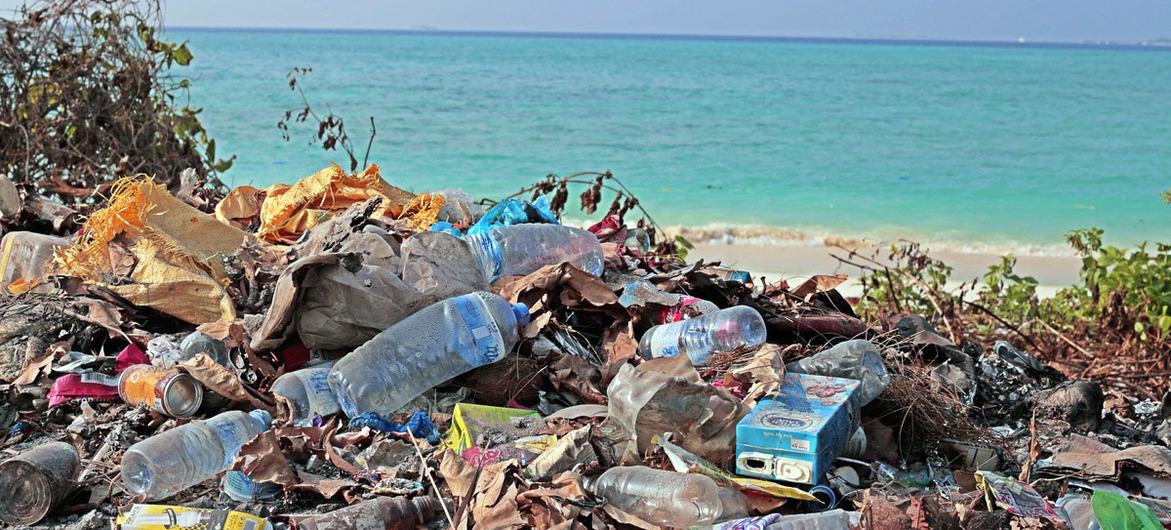
    Plastic waste washes ashore in the Maldives archipelago.
    © UNDP
     
    Plastic waste washes ashore in the Maldives archipelago.


    15 August 2025

     Climate and Environment

    The international push for consensus on a legally binding deal to end plastic pollution proved beyond the grasp of weary UN Member States meeting in Geneva on Friday, as they agreed to resume discussions at a future date.

    “This has been a hard-fought 10 days against the backdrop of geopolitical complexities, economic challenges and multilateral strains,” said Inger Andersen, Executive Director of the UN Environment Programme (UNEP). “However, one thing remains clear: despite these complexities, all countries clearly want to remain at the table.”   

    ‘Deep regret’: Guterres

    Responding to news of the failure to reach agreement, UN Secretary-General António Guterres said: “I deeply regret that, despite earnest efforts, negotiations to reach an international legally binding instrument on plastic pollution, including in the marine environment, concluded without achieving a consensus.

    I welcome the determination of Member States in continuing to work to beat plastic pollution and keep engaged in the process, united in purpose, to deliver the treaty the world needs to tackle this monumental challenge to people and the environment.”

    Search for consensus continues

    Speaking to media at the end of Intergovernmental Negotiating Committee (INC) talks at the UN in the Swiss city, Ms. Andersen emphasized how Member States had expressed a clear wish to continue engaging in the process, recognising their significant differences regarding plastic pollution.

    “While we did not land the treaty text we hoped for, we at UNEP will continue the work against plastic pollution – pollution that is in our groundwater, in our soil, in our rivers, in our oceans and yes, in our bodies,” she said.

    World view

    “People are demanding a treaty,” the UN agency head continued, before underscoring the hard work that lies ahead to maintain the momentum needed to ink a binding international accord.

    Delegates from 183 nations attested to the convening power and importance of the proposed agreement, with some Pacific island representatives - complete with dazzling fresh blooms in their hair - rubbing shoulders with other participants, drained by the final all-night negotiating session.

    The resumed fifth session of talks – referred to as INC-5.2, after previous talks in Busan known as INC-5.1 – gathered more than 2,600 participants at the UN Palais des Nations. In addition to the approximately 1,400 country delegates, there were close to 1,000 observers representing at least 400 organizations.

    Tweet URL

    NGO voices heard

    The session also involved the active participation of civil society – including Indigenous Peoples, waste pickers, artists, young people and scientists. They raised their voices through protests, art installations, press briefings and events in and around the Palace of Nations.

    The goal of the negotiations was to agree on a text for the legally binding instrument to end plastic pollution “and highlight unresolved issues requiring further preparatory work ahead of a diplomatic conference”, UNEP said.

    In addition to meetings together in UN Geneva’s vast assembly hall, four contact groups were created to tackle key issues including plastic design, chemicals of concern, production caps, finance and compliance instruments.

    Despite “intensive engagement”, Members of the Intergovernmental Negotiating Committee was unable to reach consensus on the proposed texts, UNEP explained.

    Chair's action call

    “Failing to reach the goal we set for ourselves may bring sadness, even frustration. Yet it should not lead to discouragement. On the contrary, it should spur us to regain our energy, renew our commitments, and unite our aspirations,” said INC Chair, Luis Vayas Valdivieso.

    “It has not happened yet in Geneva, but I have no doubt that the day will come when the international community will unite its will and join hands to protect our environment and safeguard the health of our people.” 

    The INC process began in March 2022 when the UN Environment Assembly passed resolution 5.2 to develop an international legally binding instrument on plastic pollution, including in the marine environment.   

    “As this session concludes, we leave with an understanding of the challenges ahead and a renewed and shared commitment to address them,” said Jyoti Mathur-Filipp, Executive Secretary of the INC Secretariat. “Progress must now be our obligation.”  

    https://news.un.org/en/story/2025/08/1165658


    https://creativecommons.org/licenses/by/4.0/legalcode

    вторник, 22 июля 2025 г.

    Deadly floods show need for faster, wider warnings, UN agency says


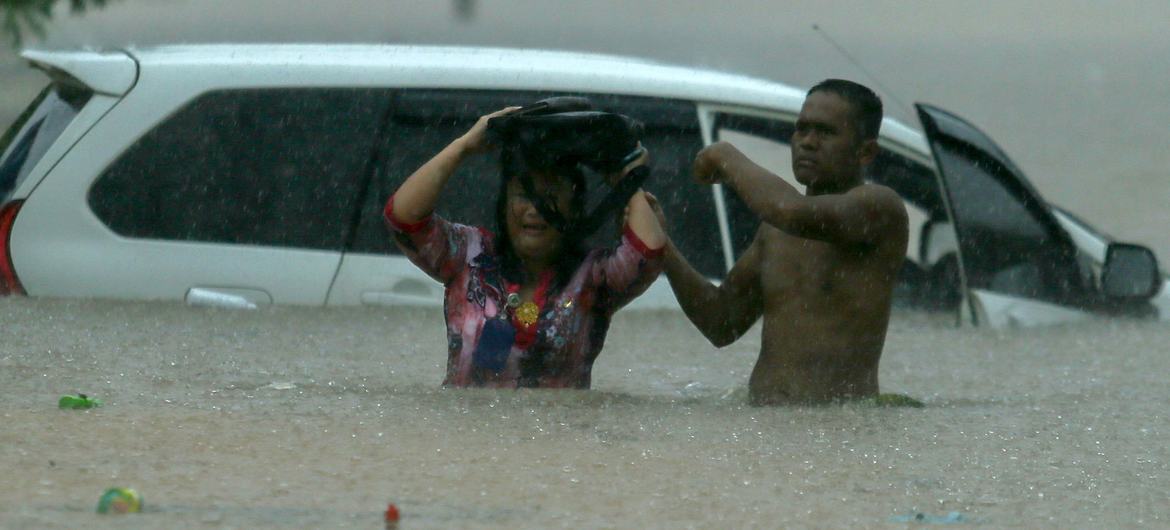
    A man helps a woman after her car is stranded in waist-deep water. Globally rains are being more extreme due to impacts of climate change.
    © WMO/Teguh Prihatna
     
    A man helps a woman after her car is stranded in waist-deep water. Globally rains are being more extreme due to impacts of climate change.


    By Vibhu Mishra
    21 July 2025 
    Climate and Environment

    From the Himalayas to rural Texas, deadly floods this month have killed hundreds and exposed dangerous gaps in early warning systems, the UN’s weather agency warned, linking the devastation to rapid urbanization, land-use change and a warming climate that traps more moisture in the atmosphere.

    The UN World Meteorological Organization (WMO) said on Monday that more intense downpours and glacier outburst floods are becoming increasingly frequent, with deadly consequences for communities caught off guard.

    Flash floods are not new, but their frequency and intensity are increasing in many regions due to rapid urbanization, land-use change and a changing climate,” said Stefan Uhlenbrook, WMO Director of Hydrology, Water and Cryosphere.

    Each additional degree Celsius of warming enables the air to hold about 7 per cent more water vapour.

    This is increasing the risk of more extreme rainfall events. At the same time, glacier-related flood hazards are increasing due to enhanced ice melting in a warmer climate,” he added.

    Thousands of lives lost every year

    Floods and flash floods claim thousands of lives each year and cause billions of dollars in damage. In 2020, severe flooding across South Asia killed more than 6,500 people and caused $105 billion in economic losses.

    Two years later, catastrophic floods in Pakistan left over 1,700 people dead, 33 million affected and losses exceeding $40 billion, reversing years of development gains.

    This year, the onslaught has continued. In July alone, South Asia, East Asia and the United States have seen a string of deadly events, from monsoon rains to glacial lake bursts and sudden flash floods.

    Each year, extreme weather and climate events take a massive toll on lives and economies worldwide.
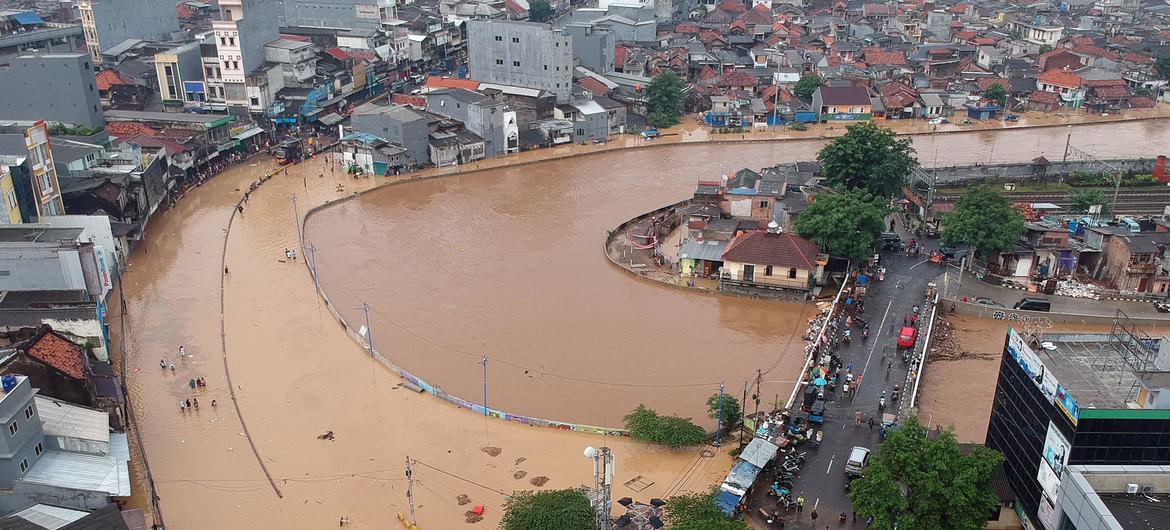
    © WMO/Arya Manggala
     
    Each year, extreme weather and climate events take a massive toll on lives and economies worldwide.

    Asia reels from monsoon onslaught

    In India and Pakistan, heavy monsoon rains have severed transport links, washed away homes and triggered landslides. Pakistan declared a state of emergency in its worst-hit areas, deploying military helicopters for rescue missions after forecasters warned of exceptional flood risk along the upper Jhelum River.

    The Republic of Korea suffered record-breaking downpours between 16-20 July, with rainfall exceeding 115 mm per hour in some locations. At least 18 people were killed and more than 13,000 were evacuated.

    In southern China, authorities issued flash flood and landslide alerts on 21 July, just a day after Typhoon Wipha battered Hong Kong, underscoring the compound risks of sequential storms.

    Texas flash flood strikes overnight

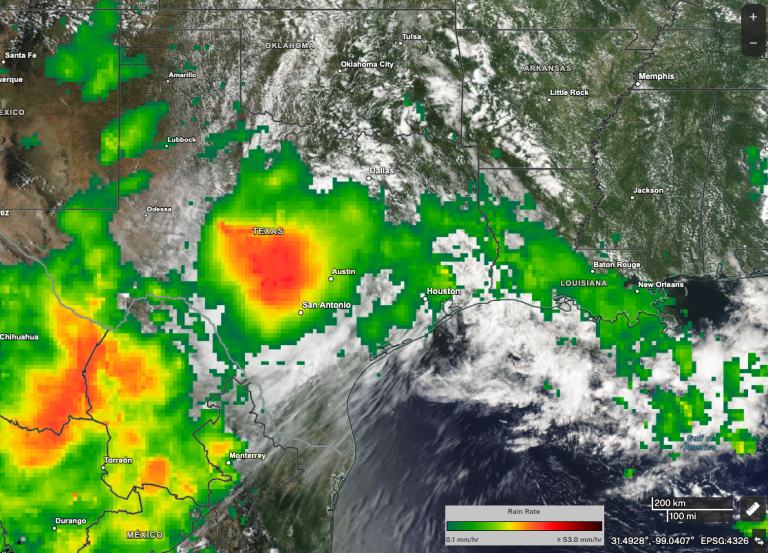
    Overnight 3 into 4 July, a sudden deluge turned Texas Hill Country into a disaster zone, killing more than 100 people and leaving dozens missing. In a few hours, 10-18 inches (25–46 cm) of rain swamped the Guadalupe River basin, sending the river surging 26 feet (8 metres) in just 45 minutes.

    1-day precipitation totals from NASA’s IMERG multi-satellite precipitation product show heavy rainfall over central Texas on July 4, 2025.
    © NASA
     
    1-day precipitation totals from NASA’s IMERG multi-satellite precipitation product show heavy rainfall over central Texas on July 4, 2025.

    Many of the victims were young girls at a summer camp, caught unaware as floodwaters tore through sleeping quarters around 4 AM. Although the US National Weather Service issued warnings ahead of time, local sirens were lacking and the final alerts came when most were asleep.

    Glacier outburst floods surge

    Not all floods this month were caused by rain.

    In Nepal’s Rasuwa district, a sudden outburst from a supraglacial lake – formed on a glacier’s surface – swept away hydropower plants, a major bridge and trade routes on 7 July. At least 11 people were killed and more than a dozen are reported missing.

    Scientists at the International Centre for Integrated Mountain Development (ICIMOD), a WMO partner, say glacial-origin floods in the Hindu Kush-Himalaya region are occurring far more often than two decades ago, when one might strike every five to 10 years.

    In May and June 2025 alone, three glacial outburst floods hit Nepal, Afghanistan and Pakistan, with two more in Nepal on 7 July. If warming continues, the risk of such floods could triple by the century’s end.

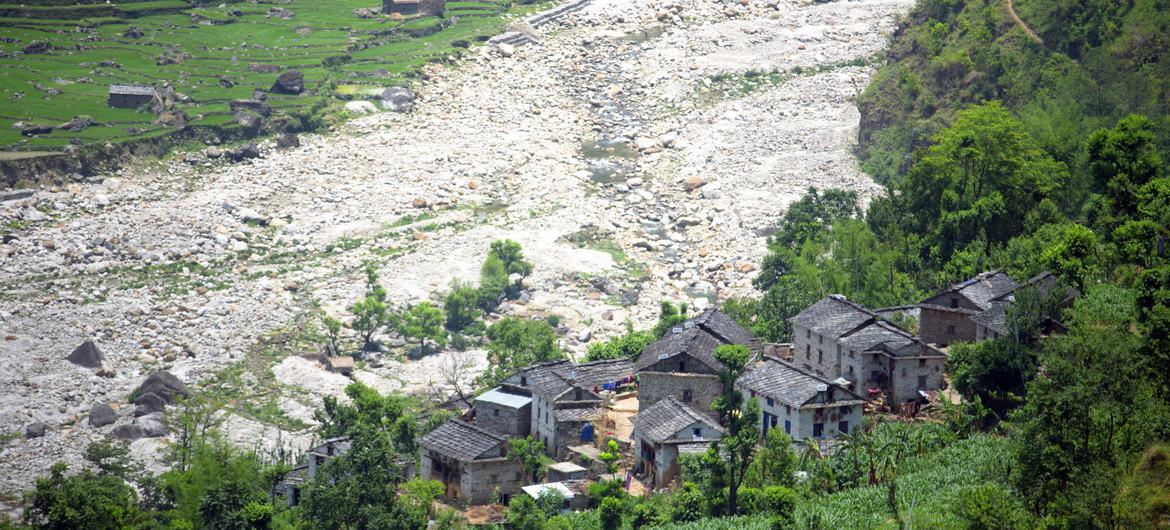
    Aftermath of a flood that swept through a high-altitude village in Nepal.
    © UNICEF
     
    Aftermath of a flood that swept through a high-altitude village in Nepal.

    Closing the warning gap

    The WMO is stepping up efforts to improve flood forecasting through its global initiative and real-time guidance platform, now used in over 70 countries.

    The system integrates satellite data, radar and high-resolution weather models to flag threats hours in advance and is being expanded into a country-led, globally interoperable framework.

    A 2022 World Bank study estimated that 1.81 billion people – nearly a quarter of the world’s population – are directly exposed to 1-in-100-year flood events, with 89 per cent living in low- and middle-income countries.

    The UN’s Early Warnings for All initiative aims to ensure that everyone, everywhere, is protected by early warning systems by 2027.


    https://news.un.org/en/story/2025/07/1165455


    https://creativecommons.org/licenses/by/4.0/legalcode

    пятница, 11 июля 2025 г.

    Overlooked and underestimated: Sand and dust storms wreak havoc across borders


    Children run from an approaching sand storm in Gao, Mali.
    UN Photo/Marco Dormino
     
    Children run from an approaching sand storm in Gao, Mali.


    10 July 2025 
    Climate and Environment

    There are three Great Pyramids at Giza in Egypt - but imagine if there were 307 of the mighty edifices. And then imagine that they had dissolved into over two billion tons of sand and dust particles. 

    That’s how much sand and dust enters the atmosphere on an annual basis according to the World Meteorological Organization (WMO)’s annual report on the storms which scatter such particles across borders worldwide.

    The UN weather agency’s reports warns that while the amount of dust decreased marginally in 2024, the impact on humans and economies is increasing.

    WMO estimates that over 330 million people across 150 countries are affected by sand and dust storms, leading to premature deaths and other health consequences in addition to steep economic costs.

    More than just a dark sky 

    Sand and dust storms do not just mean dirty windows and hazy skies. They harm the health and quality of life of millions of people and cost many millions of dollars,” said Celeste Saulo, the Secretary-General of WMO.

    While the movement of sand and dust is a natural weather process, increased land degradation and water mismanagement have, in the past few decades, exacerbated the prevalence and geographic spread.

    Dust and sand particles – 80 per cent of which come from North Africa and the Middle East – can be transported thousands of kilometres across borders and oceans.

    Tweet URL

    “What begins in a storm in the Sahara, can darken skies in Europe. What is lifted in Central Asia, can alter air quality in China. The atmosphere does not recognize borders,” said Sara Basart, WMO Scientific Officer, at a briefing in Geneva.

    And this is precisely what happened in 2024. Dust and sand from the Western Sahara travelled all the way to Spain’s Canary Islands. And fierce winds and drought in Mongolia brought dust to Beijing and northern China.

    Fast-growing challenge

    “These extreme weather events are not local anomalies. Sand and dust storms are fast becoming one of the most overlooked yet far-reaching global challenges of our time,” said a senior official on Thursday morning speaking on behalf of Philémon Yang, President of the General Assembly.

    The storms can obscure sunlight, altering ecosystems on land and in the ocean. In addition to environmental impacts, these weather occurrences have profound impacts on humans and their economies.

    “Once considered seasonal or localised, sand and dust storms have escalated into a persistent and intensifying global hazard,” said Rola Dashti, the co-chair of the UN Coalition on Combating Sand and Dust Storms.

    Between 2018-2022, over 3.8 billion people were exposed to dust particles, with the worst-affected regions experiencing dust exposure 87 per cent of the time during that same period.

    These particles exacerbate cardiovascular diseases and have other adverse health effects, leading to 7 million premature deaths each year especially among already vulnerable populations.

    Mr. Yang referred to this as the “staggering human toll”: from an economic perspective, storms can lead to a 20 per cent reduction in crop production among rural communities, pushing them towards hunger and poverty.

    In the Middle East and North Africa alone, economic losses in 2024 as a result of sand and dust storms accounted for 2.5 per cent of the regional GDP.

    Can’t go it alone

    WMO is calling on the international community to invest more in early warning systems and data tracking.

    No country, no matter how prepared, can face this challenge alone. Sand and dust storms are a trans-boundary threat that demands coordinated, multisectoral and multilateral action,” said Ms. Dashti.

    With 2025-2034 declared the Decade on Combating Sand and Dust Storms, Mr. Yang said this should prove a turning point. He urged Member States to move from awareness to action – and fragmentation to coordination.


    https://news.un.org/en/story/2025/07/1165363


    https://creativecommons.org/licenses/by/4.0/legalcode