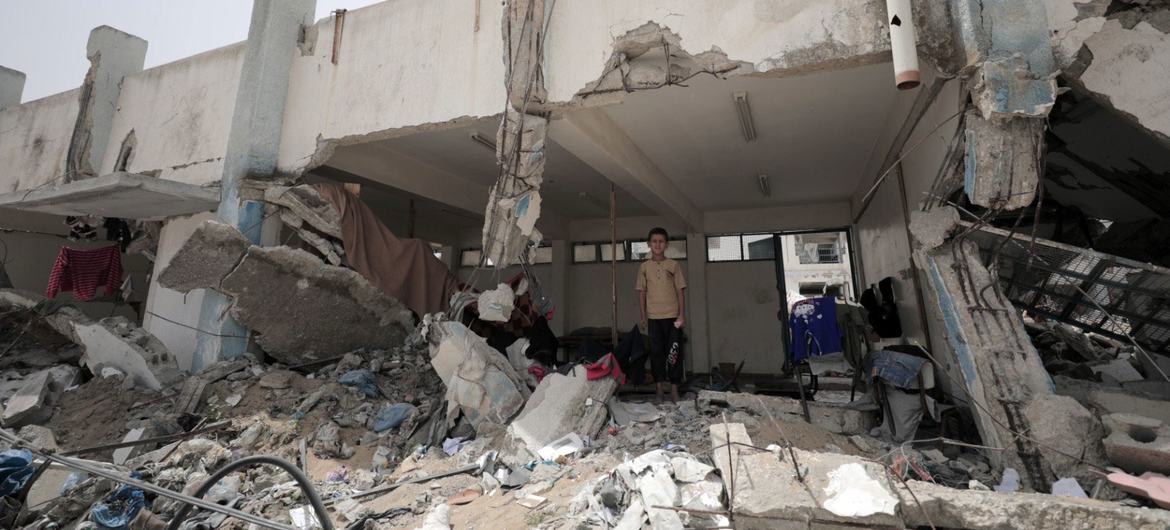
Amid reports of intensified heavy shelling in north, central and southern Gaza, the head of the UN agency for Palestine refugees, UNRWA, confirmed on Wednesday that schools-turned-shelters have been “bombed-out” as a result of the latest escalation.
“Four schools hit in the last four days. Since the war began, two thirds of UNRWA schools in Gaza have been hit, some were bombed out, many severely damaged,” said Philippe Lazzarini, in a post on X.
In a statement posted on Tuesday, the Israeli military said it had been targeting “terrorist infrastructure and terrorist operatives” in Gaza City.
Under fire
On Tuesday, at least 25 people were killed after an Israeli strike near a school building sheltering displaced Gazans in eastern Khan Younis, southern Gaza, according to the enclave’s health authorities.
On Saturday, another strike left at least 16 dead at an UNRWA school in Nuseirat, central Gaza, followed a day later by a hit on a school in Gaza City that was reportedly sheltering hundreds of people.
Further Israeli strikes on Monday were reported on or near an UNRWA school in Nuseirat, UNRWA Director of Communications Juliette Touma told UN News.
No safe place
“This is becoming commonplace; only in the past four days we've seen four schools come under attack,” she said. Every time a school is hit “dozens of people pay the price.”
The UN agency – the largest humanitarian operator in Gaza - closed all of its schools when war erupted on 7 October in response to Hamas-led attacks on multiple targets in southern Israel that left some 1,250 dead and more than 250 taken hostage.
“We've turned the vast majority of them into shelters and at some point we had one million people staying in our schools,” Ms. Touma explained, adding that of the casualties from the latest school strikes, “many” were women and children.
Since the war began, more than half of UNRWA’s facilities - the vast majority of them schools - have been hit.
“Some were completely bombed out and are out of commission”, Ms. Touma continued, adding that since the war began, at least 600,000 children have seen their schools close.
Lost generation
“In the case of UNRWA most of them were used as shelters, but what this means is that if this war continues, we are on the verge of losing a whole generation of children,” she continued.
“The longer children stay out of school, the more difficult it is for them to catch up on education losses; the higher the risk that they fall prey to exploitation, including child labour, child marriage, but also recruitment into armed groups, and recruitment into the fighting. So it is for the sake of those children that we must have a ceasefire”.
In response to allegations that the schools were being used by Hamas fighters or affiliates, the UNRWA official insisted that no UN facility should be used for military purposes, before reiterating repeated calls by the Commissioner-General for “independent inquiries and investigations into all these very serious claims”.
“Civilian infrastructure, including schools, including shelters, including other facilities like health, clinics, or hospitals, must be protected at all times, including in times of conflict,” Ms. Touma insisted.
Rising toll
In a related development, the UN sexual reproduction agency, UNFPA, warned that the humanitarian situation in Gaza continues to worsen, with “severe suffering” now the norm.
Citing Gazan health authorities, UNFPA said that nearly 38,000 Palestinians have now been killed and more than 87,000 injured, with food, shelter, health and livelihood resources all “critically low”.
Across the enclave some 1.9 million people remain forcibly uprooted by the conflict – often repeatedly - and evacuation orders issued by the Israeli military.
Gazans live in “tents, overcrowded shelters, or on the streets without basic necessities”, the UN agency said, pointing to widespread feelings of hopelessness by people “with little prospect of returning home or ending the conflict”.
Lifesaving supplies blocked
“Severe obstacles” in ensuring that humanitarian aid can reach those who need it continue to hamper the relief operation, the UNFPA situation update noted, listing “crossing point closures and bureaucratic hurdles impeding life-saving assistance”.
Problems associated with the breakdown in law and order in Gaza has also increased theft and violence, endangering humanitarian workers and their operations, according to the UN agency.
In addition, doctors continue to report rising numbers of preterm and low-birth-weight babies, “indicators of severe malnutrition exacerbated by stress and fear among pregnant women” UNFPA said, while also highlighting the high risk of gender-based violence (GBV) faced by women and adolescent girls, “particularly those displaced, widowed, or unaccompanied”.
Aid successes
Despite the challenges, UNFPA has distributed essential sexual reproductive health and GBV services in Gaza and the West Bank.
The UN agency and partners have also established two maternal health units for emergency births, provided menstrual hygiene products to thousands of women and girls and supported mobile medical points and deployed sexual and reproductive health teams to shelters.
https://news.un.org/en/story/2024/07/1151921