Избранное сообщение

Показаны сообщения с ярлыком Education. Показать все сообщения

четверг, 11 апреля 2024 г.

Make 2024 a ‘turning point’ for education, UN deputy chief urges


Addressing a high-level education on education convened by the European Union (EU) in Brussels, Amina Mohammed paid tribute in particular to the children of Gaza.


11 April 2024
Culture and Education

The UN Deputy Secretary-General on Thursday called for a transformation in learning, stressing that receiving a good education represents hope for all future generations.

Addressing a high-level education on education convened by the European Union (EU) in Brussels, Amina Mohammed paid tribute in particular to the children of Gaza, who have had no education for over six months, and where there have been direct hits on 212 schools.

“Today, the light for Gaza and the children of Gaza, is out. We need a commitment to try to light that candle again for the children and the people of Gaza. Education is hope. Education is the future,” she said.

Building momentum

This year will see a series of meetings that will build on the Transforming Education Summit convened by the UN in September 2022 in response to a global crisis in education, after more than 90 per cent of the world’s children lost access to the classroom during the COVID-19 pandemic.

In September this year, world leaders will gather to forge a new international consensus as part of the Summit of the Future. 

 Ms. Mohammed called for two specific outcomes on education at the Summit. 

“First, we need a clear recognition from world leaders of the urgent need to transform and invest in education as a global imperative,” she said.

“Second, we need major breakthroughs on issues that are critical for education, including reform of the international financial architecture, strengthened digital cooperation and a new agenda for peace.”

Education a human right

Without additional measures, an estimated 84 million children and young people will still be denied access to the classroom by 2030, and approximately 300 million students will lack the basic – and vital – numeracy and literacy skills.

“Education is a fundamental human right. Investing in education is the greatest investment we can make in our common future, in peace, and sustainable development, and particularly in gender equality,” Ms. Mohammed stressed.

Contemporary education systems across the world are beset by challenges, including access, equity, relevance and digital inequality – which could leave billions of people behind, she added.

“I know that we can make 2024 a turning point for education. Let’s get to it.”

Spotlight on violence against women

During her visit to Brussels, the Deputy Secretary-General also chaired the Governing Body meeting of the Spotlight Initiative, the world’s largest targeted effort to eliminate violence against women and girls.  

The UN initiative is in partnership with the (EU) and other stakeholders and responds to all forms of violence against women and girls. 

Its programmes across 30 countries and regions, focus on domestic and family violence, sexual and gender-based violence and rising rates of femicide, together with human trafficking. 

Since 2019, the initiative has resulted in more than 2.5 million women and girls accessing gender-based violence services, and two million men and boys have been educated on positive masculinity.

https://news.un.org/en/story/2024/04/1148421

https://creativecommons.org/licenses/by/3.0/legalcode

понедельник, 18 сентября 2023 г.

Taliban urged to uphold Afghan girls’ right to education

Taliban urged to uphold Afghan girls’ right to education
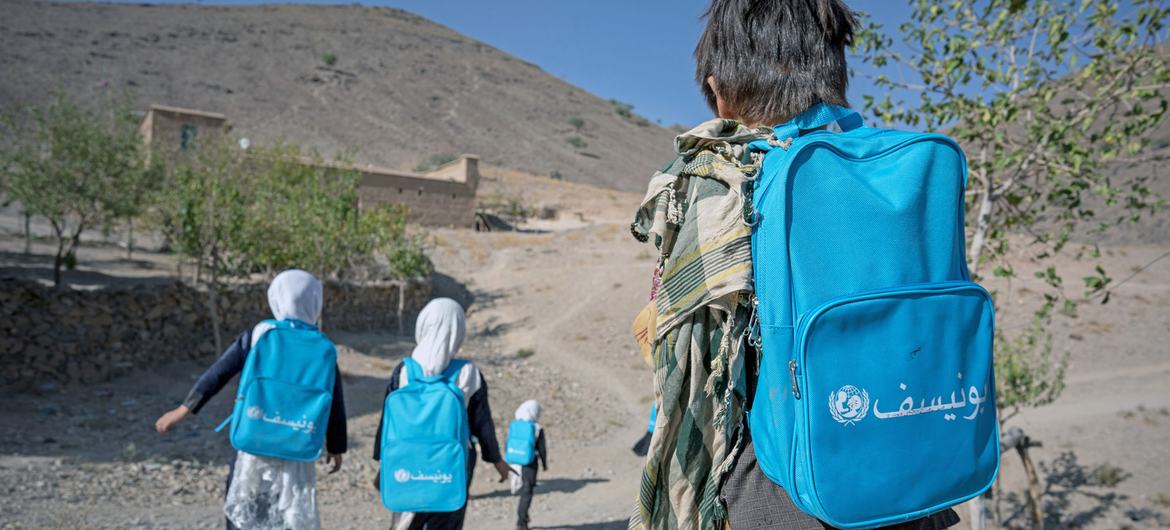
Primary school girls and boys walk to a UNICEF-supported community centre in Shahristan District in central Afghanistan.
© UNICEF/Mark Naftalin
 
Primary school girls and boys walk to a UNICEF-supported community centre in Shahristan District in central Afghanistan.
Culture and Education

The international community must ensure that every girl in Afghanistan has an opportunity to learn, the head of the UN fund for education in emergencies said on Monday – the second anniversary of the Taliban’s edict banning secondary education for girls. 

“Denying education to girls is a violation of universal human rights,” said Yasmine Sherif, Executive Director of Education Cannot Wait (ECW).

“The de facto authorities can do the right thing for the long-suffering people of Afghanistan by ensuring that every girl in Afghanistan can access quality education and contribute to rebuilding their war-torn country,” she added.

2.5 million girls affected

Ms. Sherif reported that 80 per cent of school-age Afghan girls are currently not in the classroom. 

"That’s 2.5 million girls denied their right to the safety, protection, opportunity of education – their inherent human right,” she said.

Uplifting #AfghanGirlsVoices 

Education Cannot Wait (ECW) has expressed solidarity with all girls in Afghanistan who are courageously speaking up for the right to education.

The fund recently launched a campaign, #AfghanGirlsVoices which will highlight the issue throughout the year.

“Together, we must ensure that, through education, every girl in Afghanistan can emerge from the shadows so they can contribute to a brighter future which every Afghan so deserves,” said Ms. Sherif.

Learning under pressure

ECW runs a multi-year resilience programme in Afghanistan that aims to support more than 250,000 children and young people across some of the most remote and underserved areas of the country.

It has appealed for urgent additional funding to fill a $30 million shortfall to fully implement the programme, and the $670 million required to fully finance a new strategic plan to reach 20 million crisis-affected children worldwide over the next three years. 

https://news.un.org/en/story/2023/09/1140937

https://creativecommons.org/licenses/by/3.0/legalcode

среда, 30 августа 2023 г.

Protection of Schools, Education Must Be Ensured for Millions of Children, Youth in Crises, Armed Conflict, Secretary-General Stresses on International Day

Protection of Schools, Education Must Be Ensured for Millions of Children, Youth in Crises, Armed Conflict, Secretary-General Stresses on International Day

Following is UN Secretary-General António Guterres’ message for the International Day to Protect Education from Attack, observed 9 September:

Education is not only a fundamental human right, but a pathway to a better future for every person, and a more peaceful, understanding world.

On the International Day to Protect Education from Attack, we shine a light on a startling truth:  224 million children and young people are in urgent need of educational support — including 72 million who are out of school altogether — because of crises like armed conflict.

Attacks on students, teachers, educational personnel and schools are becoming all-too-common, cruelly disrupting young learners’ education and inflicting untold psychological and physical damage that can last a lifetime.

I call on all countries to ensure the protection of schools, children and teachers at all times.

I also urge all countries to endorse the Safe Schools Declaration, support the Global Coalition to Protect Education from Attack, and join the Global Initiative: Partnership for Transformative Actions in Crisis Situations that brings together partners to ensure children and young people can keep learning in times of crisis.

Together, we can ensure that schools are havens of safety and learning for every child, no matter where they live.


https://press.un.org/en/2023/sgsm21919.doc.htm
https://creativecommons.org/licenses/by/3.0/legalcode

вторник, 15 августа 2023 г.

Afghan girls' voices for education echo loudly through new global campaign


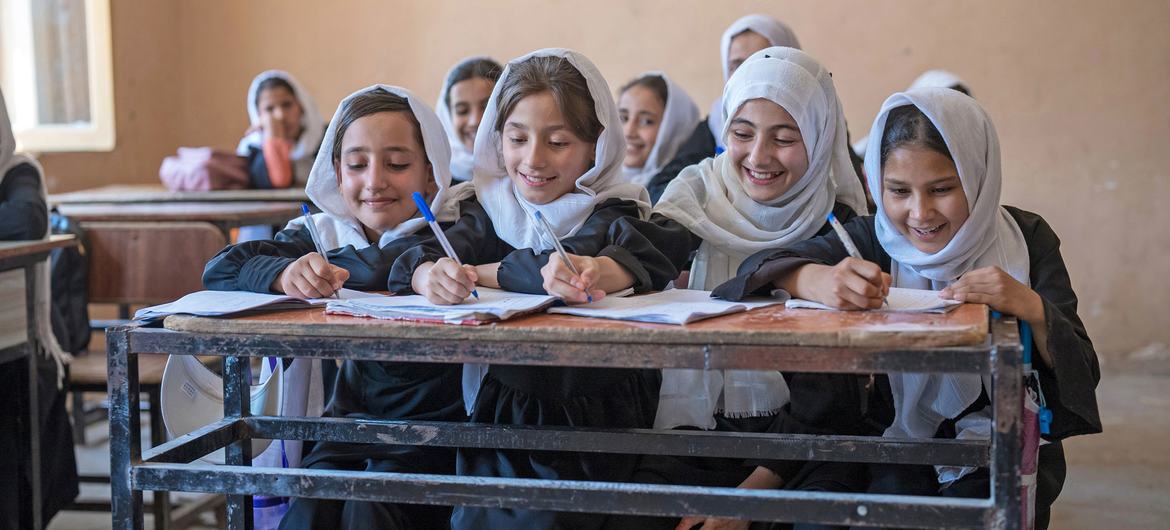
Young girls study at a school in Mazar-i-Sharīf, Balkh Province, Afghanistan.
© UNICEF/Mark Naftalin
 
Young girls study at a school in Mazar-i-Sharīf, Balkh Province, Afghanistan.
15 August 2023
Culture and Education

The UN fund that ensures children can continue learning during emergencies and protracted crises, Education Cannot Wait (ECW), launched a campaign on Tuesday to elevate the voices of young Afghan girls deprived of their basic right to education.  


#AfghanGirlsVoices comes precisely two years after the de facto Taliban authorities seized control in Afghanistan and will continue until September 18, which marks the start of their official ban on school for adolescent girls.

Voices and visuals

The campaign was developed in collaboration with ECW Global Champion Somaya Faruqi, former captain of the Afghan Girls’ Robotic Team, with compelling artwork by a young Afghan female artist.

It features a series of inspiring, heart-wrenching and determined testimonies from Afghan girls whose lives have been abruptly upended by the ban preventing them from pursuing their education and dreams.

Tweet URL

Their powerful words are conveyed together with striking illustrations depicting both the profound despair experienced by these girls along with their incredible resilience and strength in the face of this unjust ban on their education.

“The courage of these girls in Afghanistan gives me the strength to use my own voice as an ECW Global Champion to amplify their voices to the world,” said Ms. Faruqi.

“The situation is taking an immense toll on girl’s mental health and rates of suicide for girls has gone up in the last two years. It’s more urgent than ever to act now, and I hope that next year, we celebrate their freedom rather than mark their oppression,” she added.

Worst situation globally

As per a recent report by UN experts, the condition of women and girls in Afghanistan is the ‘worst globally’. The systematic curtailment of their human rights, coupled with the profound bias they face under the regime of the de facto Taliban authorities, could potentially qualify as "gender apartheid" and "gender persecution," the report said.

“The international community must hear this poignant call from the heart from Afghan girls and young women and mobilise in greater numbers and with renewed strength of purpose to condemn the violation of their rights,” said UN Special Envoy for Global Education and Chair of ECW’s High-Level Steering Group, Gordon Brown.

Call to action

Additionally, the campaign's timing will elevate the voices of Afghan girls onto the global stage, as world leaders gather at the UN General Assembly in New York for the Sustainable Development Goals (SDG) Summit on September 18-19.

“It is hard to think of anyone further left behind than the girls in Afghanistan who are being denied their most basic human rights, including their right to education, based solely on their gender,” said ECW Executive Director Yasmine Sherif.

“We will continue to steadfastly advocate for the full resumption of their right to education in Afghanistan, and to work with our partners to deliver crucial learning opportunities to Afghan children through the community-based education programmes we support,” she added.       


 https://news.un.org/en/story/2023/08/1139737


https://creativecommons.org/licenses/by/3.0/legalcode

суббота, 22 апреля 2023 г.

UNESCO's Global Education Coalition launches the Digital Transformation Collaborative at annual meeting


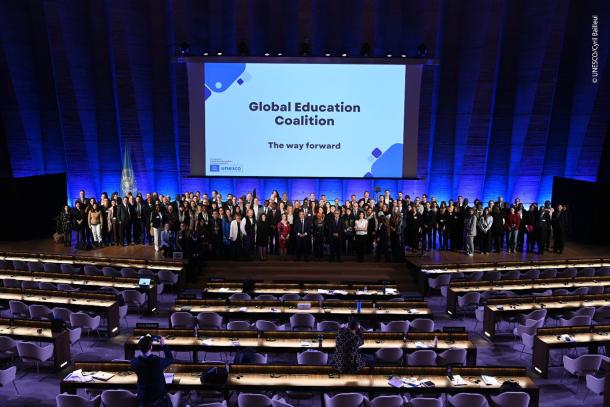
GEC - launch of the Digital Transformation Collaborative

A new collaborative to accelerate digital transformation in education was launched as UNESCO brought together representatives from more than 70 partner organizations and over 40 Member States for the third annual meeting of the Global Education Coalition.

The event, which took place on 28 March at the UNESCO headquarters in Paris, was the first in-person meeting of the Coalition. On the occasion, the Coalition’s annual report - Transforming education together: the Global Education Coalition in action - was launched, highlighting how Members are supporting countries’ efforts to achieve SDG 4 and the commitments made during the Transforming Education Summit.

Opening the meeting, Stefania Giannini, UNESCO Assistant Director-General for Education, thanked the more than 200 Coalition Members for their contributions to transform education while noting the opportunities promised by new technologies and how these can accelerate the group’s efforts.

 “The next five years will be critical to invest in the digital transformation of national education systems … As the Coalition moves forward, steering the digital and green transitions in and through education will increasingly be at the heart of all that it does,” Ms Giannini added. 

The future of the Coalition

Throughout the day, Members discussed important questions on the future of the Coalition, including how the group can respond in crisis while also supporting sustainable pathways to scale, and how it can collectively overcome the challenges to creating successful and sustainable multi-stakeholder partnerships.

Firmin Edouard Matoko, Assistant-Director General, Priority Africa and External Relations at UNESCO, stressed the importance of multi-stakeholder partnerships in meeting global goals for education and in addressing ongoing crises – including environmental and economic – that undermine efforts to achieve universal access to quality education.

“The situation demands that we bond together - that we forge bolder partnerships and that we harness the power of collective action to overcome the barriers to learning, to bridge the gaps that exist, and to transform education in ways that will benefit all learners,” said Mr Matoko.

Jane Lawrie, Global Head of Corporate Affairs at KPMG, suggested that Coalition Members should join forces and focus on a shared outcome by identifying and investing in a handful of programmes that have the greatest impact. “I think everyone in this room has a unique skill set [and] by putting their skills towards one outcome, that's where I think we make the biggest difference to young people,” said Ms Lawrie.

Meanwhile, Benjamin Marteau, CEO of Pix, suggested that increased collaboration with education institutions in every country is needed for initiatives to have long term impact. The Coalition, he said, can facilitate the relationships between private sector players and relevant Ministries to make this happen.

The contribution of the private sector in providing access to education was also discussed. Andreas Schleicher, Director for the Directorate of Education and Skills at the OECD, praised the Coalition for encouraging a “culture of public [working] with private in service of the public good.”

“Most of the technological and also social innovation in education has actually come from private sector engagement in the public education system,” said Mr Schleicher. “The Global Education Coalition has really been able to really mobilize that … the question to me really is how can we move from a moment of managing crisis to actually working together to build a future.” 

The launch of the Digital Transformation Collaborative

The newly formed Digital Transformation Collaborative, which was officially launched at the event last Tuesday, will play an important role in guiding the work of the Coalition in 2023 and beyond.

Having emerged from the private sector and donor conversations during the Transforming Education Summit last year, the DTC is made up of 30 Coalition partners with on-the-ground digital technology resources and expertise.

Borhene Chakroun, Director for the Division for Policies and Lifelong Learning Systems with UNESCO’s Education Sector, said “The Digital Transformation Collaborative can collectively steer digital transformation education towards equity, inclusion, sustainability, in partnership with member states.” It will do this by focusing on “five keys” - coordination and leadership, cost and sustainability, connectivity and infrastructure, capacities and culture, and content and curriculum.

“We have a theory of change - if we come together and coordinate resources in a smart way, we have the potential to move the needle from small scale pockets of good practises to scale … [and build] ecosystem and sustainable policies, plans and programmes for digital transformation education at a system level and national scale,” Mr Chakroun explained.

Google is one of the founding members of the DTC. William Florance, the company’s Government Relations Program Lead for EMEA, encouraged a more holistic approach to transforming education systems - one which involves working with Ministries of finance, economy and human resource development, as well as education.

Florence also suggested that funding for education should come from a variety of sources - not only national budgets - and that countries need support in making smart investments in scalable technology. “Too often we see heavy investments in technology that maybe is more than what's needed to meet the basic needs of the education system,” he said. But the DTC can support Ministries in investing in the appropriate technologies to facilitate education transformation.

Dina Ghobashy, Senior Manager for Digital Transformation Leadership at Microsoft, another member of the Collaborative, suggested that Member States think of Coalition partners as “innovation labs” that can mobilize research and help design solutions to their country-specific challenges.

 “We feel responsible to share what's possible, to amplify the best practises that we're seeing, to help governments leapfrog and even avoid some of the common pitfalls,” said Ms Ghobashy. “It is really important for us to be part of this Collaborative and the Coalition [because] a country's success is our success, and we share the same goals.”


https://www.unesco.org/en/articles/unescos-global-education-coalition-launches-digital-transformation-collaborative-annual-meeting

https://creativecommons.org/licenses/by/3.0/legalcode