Избранное сообщение

Показаны сообщения с ярлыком plastic pollution. Показать все сообщения

вторник, 24 октября 2023 г.

New round of talks on global plastic pollution treaty underway in Nairobi


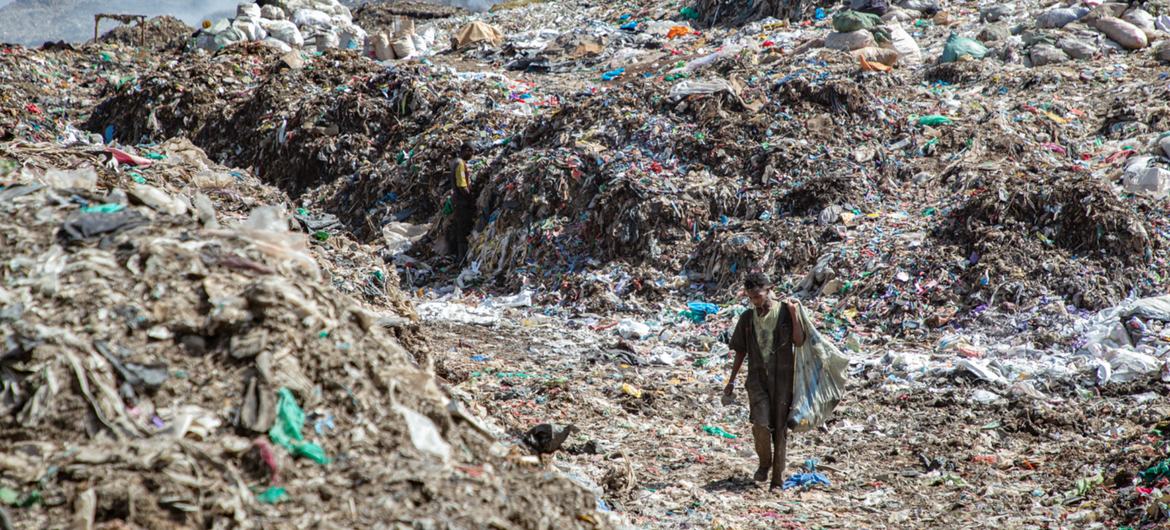
Dandora landfill in Nairobi, Kenya, where much of the waste in the landfill is plastic (file photo).
© UNEP
 
Dandora landfill in Nairobi, Kenya, where much of the waste in the landfill is plastic (file photo).
13 November 2023
Climate and Environment

Negotiators from around the world gathered in Nairobi, Kenya, on Monday for fresh talks over a landmark international treaty to combat plastic pollution. 

The urgency of this effort is underscored by the ongoing global plastic pollution crisis, where approximately 430 million tonnes of plastic are produced annually. 

Around two-thirds of it is just thrown away, harming both the environment and the food chain.

Convening for its third session, the Intergovernmental Negotiating Committee (INC-3) will focus on the so-called zero draft of the international legally binding instrument on plastic pollution, released earlier this year, with the goal of concluding negotiations by the end of 2024. 

No to ‘throwaway economy’

According to the Executive Secretary of the INC Secretariat Jyoti Mathur-Filipp, the devastating impact of plastic pollution on ecosystems, climate, the economy, and human health, costs the planet between $300 and $600 billion per year.

Plastics production is expected to double in the next 20 years if no action is taken. 

Organizers are demanding a transition from the “throwaway economy” to a “reuse economy”.

The INC-3 will feature 12 side events addressing various aspects of plastic pollution, including sustainable production and consumption, the shift to a ‘circular plastic’ approach, and more.

Officials are underscoring the need to reduce  plastic production, eliminate single-use and short-lived plastic products, and switch to non-plastic substitutes.

Soundcloud

Text on the table

At a press-conference ahead of this week’s intensive talks leading to what delegates hope will be a global binding agreement, the INC’s President Gustavo Meza-Cuadra Velasquez said: “We are entering a very important phase of our negotiations…For the first time we are entering a discussion with a text.”

The session will feed into another round of draft discussions scheduled for April 2024 in Canada.

As the international community grapples with the plastic pollution crisis, the outcome of INC-3 could be a significant step forward.

The Zero Draft text of the international legally binding instrument, prepared by the Chair of the INC, with the support of the INC Secretariat, is now available in all six UN official languages.

To learn more about plastic pollution and its harm to the planet CLICK HERE 


https://news.un.org/en/story/2023/11/1143537


https://creativecommons.org/licenses/by/3.0/legalcode

суббота, 3 июня 2023 г.

World must ‘work as one’ to end plastic pollution: Guterres


Marine debris, including plastics, paper, wood, metal and other manufactured material is found on beaches worldwide and at all depths of the ocean.
UN News/Laura Quiñones
 
Marine debris, including plastics, paper, wood, metal and other manufactured material is found on beaches worldwide and at all depths of the ocean.
4 June 2023
Climate and Environment

As international negotiators committed to hammering out a draft treaty by November on ending plastic pollution, the UN chief stressed in his message for World Environment Day on Monday, the importance of curbing the “catastrophic” consequences of waste plastics.

“Every year, over 400 million tons of plastic is produced worldwide – one third of which is used just once”, said Secretary-General Antonio Guterres.

Tweet URL

2,000 truckloads a day

“Every day, the equivalent of over 2,000 garbage trucks full of plastic is dumped into our oceans, rivers, and lakes.”

He noted that microplastics are finding their way into the food we eat, the water we drink, and even the air we breathe.

“Plastic is made from fossil fuels – the more plastic we produce, the more fossil fuel we burn, and the worse we make the climate crisis”, the UN chief said.

We have the solutions

But solutions are at hand: including the legally binding agreement that remains on course, following five days of negotiations involving more than 130 nations last week.

“This is a promising first step, but we need all hands-on deck”, he said, stressing that a new report from the UN Environment Programme (UNEP) shows that plastic pollution can be reduced by a staggering 80 per cent by 2040 – if humankind acts now to reuse, recycle, and pivot away from plastics.

“We must work as one – governments, companies, and consumers alike – to break our addiction to plastics, champion zero waste, and build a truly circular economy. 

“Together, let us shape a cleaner, healthier, and more sustainable future for all.”

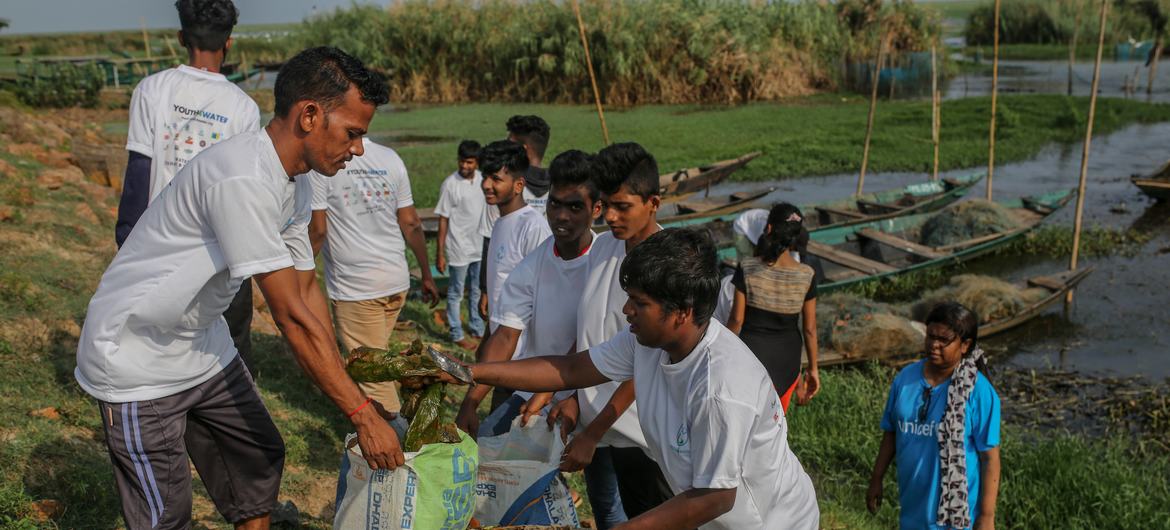
Young people collecting plastic bottles, cans and solid waste from Chilika wetland, eastern India..
© UNICEF/Dhiraj Singh
 
Young people collecting plastic bottles, cans and solid waste from Chilika wetland, eastern India..

Unsavoury facts

The statistics for the damage caused by plastics are daunting: more than 400 million tonnes of plastic is produced every year worldwide, half of which is designed to be used only once. Of that, less than 10 per cent is recycled, according to UN figures.  

An estimated 19-23 million tonnes end up in lakes, rivers and seas annually - approximately the weight of 2,200 Eiffel Towers.

Soundcloud

Plastic on the menu

Microplastics – defined as plastic particles up to 5mm in diameter – find their way into everything we consume and breathe. It is estimated that each person on the planet consumes more than 50,000 plastic particles per year –and many more if inhalation is considered. 

Discarded or burnt single-use plastic harms human health and biodiversity and pollutes every ecosystem from mountain tops to the ocean floor. 

With available science and solutions to tackle the problem, governments, companies and other stakeholders must scale up and speed actions to solve this crisis, said the UN, underscoring the importance of  World Environment Day ”in mobilizing transformative action from every corner of the world.”


 https://news.un.org/en/story/2023/06/1137322


https://creativecommons.org/licenses/by/3.0/legalcode

четверг, 1 июня 2023 г.

‘Toxic tidal wave’ of plastic pollution putting human rights at risk

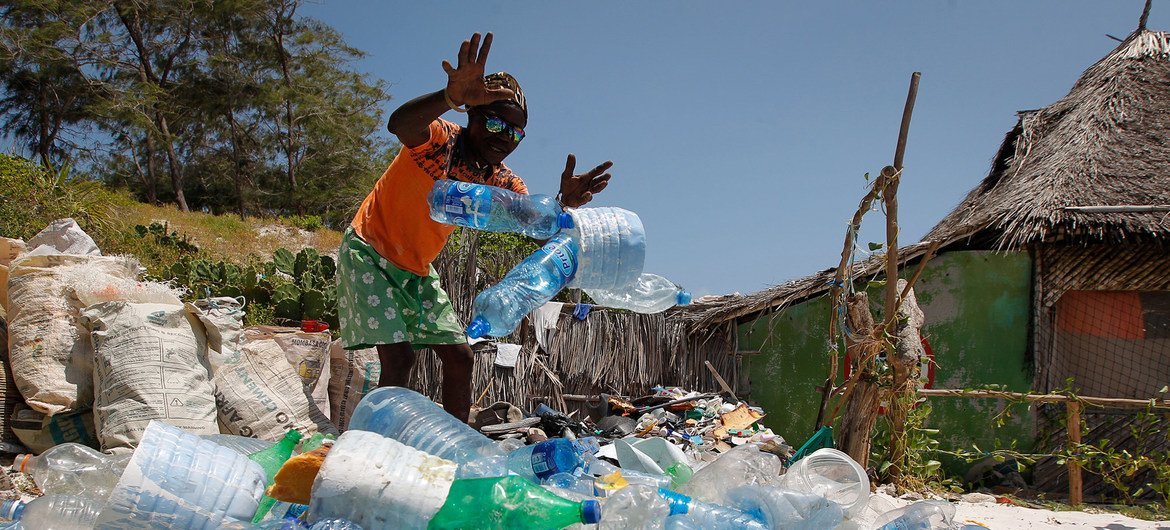
Local people from Watamu, Kenya, work with Local Ocean Conservation to pick up plastic on the beach each Friday.
UNEP/Cyril Villemain
 
Local people from Watamu, Kenya, work with Local Ocean Conservation to pick up plastic on the beach each Friday.
1 June 2023
Climate and Environment

The world must combat the “toxic tidal wave” of plastic pollution that threatens human rights, two UN independent experts said on Thursday.

The appeal comes as countries continue negotiations towards an international treaty on plastic pollution, and ahead of World Environment Day on 5 June.

“Plastic production has increased exponentially over recent decades and today the world is generating 400 million tonnes of plastic waste yearly,” said David R. Boyd, UN Special Rapporteur on human rights and the environment, and Marcos Orellana, Special Rapporteur on toxics and human rights.

Tweet URL

“We are in the middle of an overwhelming toxic tidal wave as plastic pollutes our environment and negatively impacts human rights in a myriad of ways over its life cycle.”

A dangerous ‘cycle’

The experts outlined how all stages of the “plastics cycle” are harmful to people’s rights to a healthy environment, life, health, food, water and an adequate standard of living.

Plastic production releases hazardous substances and almost exclusively relies on fossil fuels, and plastic itself contains toxic chemicals which put humans and nature at risk.  Furthermore, 85 per cent of single use plastics end up in landfills or dumped in the environment.

Meanwhile, incineration, recycling and other “false and misleading solutions” only aggravate the threat, they added, noting that “plastic, microplastic and the hazardous substances they contain can be found in the food we eat, the water we drink and the air we breathe.”

Suffering in ‘sacrifice zones’

The statement also addressed how marginalized communities are most affected by exposure to plastic-related pollution and waste.

“We are particularly concerned about groups suffering from environmental injustices due to heightened exposure to plastic pollution, many of them living in 'sacrifice zones'”, they said, referring to locations near facilities such as open-pit mines, petroleum refineries, steel plants and coal-fired power stations.

Plastic pollution has also made an “alarming” contribution to climate change, which is often overlooked, according to the experts.  “For instance, plastic particles found in oceans limit the ability of marine ecosystems to remove greenhouse gases from the atmosphere,” they said.

As Special Rapporteurs, Mr. Boyd and Mr. Orellana receive their mandates from the UN Human Rights Council.  They are not UN staff and are not paid for their work.

They noted that over the past two years, the Council and the UN General Assembly have adopted landmark resolutions recognising the human right to a clean, healthy and sustainable environment, which should prompt and guide initiatives to address plastic pollution.

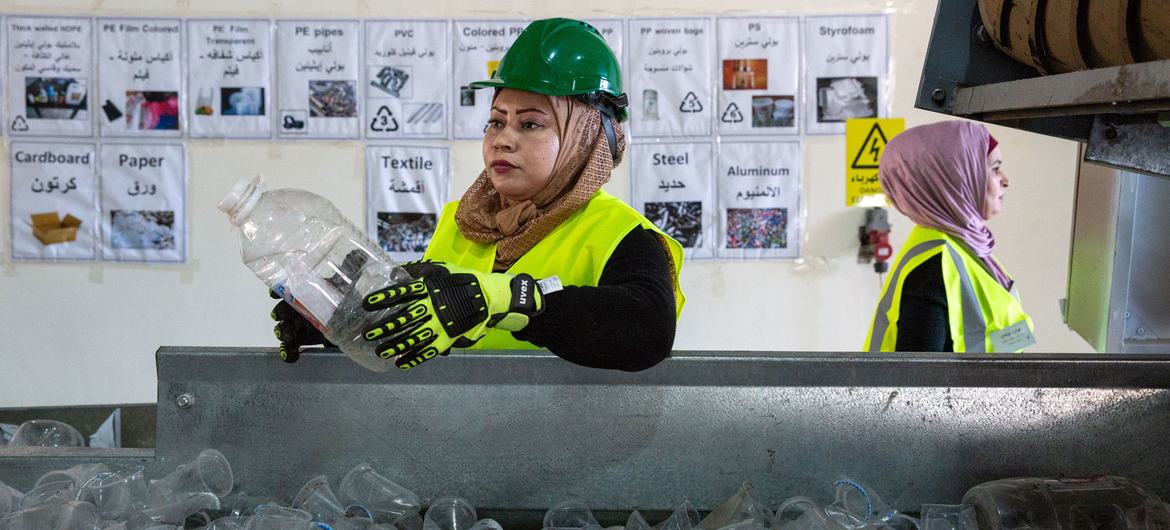
A woman sorts plastic at a recycling plant in Jordan.
© UNDP/Sumaya Agha
 
A woman sorts plastic at a recycling plant in Jordan.

Treaty negotiations underway

They also welcomed progress towards an internationally binding treaty to turn the tide on plastic pollution, including in the marine environment.  The UN Environment Programme (UNEP) projects that the amount of plastic waste entering aquatic ecosystems could reach some 23 to 37 million tonnes per year by 2040.

Negotiations continued this week in Paris, following on from an initial session held last year in Uruguay.

Speaking during the opening on Monday, UNEP chief Inger Andersen bluntly stated that “we cannot recycle our way out of this mess”, adding that “only elimination, reduction, a full life-cycle approach, transparency and a just transition can bring success.”

The second meeting of the Intergovernmental Negotiating Committee on Plastic Pollution (INC-2) will conclude on Friday, and delegates have a deadline to agree a treaty by 2024.


 https://news.un.org/en/story/2023/06/1137267

https://creativecommons.org/licenses/by/3.0/legalcode