Избранное сообщение

Показаны сообщения с ярлыком UN weather agency. Показать все сообщения

четверг, 19 сентября 2024 г.

Climate crisis: Satellites and AI offer hope for global action, says UN weather agency


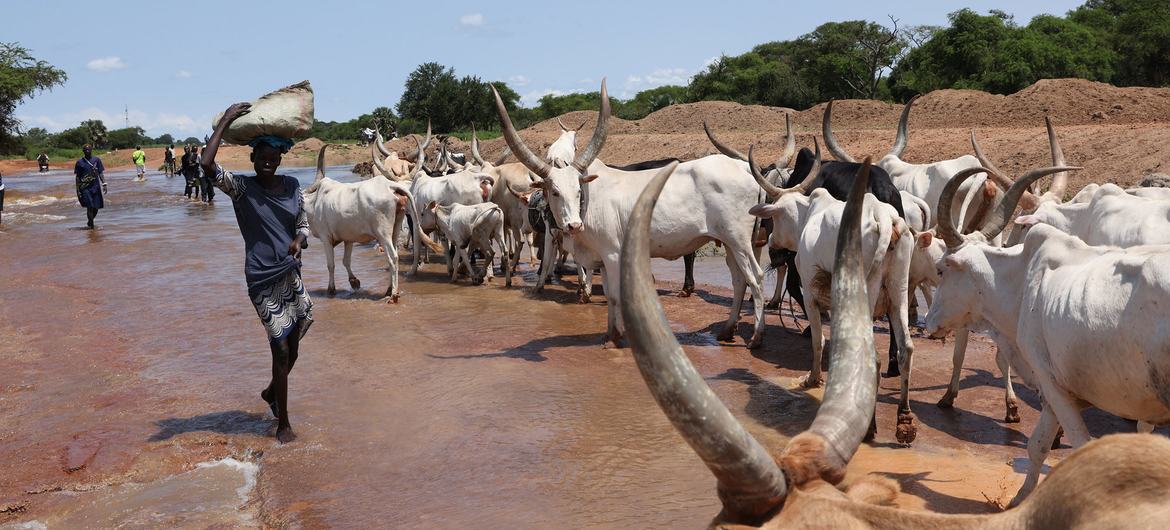
Space-based observations and AI modelling are already transforming the science of forecasting, a potential gamechanger for countries ill-equipped to protect themselves from weather hazards, such as South Sudan.
© UNMISS/Nektarios Markogiannis
 
Space-based observations and AI modelling are already transforming the science of forecasting, a potential gamechanger for countries ill-equipped to protect themselves from weather hazards, such as South Sudan.


18 September 2024 

Climate and Environment

Amid renewed warnings from leading climate scientists that global warming could reach 3C above pre-industrial levels this century, the head of the UN World Meteorological Organization (WMO) insisted on Wednesday that new technology and AI offer the opportunity to implement the drastic action needed to resist the existential crisis. 

“The science is clear: we are far off track from achieving global climate goals. 2023 was the warmest year on record by a huge margin. Leading international data sets say that the first eight months of 2024 are also the warmest on record," said WMO Secretary-General Celeste Saulo.

She appealed for "urgent and ambitious action" in support of sustainable development, climate action and disaster risk reduction as "the decisions we make today could be the difference between a future breakdown or a breakthrough to a better world”. 

Echoing the stark assessment of the latest UN-partnered United in Science report that record concentrations of greenhouse gases will fuel global temperature increase, Ms. Saulo noted that extreme weather “is wreaking havoc with our lives and our economies”.

Her comments came against a backdrop of deadly wildfires across Latin America and Portugal, along with catastrophic flooding in central Europe linked to Storm Boris that has inundated parts of Austria, the Czech Republic, Hungary, Poland, Romania and Slovakia, and floods and landslides triggered by Typhoon Yagi that have ravaged Viet Nam, Myanmar, Laos and Thailand.

Tweet URL

And in a call for global action coinciding with the upcoming Summit of the Future at UN headquarters in New York, the WMO chief underscored the untapped potential of natural and social sciences, new technology and innovation to help countries develop, reduce their vulnerability to disaster and adapt to climate change. 

Digital benefits a reality 

AI and machine learning are already revolutionizing the science of weather forecasting by it “faster, cheaper and more accessible”, she noted, before adding that cutting-edge satellite technologies and virtual reality simulations are now “opening new frontiers” in key sectors already threatened by climate change and hazardous weather, such as land and water management.

Highlighting the value of satellite technology to climate science, Ms. Saulo explained that innovations in space-based Earth observations have helped to improve monitoring of greenhouse gas sources and carbon sinks.

The WMO Secretary-General also noted the potential of new technologies such as “digital twin” – which creates a virtual replica of a physical object, such as Earth - and virtual reality – which offers immersive simulated environments – to help achieve universally agreed Sustainable Development Goals and enhance disaster preparedness.

Ms. Saulo insisted that technology alone will not be enough to solve climate change, as she urged all countries to share their expertise and experiences at the Summit of the Future in New York from 22-23 September, “to ensure that the benefits of science and technology are accessible to all if we are to achieve global goals”.

Global goal objective

These goals include the Paris Agreement, the Sendai Framework for Disaster Risk Reduction and 2030 Agenda for Sustainable Development (SDGs).

According to the latest international datasets crunched for this year’s United in Science report, there is an 86 per cent chance of at least one year in the next five exceeding 2023 as the warmest year on record. There is also an 80 per cent chance that the global mean near-surface temperature will temporarily exceed 1.5C above pre-industrial levels in at least one of the next five years.

Despite the sombre outlook, significant progress has been made in mitigating global global greenhouse gas emissions which were expected to increase by 16 per cent from 2015 to 2030, whereas the projected increase is now three per cent. "But the emissions gap remains high”, the WMO-partnered report maintained. 

It further warns that if there is no change to current policies, there is a 66 per cent probability that global warming will reach 3C this century. “To reach levels consistent with limiting global warming to below 2C and 1.5C, global greenhouse gas emissions in 2030 must be reduced by 28 per cent and 42 per cent respectively, from the emission levels that current policies are projected to deliver,” the report’s authors insist.


https://news.un.org/en/story/2024/09/1154466


https://creativecommons.org/licenses/by/4.0/legalcode

четверг, 8 августа 2024 г.

Another month, another heat record broken: UN weather agency


Temperatures have hit record highs across the world in 2024.
© Unsplash/Timo Volz
 
Temperatures have hit record highs across the world in 2024.


7 August 2024
 Climate and Environment

Last month saw another extreme weather milestone with the world’s hottest day on recent record registered on 22 July – yet another indication of the extent to which greenhouse gas emissions from human activities are changing our climate, the World Meteorological Organization (WMO) reported on Wednesday. 

Global average temperatures for 13 consecutive months from June 2023 to June 2024 also set new monthly records.

50℃ barrier broken

Widespread, intense and extended heat waves have hit every continent in the past year. At least ten countries have recorded daily temperatures of more than 50 degrees Celsius in more than one location,” said WMO Secretary-General Celeste Saulo.

These trends underline the urgency of the Call to Action on Extreme Heat, a new initiative launched in July by UN Secretary-General António Guterres to enhance international cooperation to address extreme heat.

Earth is becoming hotter and more dangerous for everyone, everywhere,” stressed the UN Chief.

Deadly impacts

Extreme heat is causing a ripple effect felt right across society.

An annual 1℃ increase in temperature leads to a 9.1 per cent increase in poverty. Moreover, 12 per cent of all food produced is lost due to a lack of cooling and working hours equivalent to 80 million full-time jobs could be lost due to heat stress by 2030.

The consequences have become deathly. Nearly half a million heat-related deaths occurred each year from 2000 to 2019.

Taken together, extreme heat is tearing through economies, widening inequalities, and derailing the future of the Sustainable Development Goals

This is becoming too hot to handle,” said Ms. Saulo. 

Soundcloud

Call to Action on Extreme Heat

The UN chief launched the Call to Action to mitigate the dire environmental and socioeconomic consequences that are already evident.

The initiative emphasises the need for concerted effort in four critical areas: caring for the vulnerable, protecting workers, boosting resilience of economies and societies using data and science, and limiting temperature rise to 1.5℃ by phasing out fossil fuels and scaling up investment in renewable energy.

It brings together the expertise and perspectives of ten specialised UN entities, underscoring the diverse multi-sectoral impacts of extreme heat on human health, lives, and livelihoods.

The WMO community is committed to responding to the UN Secretary-General’s Call to Action with better heat-health early warnings and action plans,” said Ms. Saulo, adding that recent estimates indicate that the global scale-up of heat health-warning systems for 57 countries alone has the potential to save around 98,000 lives per year. 


https://news.un.org/en/story/2024/08/1152911

https://creativecommons.org/licenses/by/4.0/legalcode

понедельник, 22 апреля 2024 г.

Heatwave deaths increased across almost all Europe in 2023, says UN weather agency


Strong winds and high temperatures caused wildfires to spread across Athens in Greece in 2023. (file)
© Unsplash/Anasmeister
 
Strong winds and high temperatures caused wildfires to spread across Athens in Greece in 2023. (file)


22 April 2024

Climate and Environment

Climate change shocks caused record levels of disruption and misery for millions in Europe in 2023 with widespread flooding and severe heatwaves – a new normal which countries must adapt to as a priority, the UN weather agency said on Monday. 

New data published jointly by the World Meteorological Organization (WMO) and the Copernicus Climate Change Service confirmed fears that 2023 was the joint warmest or second warmest year on record in Europe.

In practical terms, this led to a record number of days with “extreme heat stress” across Europe“an increasing trend” in the number of “strong heat stress” days on the Continent and an “extended summer” from June to September, marked by heatwaves, wildfires, droughts and flooding.

“2023 was the joint warmest or second warmest year on record depending on the dataset,” WMO said. “Heat-related mortality has increased by around 30 per cent in the past 20 years and heat-related deaths are estimated to have increased in 94 per cent of the European regions monitored.”

Unenviable record

Tweet URL
WMO

A precise estimate of heat-related deaths is not yet available for 2023, but WMO noted that between 55,000 and 72,000 people died in heatwaves in 2003, 2010 and 2022.

The findings in the WMO's 2023 European State of the Climate report reflect increasing wider climate change shocks globally, but they are particularly significant because the continent is the fastest-warming, WMO said.

“The climate crisis is the biggest challenge of our generation,” said Celeste Saulo, WMO Secretary-General. “The cost of climate action may seem high but the cost of inaction is much higher. As this report shows, we need to leverage science to provide solutions for the good of society.”

Researchers who tracked back a decade found that members of the public and some health providers also had “a low-risk perception” of the dangers of heat exhaustion. To counter this, early warning systems including the WMO’s Regional Climate Centre’s Climate Watch are designed to raise awareness of impending extreme weather events and encourage preparedness.

According to the UN agency, land temperatures in Europe were above average for 11 months of the year in 2023, including the warmest September on record. 

Rainfall was also seven per cent higher than average, WMO’s weather report found, with European rivers flowing at record levels in December and “exceptionally high” flow in almost a quarter of the river network. 

This meant that during 2023, “high” flood thresholds were crossed in one third of the European river network, while close to one in seven exceeded “severe” flood thresholds.

‘Beyond extreme’ sea heat spike

Record sea surface temperatures around Europe also reflected the deeply worrying warming trend on land, with an alarming “marine heatwave” present in June, in the Atlantic Ocean west of Ireland and around the United Kingdom. The event was classified as “extreme” and in some areas “beyond extreme”, WMO said, with sea surface temperatures as much as 5 degrees Celsius above average.

“For the year as a whole, the average sea-surface temperature for the ocean across Europe was the warmest on record,” WMO said. “Parts of the Mediterranean Sea and the northeastern Atlantic Ocean saw their highest annual average sea-surface temperature on record.”

In a focus on sustainability and resilience to climate change shocks, the UN agency report underscored a record increase in electricity generation using renewable technology in Europe.

This was linked to higher-than-normal storm activity from October to December, which resulted in above-average wind power production. Also significant was above-average hydroelectric power generation across much of Europe over 2023, linked to above-average rainfall and river flow.

On the other hand, solar panel power generation was below average in northwestern and central Europe, but above average in southwestern Europe, southern Europe and Scandinavia.

Fewer snow days

WMO’s State of the Climate update also confirmed suspicions that much of Europe experienced fewer days with snow than average, particularly across central Europe and the Alps over the winter and spring.

This resulted in “exceptional” glacier ice loss in the Alps, made worse by strong summer melt caused by heatwaves, with glaciers losing around 10 per cent of their remaining volume over 2022 and 2023.

Arctic shock

Data for 2023 did little to allay concerns about the earth’s poles, with Arctic temperatures the sixth warmest on record. Breaking this down further, temperatures on Arctic land masses were the fifth warmest on record, closely behind 2022. “The five warmest years on record for Arctic land have all occurred since 2016,” WMO noted.

The fluctuating extent of Arctic Sea remained below average through most of 2023, the UN agency also reported. “At its annual maximum in March, the monthly extent was four per cent below average, ranking fifth lowest on record. At its annual minimum in September, the monthly extent ranked sixth lowest, at 18 per cent below average.”

Persistent wildfire threat

Total wildfire carbon emissions from the sub-Arctic and Arctic regions were the second highest on record in 2023, WMO said, linked to high-latitude wildfires, the majority occurring in Canada between May and September.


https://news.un.org/en/story/2024/04/11487960.


https://creativecommons.org/licenses/by/3.0/legalcode