Избранное сообщение

Показаны сообщения с ярлыком UN chief. Показать все сообщения

суббота, 17 мая 2025 г.

‘On thin ice’: UN chief sounds alarm over rapid Himalayan glacier melt


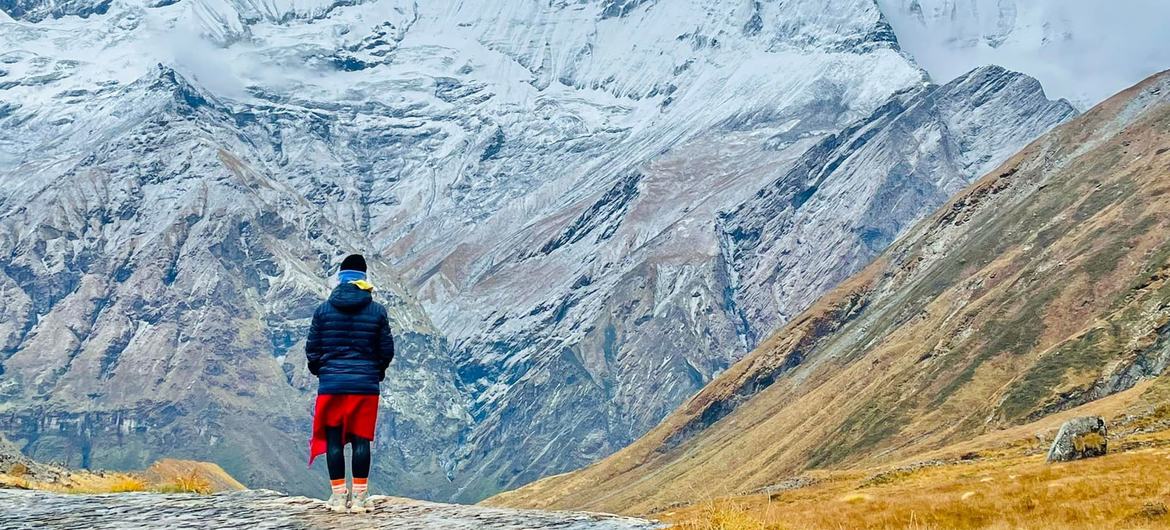
Mountains in Nepal’s Annapurna range, where glaciers are retreating and snow lines are rising due to climate change.
UN News/Vibhu Mishra
 
Mountains in Nepal’s Annapurna range, where glaciers are retreating and snow lines are rising due to climate change.


By Vibhu Mishra
16 May 2025 
Climate and Environment

The United Nations Secretary-General warned on Friday that Himalayan glaciers are “caving in,” urging immediate action to address the climate crisis, especially in the world’s most fragile ecosystems.

António Guterres issued the warning in a video message to the inaugural Sagarmatha Sambaad, or “Everest Dialogue,” convened by the Government of Nepal in Kathmandu.

“Record temperatures have meant record glacier melt,” he said.

“Nepal today is on thin ice – losing close to one-third of its ice in just over thirty years. And your glaciers have melted 65 per cent faster in the last decade than in the one before.”

Named after Mount Everest (Sagarmatha in Nepali), the international platform convened ministers, parliamentarians, climate experts, and civil society to focus on climate change, mountain ecosystems, and sustainability.

Secretary-General's video message.

Two billion futures at stake

Glaciers in the region have served for centuries as vital freshwater reservoirs. Their accelerated melt now threatens not only local communities but vast populations downstream who rely on Himalayan-fed rivers.

Reduced water flow in river systems such as the Ganges, Brahmaputra and Indus threatens not only water but also food production for nearly two billion people across South Asia.

Combined with saltwater intrusion, this could trigger collapsing deltas and mass displacement, the UN chief warned.

“We would see low-lying countries and communities erased forever,” he said.

Children raise their voices

Ahead of the summit, Nepal’s children and youth stepped into the spotlight with their own call to action.

In a declaration submitted to the dialogue, over 100 children and young people demanded urgent and inclusive climate action that recognizes them as rights-holders and climate actors – not just passive victims.

Among their key demands: ensuring child participation in climate decisions, supporting youth-led programmes, and promoting their innovations and climate action.

“The climate crisis is a child rights crisis – disproportionately impacting their health, nutrition, education and well-being,” said Alice Akunga, head of the UN Children’s Fund (UNICEF) in Nepal, which supported the deliberations.

“Listening to the voices of the ‘future of humanity’ is critical to designing and implementing meaningful and lasting solutions to address the adverse effects of climate change on children and youth.”
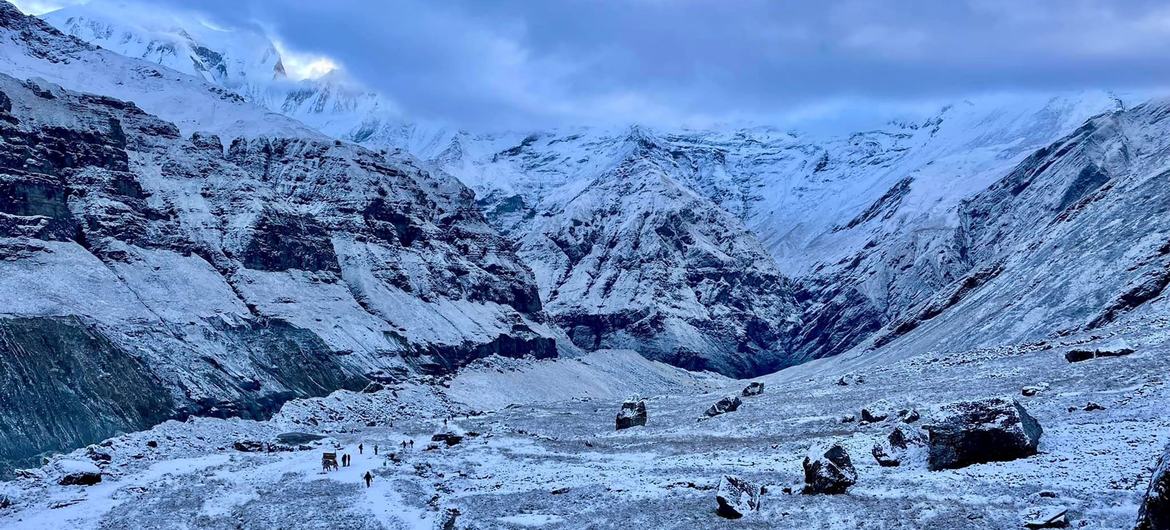
Glaciers in the high Himalayas, like those in Nepal’s Langtang region (pictured), feed major South Asian river systems sustaining tens of millions of lives and livelihoods downstream
UN News/Vibhu Mishra
 
Glaciers in the high Himalayas, like those in Nepal’s Langtang region (pictured), feed major South Asian river systems sustaining tens of millions of lives and livelihoods downstream

Stop the madness

In his message, Mr. Guterres reiterated his call on the world to “stop the madness” of fossil fuel-driven global warming, a warning he made during his previous visit to the Everest region in 2023.

At the time, he stood amid glacial basins in the Himalayas, warning that the “rooftops of the world” were rapidly vanishing.

“And that is why you are gathered together focused on Sambaad – dialogue,” the UN chief said on Friday, applauding Nepal’s climate leadership, including reforestation programmes, early warning systems and its goal to achieve net-zero emissions by 2045.

Act now

The world must act without delay to limit global temperature rise to 1.5°C, he continued – the target set by the Paris Agreement on climate change – with the biggest emitters leading the way.

This includes investing in renewable energy, fulfilling the $1.3 trillion climate finance goal agreed at COP29, doubling adaptation finance to at least $40 billion this year as pledged by developed countries, and providing robust, sustained support to the Loss and Damage Fund.

“Achieving these goals demands bold collaboration,” Mr. Guterres concluded. “The United Nations is your ally in this essential task.”


https://news.un.org/en/story/2025/05/1163376


https://creativecommons.org/licenses/by/4.0/legalcode

пятница, 26 июля 2024 г.

The heat is on: We must rise to the challenge of rising temperatures, urges UN chief


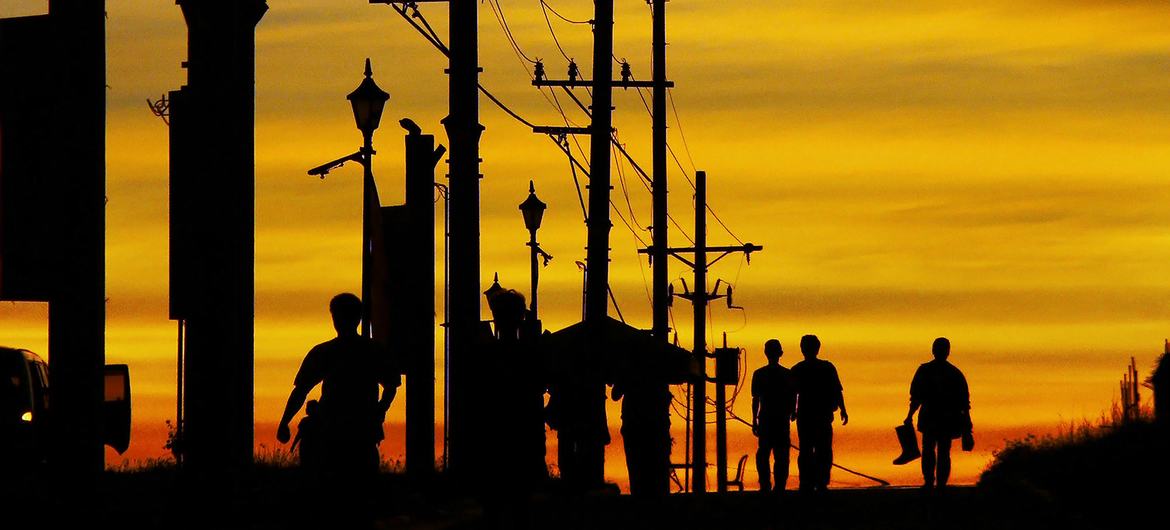
Construction workers walk along a road in Daan Hari, Philippines.
© ILO/Bobot Go
 
Construction workers walk along a road in Daan Hari, Philippines.


By Vibhu Mishra
25 July 2024

 Climate and Environment

The UN chief on Thursday issued an urgent call to action to better protect billions around the world exposed to crippling effects of extreme heat, as global temperature rise continues unabated.

The appeal comes against the backdrop of record temperatures and deadly heatwaves – from the United States to Africa’s Sahel and Europe to the Middle East – that have killed several hundred people this summer.

During the Hajj, for instance, scorching heat claimed over 1,300 pilgrim lives.

“Billions of people are facing an extreme heat epidemic – wilting under increasingly deadly heatwaves, with temperatures topping 50 degrees Celsius around the world. That is 122 degrees Fahrenheit – halfway to boiling,” Secretary-General António Guterres said at a press conference at UN Headquarters in New York.

Tweet URL

“The message is clear: the heat is on. Extreme heat is having an extreme impact on people and planet. The world must rise to the challenge of rising temperatures.”

Protect the most vulnerable

The UN chief highlighted that while “crippling heat is everywhere”, it does not affect everyone equally.

Those most at risk include the urban poor, pregnant women, children, older persons, those with disabilities, the sick, and the displaced, who often live in substandard housing without access to cooling.

According to UN estimates, heat-related deaths for people over 65 years of age increased by about 85 per cent over the past two decades, while 25 per cent of all children today are exposed to frequent heatwaves and by 2050, that could rise to almost 100 per cent.

“We must respond by massively increasing access to low-carbon cooling, expanding passive cooling – such as natural solutions and urban design and cleaning up cooling technologies while boosting their efficiency,” Mr. Guterres said, calling for scaling up of finances to protect communities from “climate chaos”.

Protect workers

Mr. Guterres also underscored the need to step up protections for workers.

Over 70 per cent of the global workforce, or 2.4 billion people, are at substantial risk of extreme heat, according to new report from the UN International Labour Organization (ILO).

The situation is particularly dire in the Africa and Arab regions, where more than 90 per cent and 80 per cent of workers are exposed, respectively. In Asia and the Pacific – the world’s most populous region – that figure is three in four workers (75 per cent).

In addition, heat stress at work is projected to cost the global economy $2.4 trillion by 2030, up from $280 billion in the mid-1990s. 

“We need measures to protect workers, grounded in human rights,” Mr. Guterres stressed.

“And we must ensure that laws and regulations reflect the reality of extreme heat today – and are enforced.”

Boost resilience

He also underscored the need to strengthen resilience of economies and societies, citing impacts such as infrastructure damage, crop failures, and increased pressure on water supplies, health systems, and electricity grids.

Cities are particularly vulnerable, experiencing heating at twice the global average rate.

To address these challenges, Mr. Guterres called for comprehensive and tailored action plans based on scientific data are essential for countries, cities and sectors.

“We need a concerted effort to heatproof economies, critical sectors and the built environment.”

Fight the disease

The UN chief reiterated that it is crucial to recognize the myriad symptoms beyond extreme heat, such as hurricanes, floods, droughts, wildfires and rising sea levels.

The core issue is the reliance on fossil fuels and climate inaction, he stated, stressing that governments, especially G20 nations, the private sector, cities and regions, must urgently adopt climate action plans to limit global temperature rise to 1.5°C.

Alongside, countries must urgently phase-out fossil fuels and end new coal projects.

“They must act as though our future depends on it – because it does.”


Press conference by the Secretary-General on the launch of  the Call to Action.
https://news.un.org/en/story/2024/07/1152496

https://creativecommons.org/licenses/by/4.0/legalcode

пятница, 12 июля 2024 г.

UN chief calls for ‘dramatic shift’ to transform education worldwide


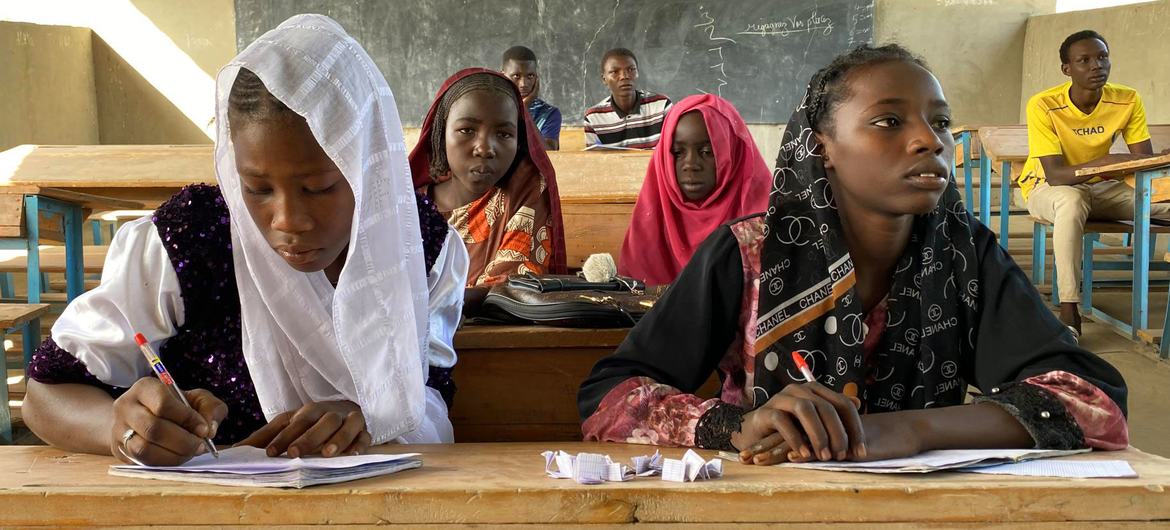
Young women study at  a centre in Bol in Chad.
© UNICEF Chad/Annadjib Ramadane
 
Young women study at a centre in Bol in Chad.


11 July 2024 

Culture and Education

The global crisis in education needs a “dramatic shift” to shape a more peaceful, sustainable and just world, the UN Secretary-General said on Thursday.

António Guterres was taking part in a Special Event on Transforming Education – part of the on-going High Level Political Forum (HLPF) and looking ahead of the upcoming Summit of the Future in September.

The event was a call to action, with the UN chief calling on all countries to make a concerted effort to establish genuine learning environments that will provide learning opportunities from childhood to adult stages.

“Given the stakes, the world cannot afford to short-change education,” Mr. Guterres said. “But by nearly every measure, that is exactly what we are doing.”

Global challenges

The UN chief said that around 84 million children are set to remain out of school by 2030 - unless action is taken to transform education worldwide.

That means that Sustainable Development Goal 4 (SDG4) which aims to “ensure inclusive and equitable quality education and promote lifelong learning opportunities for all” is unlikely to be reached.

Tweet URL

Currently, only a sixth of countries are on courses to achieve the SDG4 target of universal access to quality education.

Mr. Guterres also noted that completion rates at a secondary level are rising far too slowly, learners are not equipped with the skills they need to succeed in a changing world, and early childhood and adult learning are often seen as optional.

“It’s truly shocking that some 70 per cent of children in sub-Saharan Africa are unable to read a basic text by age 10,” he said.

Financial roadblocks

The Secretary-General said that financing to provide quality education is also insufficient to meet the challenge.

In 2023, the UN Education, Scientific and Cultural Organization (UNESCO) estimated that developing nations would need to invest $100 billion annually to achieve SDG4. This amount increases by about 50 per cent when costs for the digital transformation of education are considered.

Further, Mr. Guterres said that four of every 10 people globally live in nations where governments spend more on debt servicing than on education or health.

He said that over 140 countries committed to turning this crisis around at the Transforming Education Summit in 2022.

But “progress is far too slow and uneven. Something has to change.”

Poverty and gender

President of the General Assembly, Dennis Francis, echoed the Secretary-General’s statements on the need for transformation.

He recalled recent visits to South Sudan where he said he learned about the “dire poverty of education evident from the fact that at least 70 per cent of eligible children are out of school.”

He also noted that the denial of a girl’s right to education in Afghanistan and the inability to access education in Ukraine and Gaza due to constant attacks are clear indicators of an intractable crisis.

“Beyond access, we must ensure quality education for all fostering inclusive, equitable and lifelong learning opportunities that empower every individual to thrive in a rapidly changing world,” Mr Francis said. “We must combine our political will, with clear targeted actions to decisively address these urgent needs.”

‘Let’s start walking the talk’

Secretary-General Guterres has a four-point plan at the special event on education to end the global education crisis and build momentum towards achieving SDG4 by 2030.

This includes closing the financing and access gap nationwide, supporting teachers on the frontlines of education and and revolutionising education systems, the UN Deputy Secretary-General Amina Mohammed said.

“Education has got to be in the mix to shape that,” Ms. Mohammed said.

“The message today is clear: Education is intrinsic to the achievement of our common goals in sustainable development, peace and human rights,” she concluded, adding that education speaks to the very fabric of our societies and it has an essential contribution to make.

Mr. Guterres said, “Education is the single-most important investment any country can make. In its people. And in its future,” in his closing remarks.

“So, let’s start walking the talk. Let’s come together to end the global crisis in education.”


https://news.un.org/en/story/2024/07/1151981

https://creativecommons.org/licenses/by/4.0/legalcode