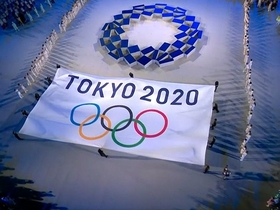
«Запланированное золото» на Токийской олимпиаде в воскресенье в актив российской команды занесли теннисисты. В «нашем» финале сильнее оказалась пара Анастасия Павлюченкова и Андрей Рублев.
Серебряных медалей у россиян было сразу четыре. Понятно, что оно на счету проигравшей пары Елена Веснина и Арсен Карацев. Их коллега по цеху Карен Хачанов уступил в финале мужского одиночного разряда немцу Александру Звереву. Гимнастка Анастасия Ильянкова была второй в упражнении на брусьях, а первенствовала здесь бельгийка Нина Дерваль. Российские рапиристы в решающем поединке проиграли французам.
Две боксерских «бронзы» получились у россиян грустными — после проигрышей в полуфиналах. Медали на счету Имама Хатаева и Андрея Замкового.
В плавании у россиян в заключительный день успехов не было. Калэб Дрессел из США победил в 50 м вольным стилем, его соотечественник Роберт Финк стал лучшим в заплыве на 1500 м. Австралийка Кайлли Маккеон выиграла 50 м вольным стилем. Женская сборная Австралии победила в комбинированной эстафете 4×100 м. В той же дисциплине у мужчин лучшими были американцы.
Китаянка Ши Тинмао завоевала золотую медаль в прыжках в воду с трехметрового трамплина.
Британка Шарлотта Уортингтон выиграла «золото» во фристайле на BMX. У мужчин тут лучшим был австралиец Логан Мартин.
В легкой атлетике китаянка Гун Лицзяо выиграла толкание ядра. Венесуэлка Юлимар Рохас выиграла «золото» в тройном прыжке, побив мировой рекорд 1995 года советской и украинской прыгуньи Инессы Кравец. Бывший американец, а ныне итальянецЛемонт Джекобс сенсационно первенствовал на стометровке. В прыжках в высоту золотые медали получили сразу два спортсмена: Мутаз Эсса Баршим из Катара и Джанмарко Тамбери из Италии.
Днепропетровец Артем Долгопят выиграл «золото» для Израиля в вольных упражнениях в спортивной гимнастике. Бразильянка Ребека Андраде стала лучшей в опорном прыжке. Макс Уитлок победил в упражнениях на коне.
Австралиец Мэтт Уэрн победил в парусном спорте в классе «Лазер». У женщин Анна Мари Риндом была первой в классе «Лазер-Радиал».
Гольфист Ксандер Шоффель принес США очередное «золото».
Чешки Барбора Крейчикова и Катерина Синякова в финале парного разряда обыграли Белинду Бенчич и Викторию Голубич из Швейцарии.
Эквадорская тяжелоатлетка Нейси Патрисия Дахомес победила в весовой категории до 76 кг.
В общекомандном зачете тройка лидеров выглядит так: Китай, США, Япония. Австралия с 14 золотыми медалями обошла Россию, которых у нее 12.
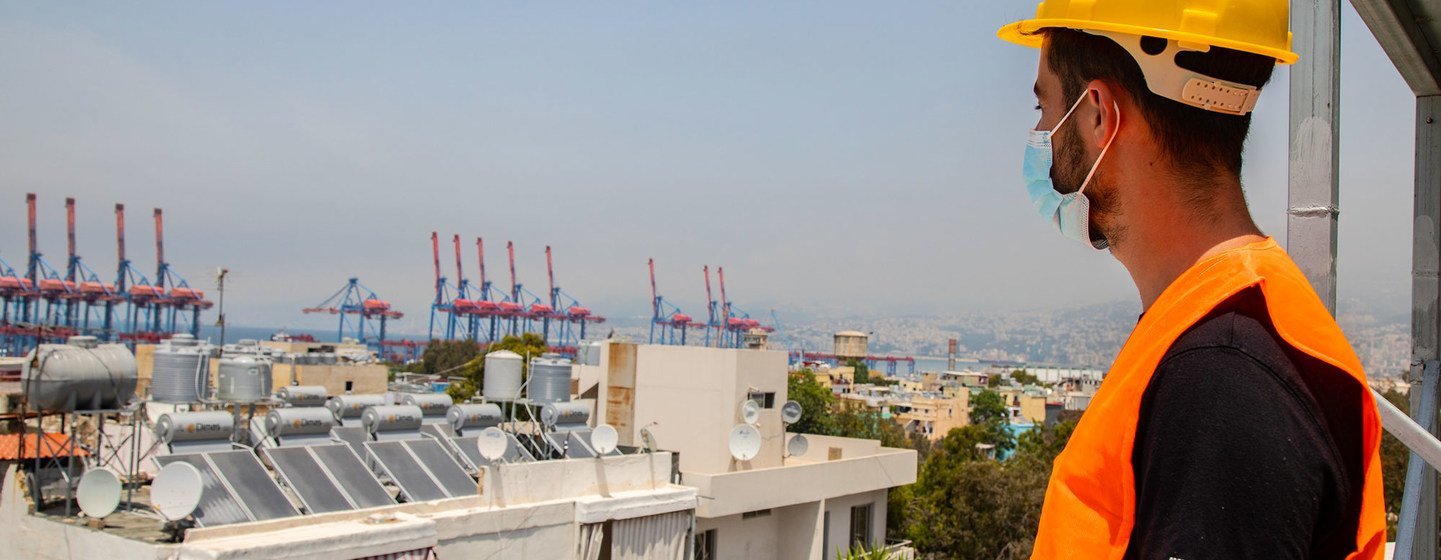
On August 4th, 2020, a devastating blast in a warehouse destroyed much of the centre of the Lebanese capital, Beirut. Many neighbourhoods were destroyed, downtown Beirut looked like a war zone. Thousands were injured and some 200 people tragically lost their lives on that day and the days that followed. For many, their property and livelihoods were literally blown away.
Najat Rochdi the UN Resident and Humanitarian Coordinator for Lebanon spoke to UN News about how the country has coped over the last 12 months and what the future holds.
“I had only been in my new position of UN Resident and Humanitarian Coordinator for Lebanon for three days when the devastating explosions ripped through Beirut Port.
The effects of those explosions are still reverberating one year later. The country is striving to find a path to emerge from a tragedy that has touched every single person.
The destructive fallout of August 4th intensified suffering in Lebanon, which was already reeling from civil unrest, economic and financial hardship, increasing poverty, and unemployment, compounded by political deadlock and a soaring number of COVID-19 cases.
A year on from this tragedy, there is deepening hardship and mounting frustration. I met with many Lebanese people who gave voice and face to the deprivation and adversity that so many are experiencing in this country.
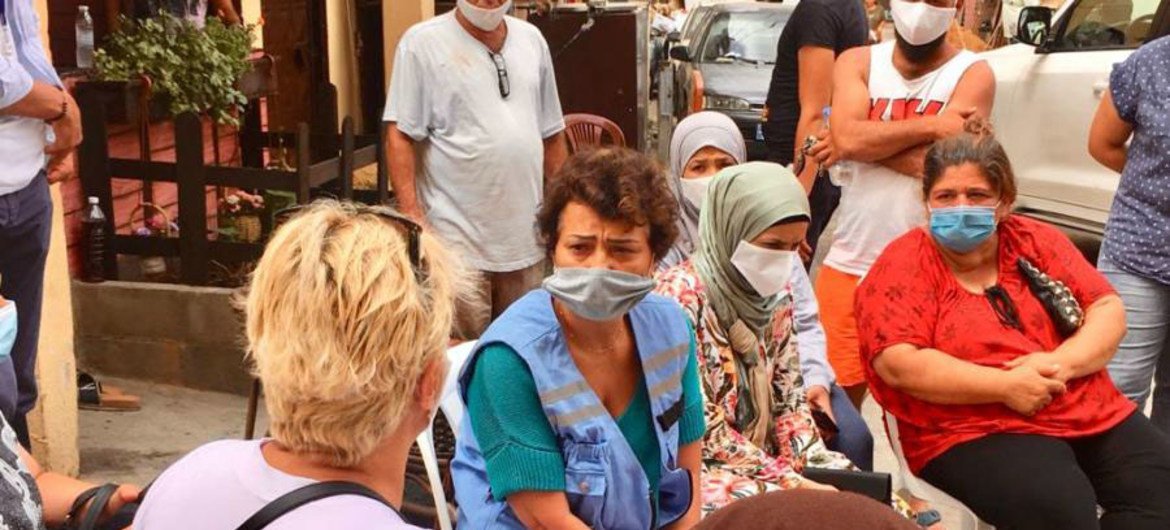
UN Lebanon/Nayla Hajjar
The UN's Najat Rochdi (centre) meets with women in Karantina, one of the neighbourhoods damaged by the port explosion.
People such as a 59-year-old homeless man called Youssef, whose dream is to have a roof above his head and a door that he can close when he sleeps and Cathy, who is 15, who has the simple desire to own a mobile phone so she can access online learning.
Or Mirna, a 50-year-old teacher who used to make her own living and provide for her family, but can now only afford one meal a day and is obliged to ask for help. She told me with tears in her eyes “They took my dignity”.
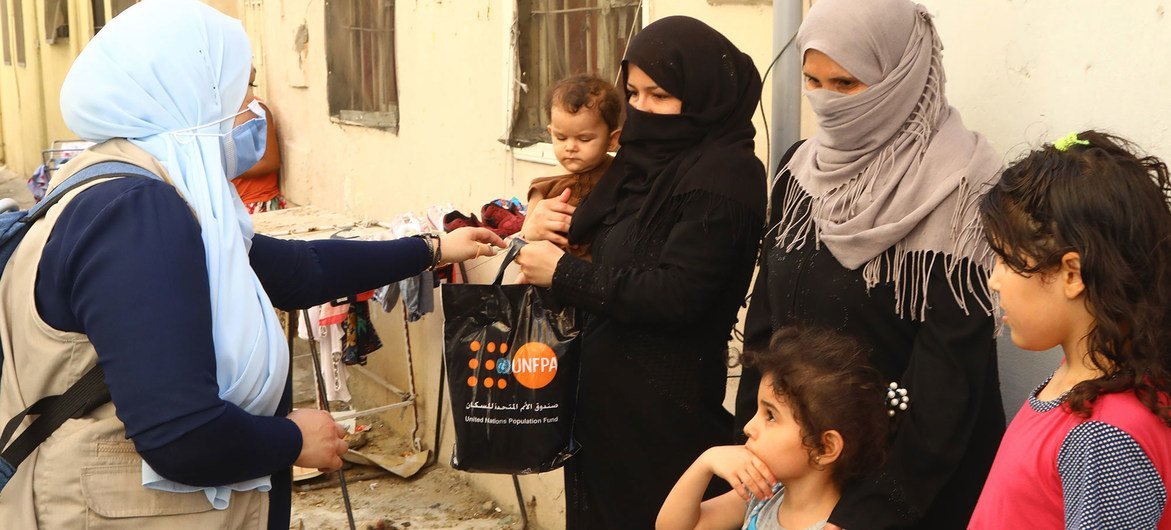
UNFPA
UNFPA distributed dignity kits to women in Beirut following the devastating explosion.
Situation ‘worsening by the day’
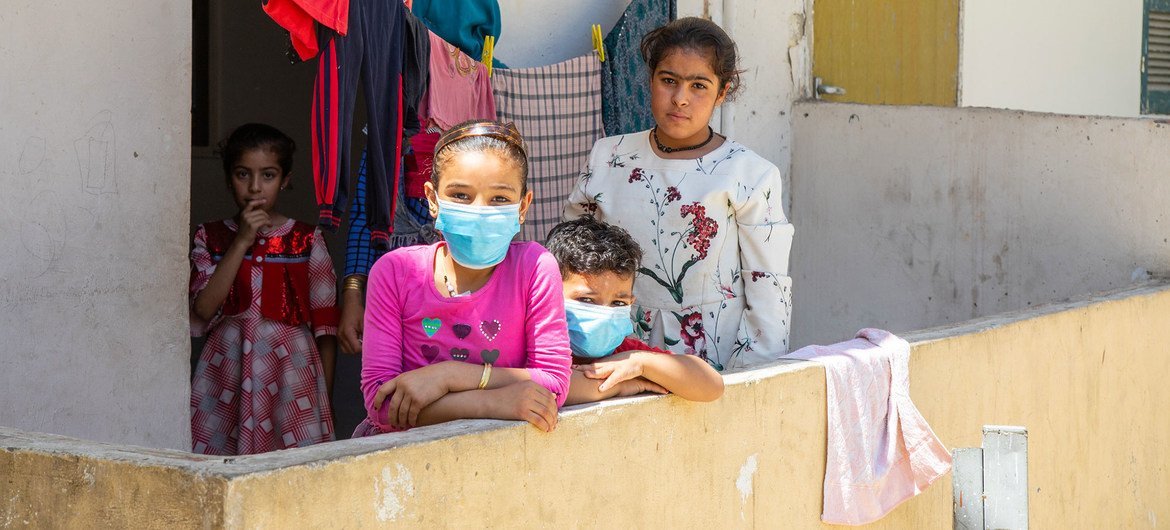
It is clear to me that the situation of ordinary people in Lebanon is worsening by the day. Currently, the UN estimates that more than one million Lebanese (out of a population of almost eight million, including more than two million refugees and migrants) need relief assistance to cover their basic needs, including access to food, health, education and water.
In addition, nine out of 10 refugees live in extreme poverty, an increase from 55 per cent from only a year before. Over half of the migrants in Lebanon say they were unable to meet their food needs, and the same number of migrants reported being unemployed (with the majority losing their jobs during the last quarter of 2020).
Lebanon, which not so long ago was a high middle-income country, is now facing probably the worst financial and economic crisis in its modern history; over half of its population is living in poverty. It is perhaps not surprising that many people have lost trust in their leaders and institutions.
UNDP Lebanon
The UN estimates that more than one million Lebanese need relief assistance to cover basic needs.
Support for a brighter future
Despite the grim viewpoint, I believe, and so do many Lebanese, that the country has strong potential for a brighter future.
In the immediate aftermath of the explosions the United Nations and its partners reacted quickly and decisively to save lives and provide emergency assistance to those affected. $167 million was generously received for the United Nations coordinated flash appeal, one of the best funded appeals in 2020.
Support was provided to hospitals and health care centres for continuation of basic services, including in relation to COVID-19; damage to houses was assessed and emergency shelter kits distributed to ensure immediate safety and protection; water connections, including pumps and tanks, were re-established; hygiene and baby kits, in addition to in-kind food parcels, were distributed; protection services and psycho-social and mental health support services were provided; resources were allocated for debris clearance efforts.
Essential repairs were also started for hospitals, primary health care centres, schools and housing, while the humanitarian community transitioned towards multi-purpose cash assistance in support of recovery, livelihoods and local markets.
On the recovery side, the UN, along with the European Union (EU) and the World Bank, and in consultation with relevant stakeholders, developed the Reform, Recovery and Reconstruction Framework. Known as 3RF, it is a people-centered programme, anchored in participation, inclusion and social justice.
It’s for the people and felt by them. It envisages a ground-breaking new way of working, which relies on partnerships, that bring together the presidency, government, parliament, civil society, private sector, and international partners, in addition to the EU, World Bank and UN to ensure the reconstruction of critical assets, services, and infrastructure for equal access to quality basic services, as well as the implementation of key reforms. Its forward-looking priorities, programmes and investments, include social inclusion and protection; housing and cultural heritage rehabilitation; municipal services and environment; and business recovery.
Already, thousands of people have received legal assistance to deal with claims arising from the explosions. Several public buildings have been retrofitted with green technologies, health facilities have received critical medical equipment. Several schools and medical facilities have been reconstructed or partially rehabilitated. In this way, Lebanon is beginning the long and arduous process of building back better.
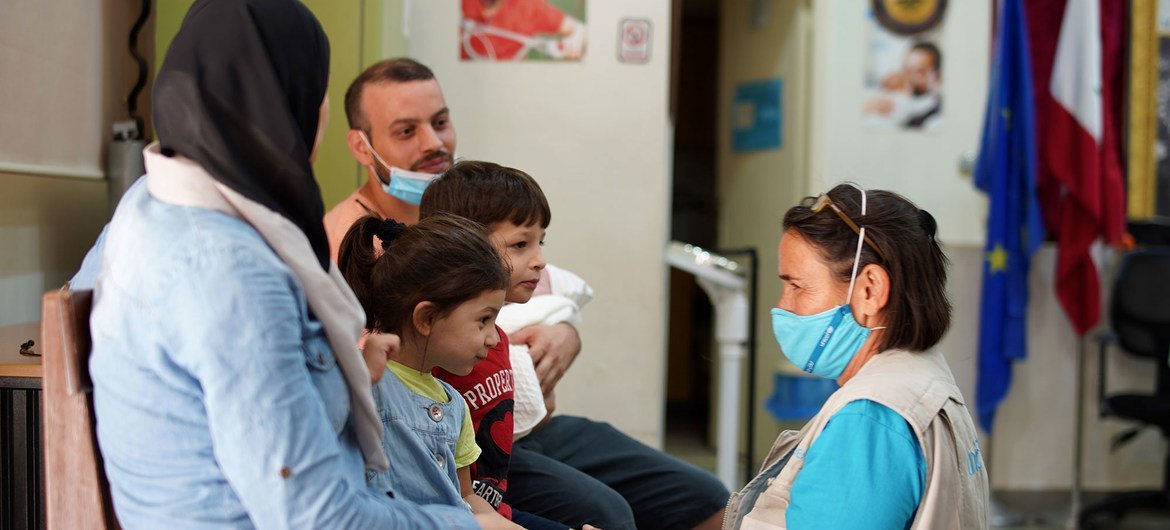
A UNICEF doctor treats a child just days after the explosion.
‘Emergency assistance is not the solution’
But also, Lebanon’s recovery must coincide with reform. Emergency assistance is not the solution. It is regretful that Lebanon’s leaders have been unable to reach agreement on the formation of a new government in the past 10 months, which has delayed urgently needed structural reforms to address the country’s numerous challenges.
This is a critical moment in Lebanon’s history. The combined magnitude, depth and multi-dimensionality of the political, socio-economic and humanitarian crises facing Lebanon is unprecedented and presents an increasingly challenging landscape for the United Nations to implement its mandates. But ultimately the responsibility for avoiding the total collapse of Lebanon lies primarily in the hands of its leaders.
UN/Pasqual Gorriz
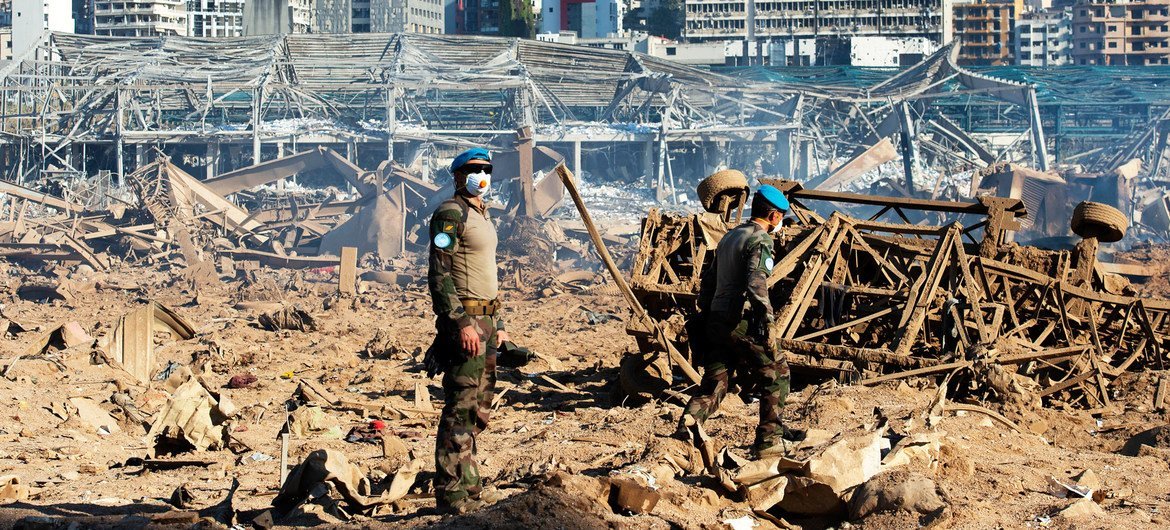
Peacekeepers from the UN mission, UNIFIL, assess the magnitude of the blast that destroyed Beirut Port, Lebanon.
UN stands by Lebanon
Unfortunately, a year on from my arrival in Lebanon and the explosions which rocked Beirut shortly thereafter, the situation continues to deteriorate. The UN is developing a 12-month Emergency Response Plan that articulates collective priority responses to the critical humanitarian needs of the most vulnerable Lebanese and migrants affected by the situation; it complements the support already provided to refugees and host communities.
This is not a solution. It aims at linking with and preparing the transition towards solutions to address the root causes of the crisis, which will only come from structural reforms and Government-led comprehensive and sustainable development interventions, including the implementation of a full-fledged comprehensive and inclusive Government-led social protection strategy.
I have been inspired by the spirit, solidarity, and courage of the young Lebanese people. The UN will continue to stand by Lebanon as it continues on the path to recovery and ultimately fulfilling its potential. That said, the greatest capital is the human capital and Lebanon can count on its women and men. Those who pledged not to leave the country despite the situation, those who use their creativity, their entrepreneurship and their commitment to build a better Lebanon. Those are the best hope for Lebanon”.
Read more here about the UN’s work in Lebanon
UN Resident Coordinator
The UN Resident Coordinator, sometimes called the RC, is the highest-ranking representative of the UN development system at the country level.
In this occasional series, UN News is inviting RCs to blog on issues important to the United Nations and the country where they serve
Суббота получилась для российской команды не самой медальной — в ее активе по одному «золоту», «серебру» и «бронзе». Саблистки в финале командного турнира победили француженок, а Юлия Зыкова и Юлия Каримова заняли второе и третье места в стрельбе из винтовки, уступив лишь Нине Кристен из Швейцарии.
Британские триатлонисты стали первыми в истории победителями в смешанной эстафете.
В плавании американец Калеб Дрессел победил на стометровке баттерфляем. Кайли Маккеон из Австралии первенствовала в заплыве на 200 м на спине. Кэйти Ледеки из США победила на дистанции 800 м вольным стилем. Сборная Великобритании была сильнейшей в смешанной комбинированной эстафете 4×100 м.
Сборная Испании победила в миксте в стендовой стрельбе.
Белорус Иван Литвинович стал чемпионом в прыжках на батуте.
Китаянка Лу Юньсю первенствовала в парусном спорте в классе RS:X. В аналогичной дисциплине у мужчин победил Киран Бадлу из Нидерландов.
Турок Мете Газоз стал чемпионом в личном первенстве по стрельбе из лука.
Тяжелоатлет Лю Сяоцзюнь из Китая победил в весовой категории до 81 кг. Фарес Эльбах стал сильнейшим среди атлетов весом до 96 кг.
Победительницей Олимпиады стала женская сборная Новой Зеландии по регби.
Сборная Франции победила на смешанном турнире по дзюдо.
В легкой атлетике швед Даниэль Столь был сильнейшим в метании диска. Суперсюрприз преподнесла сборная Польши, выиграв смешанную эстафету 4×400 м. Элайн Томпсон из Ямайки выиграла золото на стометровке.
Швейцарка Белинда Бенчич победила в женском одиночном разряде в теннисе.
Теперь таблица общекомандного зачета выглядит так: у Китая 21 золотая медаль, 13 серебряных и 12 бронзовых; Японии — 17-5-8; у США — 16-17-13.
Россия сохраняет четвертую позицию с 11 золотыми, 15 серебряными и 11 бронзовыми медалями.
ЦБ РФ повысил надбавки к коэффициентам риска по ипотечным кредитам с первоначальным взносом от 15% до 20%, что сделает выдачу таких ссуд менее выгодным для банков. Новые значения надбавок будут применяться к кредитам, выданным с 1 августа 2021 года.
Так, повышаются надбавки к коэффициентам риска по ипотечным кредитам с соотношением «кредит/залог» от 80% до 85%, надбавки по ипотечным кредитам с первоначальным взносом от 15% до 20% до доковидного уровня. Регулятор будет увеличивать надбавки, если рост в этом сегменте не замедлится, отметили в ЦБ.
Для ссуд с первоначальным взносом 15-20% надбавки по кредитам, выданным заемщикам с показателем долговой нагрузки до 30% (ПДН, отношение платежа по кредиту к доходу заемщика), увеличатся с 20 до 50 п. п., с долговой нагрузкой 30-40% - с 30 до 50 п. п., 40-50% - с 40 до 50 п. п., 50-60% - с 50 до 70 п. п., 60-70% - с 60 до 80 п. п., 70-80% - с 70 до 90 п. п., свыше 80% - с 80 до 100 п. п.
В регуляторе отметили, что с середины 2020 года значительно ускорился рост цен на жилье, он существенно опережал увеличение доходов граждан. При этом банки постепенно увеличивают долю ипотечных кредитов с низким первоначальным взносом (менее 20%). Особенно это характерно для первичного рынка ипотеки, где действует госпрограмма по льготной ставке 7%. В этих условиях возросла значимость величины первоначального взноса, который является одним из ключевых факторов риска в ипотечном кредитовании. Кроме того, размер первоначального взноса коррелирует с частотой выходов заемщиков на просрочку и характеризует платежеспособность заемщика.
Так как платежеспособность заемщиков в значительной мере зависит от уровня их долговой нагрузки, в случае дальнейшего повышения долговой нагрузки и сохранения ускоренного роста цен на недвижимость Банк России во втором полугодии 2021 года может увеличить надбавки к коэффициентам риска также для кредитов с первоначальным взносом более 20% и высоким ПДН заемщика, отмечают в ЦБ.
Инфляция в России останется надолго, а ЦБ РФ, вероятнее всего, продолжит жесткую монетарную политику, заявила в интервью Financial Times в субботу глава регулятора Эльвира Набиуллина.
По ее словам, стремительное подорожание продуктов питания «сорвало с якоря» инфляционные ожидания простых россиян, которые теперь считают, что цены будут расти втрое быстрее 4-процентной цели ЦБ.
При том что Росстат оценивает потребительскую инфляцию в 6,5%, сами граждане заявляют, что цены выросли в среднем на 16,5%, а каждый пятый - 21,7% - уже видит в стране гиперинфляцию на уровне 30% и выше.
Инфляционные ожидания потребителей на 12 месяцев с 7,9% прошлой весной подскочили до 13,4% в июле, оформив максимум за пять лет, показал опрос ЦБ.
Причина этого, по словам Набиуллиной, кроется в низком доверии к центробанку, а также незабытом опыте гиперинфляции 1990х. «У нас был очень продолжительный период высокой инфляции в конце 1990х и 2000х. Наши люди жили с низкой инфляцией лишь короткие промежутки времени. Инфляционные ожидания были заякорены, когда условия были более стабильны, но теперь они реагируют на пандемию и высокие темпы роста цен», - заявила Набиуллина.
Россия позже других приступила к инфляционному таргетированию, и «у населения нет достаточно доверия, чтобы понять, что центробанк всегда будет принимать меры, чтобы вернуть инфляцию к цели», добавила глава ЦБ.
Опустив процентную ставку до минимума с царских времен в прошлом году, Банк России перешел к ужесточению в 2021-м и за четыре месяца увеличил стоимость заимствований с 4,25% до 6,5% годовых. И хотя цикл ужесточения стал самым резким с 2014 года, Набиуллина не считает, что политика ЦБ стала «ястребиной».
«Ставки по депозитам ниже инфляции, не говоря уже об инфляционных ожиданиях. Люди считают их слишком низкими для сбережений», - объясняет она.
По данным ЦБ, во второй декаде июля топ-10 банков предлагали в среднем максимальную ставку по вкладам в размере 5,46%. И хотя с начала года этот показатель вырос более чем на 1 процентный пункт, в реальном выражении - с учетом инфляции - доходность остается отрицательной.
Люди в ответ голосуют ногами. За январь-июнь объем рублевых средств физлиц в банках сократился на 365 млрд рублей, до 25,667 трлн.
Попытки сдуть пыль с советских рецептов управления экономикой и затормозить инфляцию директивной заморозкой цен и ограничениями на экспорт, по мнению Набиуллиной, могут закончиться печально.
«Просто заморозить цены на некоторые товары - это, пожалуй, самое простое что можно сделать. Но мы знаем, что могут быть последствия, - сказала она. - Если цены растут каждый день на множество товаров, нужно увеличивать меры поддержки для наиболее страдающих групп населения».
Small island nations across the world are bearing the brunt of the climate crisis, and their problems have been accentuated by the COVID-19 pandemic, which has severely affected their economies, and their capacity to protect themselves from possible extinction. We take a look at some of the many challenges they face, and how they could be overcome.
Low emissions, but high exposure
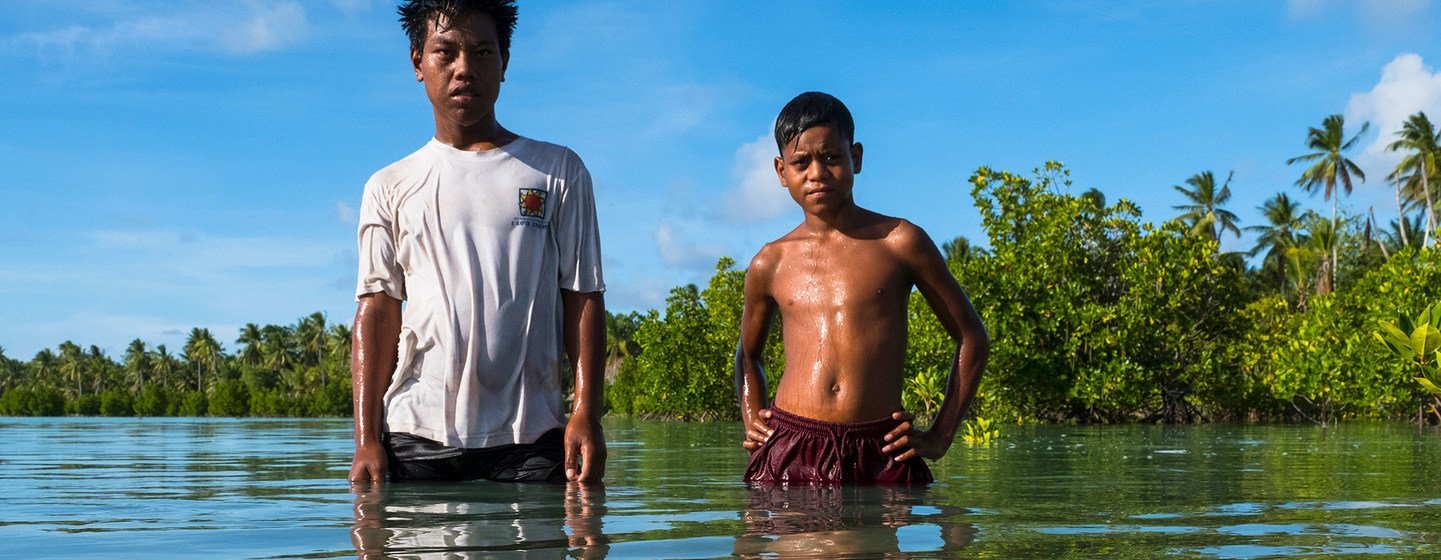
The 38 member states and 22 associate members that the UN has designated as Small Island Developing States or SIDS are caught in a cruel paradox: they are collectively responsible for less than one per cent of global carbon emissions, but they are suffering severely from the effects of climate change, to the extent that they could become uninhabitable.
Although they have a small landmass, many of these countries are large ocean states, with marine resources and biodiversity that are highly exposed to the warming of the oceans. They are often vulnerable to increasingly extreme weather events, such as the devastating cyclones that have hit the Caribbean in recent years, and because of their limited resources, they find it hard to allocate funds to sustainable development programmes that could help them to cope better,for example, constructing more robust buildings that could withstand heavy storms.
The COVID-19 pandemic has worsened the economic situation of many island states, which are heavily dependent on tourism. The worldwide crisis has severely curtailed international travel, making it much harder for them to repay debts. “Their revenues have virtually evaporated with the end of tourism, due to lockdowns, trade impediments, the fall in commodity prices, and supply chain disruptions”, warned Munir Akram, the president of the UN Economic and Social Council in April. He added that their debts are “creating impossible financial problems for their ability to recover from the crisis.”
UNDP/Michael Atwood
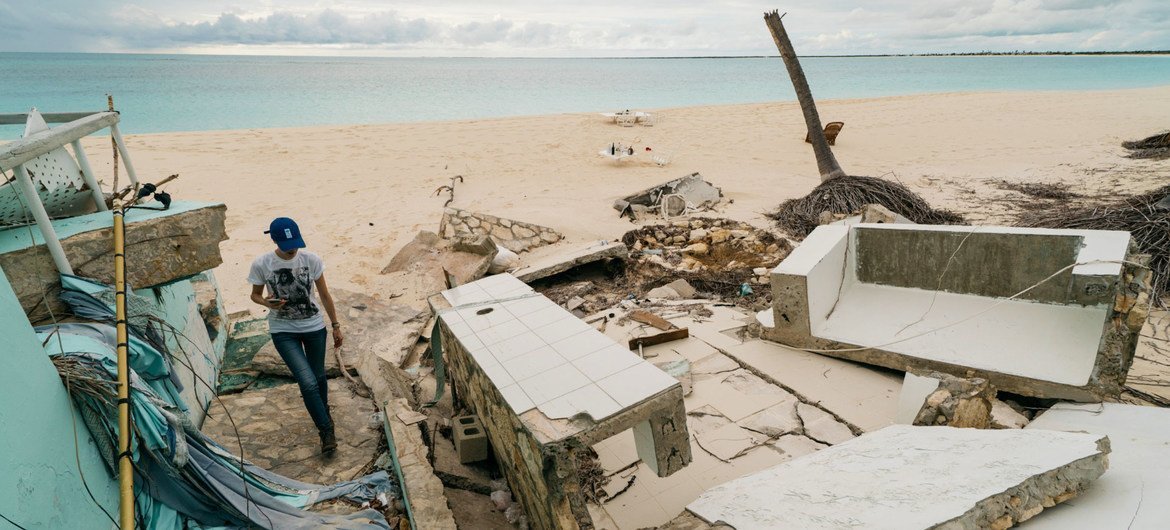
The aftermath of Hurricane Irma in Barbuda.
Most research indicates that low-lying atoll islands, predominantly in the Pacific Ocean such as the Marshall Islands and Kiribati, risk being submerged by the end of the century, but there are indications that some islands will become uninhabitable long before that happens: low-lying islands are likely to struggle with coastal erosion, reduced freshwater quality and availability due to saltwater inundation of freshwater aquifers. This means that small islands nations could find themselves in an almost unimaginable situation, in which they run out of fresh water long before they run out of land.
Furthermore, many islands are still protected by reefs, which play a key role in the fisheries industry and balanced diets. These reefs are projected to die off almost entirely unless we limit warming below 1.5 degrees celsius
Climate change continues to exacerbate the frequency and severity of natural disasters, including wildfires, droughts, hurricanes and floods.
Despite the huge drop in global economic activity during the COVID-19 pandemic, the amount of harmful greenhouse gases released into the atmosphere increased in 2002, and the past six years, 2015–2020, are likely to be the six warmest on record.
Climate finance (climate-specific financial support) continues to increase, reaching an annual average of $48.7 billion in 2017-2018. This represents an increase of 10% over the previous 2015–2016 period. While over half of all climate-specific financial support in the period 2017-2018 was targeted to mitigation actions, the share of adaptation support is growing, and is being prioritized by many countries.
This is a cost-effective approach, because if not enough is invested in adaptation and mitigation measures, more resources will need to be spent on action and support to address loss and damage.
UNDP Maldives
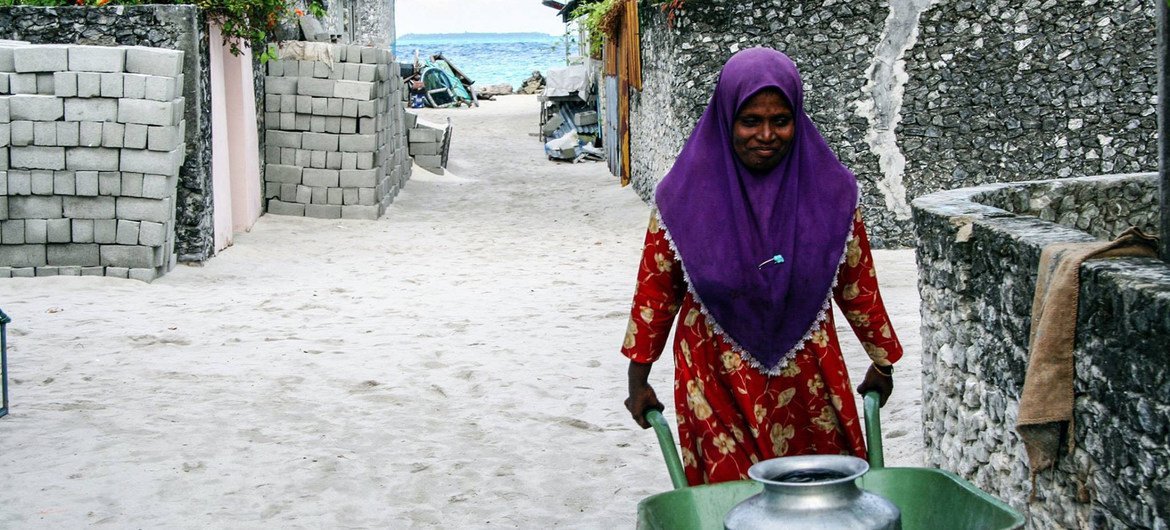
Water shortages exacerbated by climate change are affecting the Maldives' low-lying islands.
Switching to renewables
SIDS are dependent on imported petroleum to meet their energy demands. As well as creating pollution, shipping the fossil fuel to islands comes at a considerable cost. Recognizing these problems, some of these countries have been successful in efforts to shift to renewable energy sources.
For example, Tokelau, in the South Pacific, is meeting close to 100 per cent of its energy needs through renewables, while Barbados, in the Caribbean, is committed to powering the country with 100 per cent renewable energy sources and reaching zero carbon emissions by 2030.
Several SIDS have also set ambitious renewable energy targets: Samoa, the Cook Islands, Cabo Verde, Fiji, Saint Vincent and the Grenadines and Vanuatu are aiming to increase the share of renewables in their energy mixes, from 60 to 100 per cent, whilst in 2018, Seychelles launched the world’s first sovereign blue bond, a pioneering financial instrument to support sustainable marine and fisheries projects.
UNDP/Pierre Michel Jean
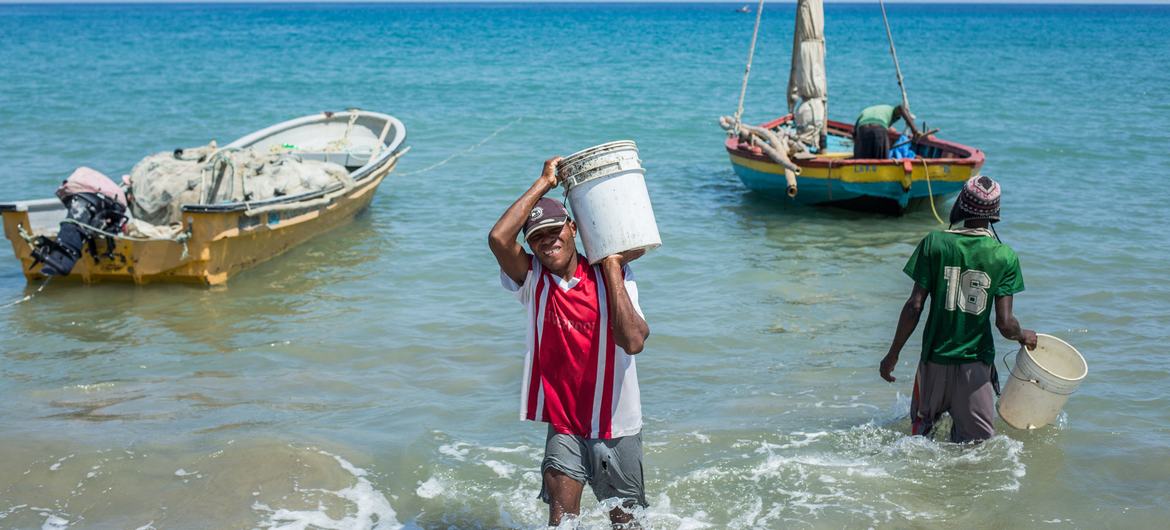
Sustainable fishing is improving livelihoods in Haiti.
The power of traditional knowledge
The age-old practices of indigenous communities, combined with the latest scientific innovations, are being increasingly seen as important ways to adapt to the changes brought about by the climate crisis, and mitigate its impact.
In Papua New Guinea, local residents use locally-produced coconut oil as a cheaper, more sustainable alternative to diesel; seafaring vessels throughout the islands of Micronesia and Melanesia in the Pacific are using solar panels and batteries instead of internal combustion; mangrove forests are being restored on islands like Tonga and Vanuatu to address extreme weather as they protect communities against storm surges and sequester carbon; and in the Pacific, a foundation is building traditional Polynesian canoes, or vakas, serving as sustainable passenger and cargo transport for health services, education, disaster relief and research.
UNDP/Stephane Belleros
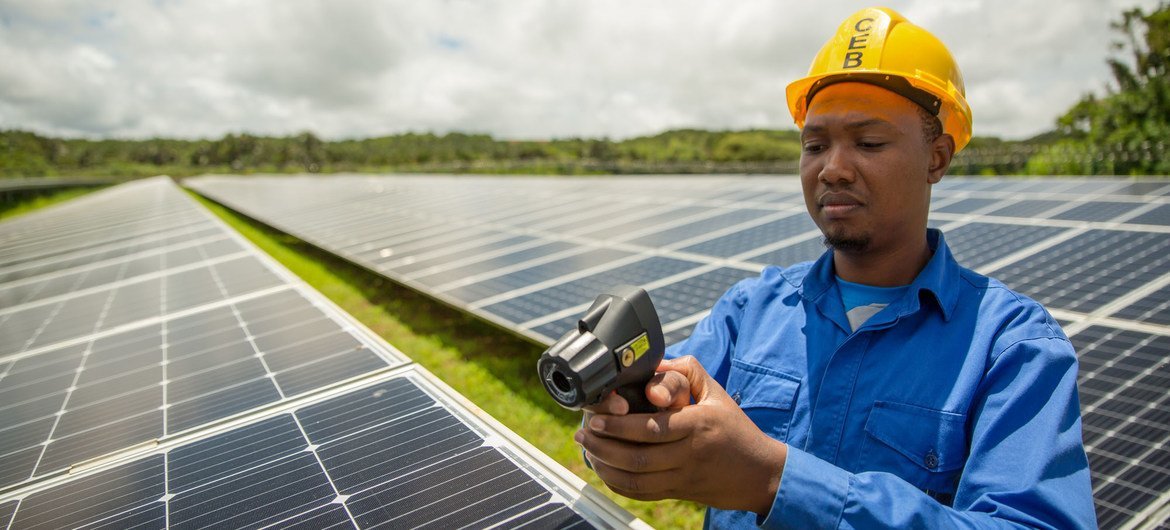
Solar panels are maintained at a farm in Mauritius.
Strategies for survival
While SIDS have brought much needed attention to the plight of vulnerable nations, much remains to be done to support them in becoming more resilient, and adapting to a world of rising sea levels and extreme weather events.
On average, SIDS are more severely indebted than other developing countries, and the availability of “climate financing” (the money which needs to be spent on a whole range of activities which will contribute to slowing down climate change) is of key importance.
More than a decade ago, developed countries committed to jointly mobilize $100 billion per year by 2020 in support of climate action in developing countries; the amount these nations are receiving is rising, but there is still a significant financing gap. A recently published UN News feature story explains how climate finance works, and the UN’s role.
Beyond adaptation and resilience to climate change, SIDS also need support to help them thrive in an ever-more uncertain world. The UN, through its Development Programme (UNDP), is helping these vulnerable countries in a host of ways, so that they can successfully diversify their economies; improve energy independence by building up renewable sources and reducing dependence on fuel imports; create and develop sustainable tourism industries, and transition to a “blue economy”, which protects and restores marine environments.
UNDP/Yuichi Ishida
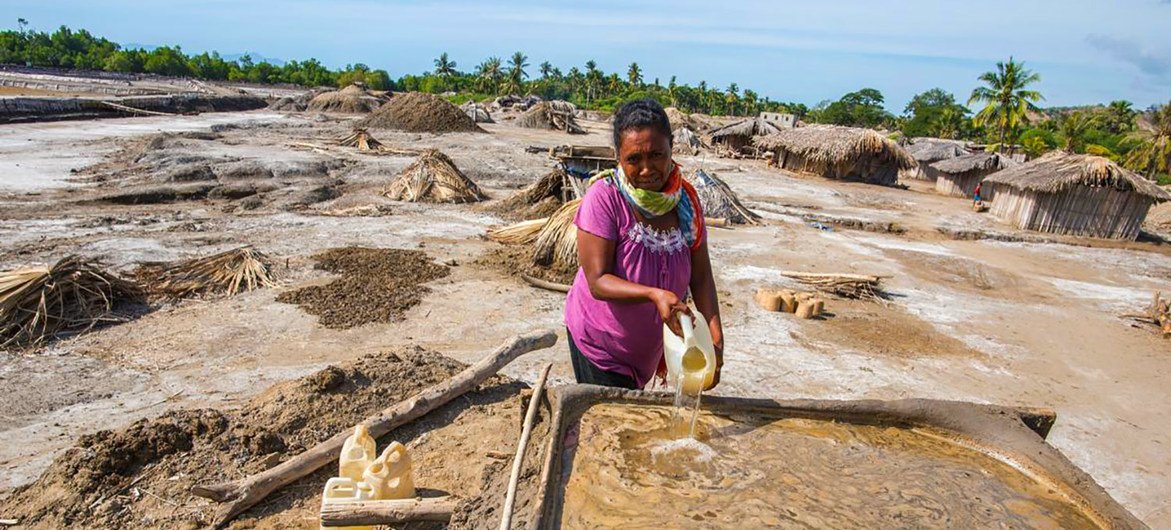
A woman harvests salt in a mangrove in Timor-Leste.
Fighting for recognition
For years, SIDS have been looking for ways to raise awareness of their plight and gain international support. As the Alliance of Small Island States (AOSIS) in 1990, they successfully lobbied for recognition of their particular needs in the text of the landmark UN Framework Convention on Climate Change (UNFCCC) two years later.
Since then, the countries have continued to push for a greater emphasis on ensuring that international agreements include a commitment to providing developing countries with the funds to adapt to climate change. An important step was ensuring that climate change negotiations address the issue of “loss and damage” (i.e. things that are lost forever, such as human lives or the loss of species, while damages refers to things that are damaged, but can be repaired or restored, such as roads or sea walls etc.).
SIDS continue to urge developed nations to show more ambition and commitment to tackling the climate crisis, and strongly support calls for a UN resolution to establish a legal framework to protect the rights of people displaced by climate change, and for the UN to appoint a Special Rapporteur on Climate and Security, to help manage climate security risks and provide support to vulnerable countries to develop climate-security risk assessments.
•SIDS have also advocated for eligibility to development finance to recognize the vulnerabilities they face, including from climate change hazards. The UN will release its recommendations in a report due to be released in August 2021.
В международных правовых документах закреплено право каждого государства на развитие атомной энергии в мирных целях. МАГАТЭ может дать гарантии, что ядерная деятельность того или иного государства является мирной.
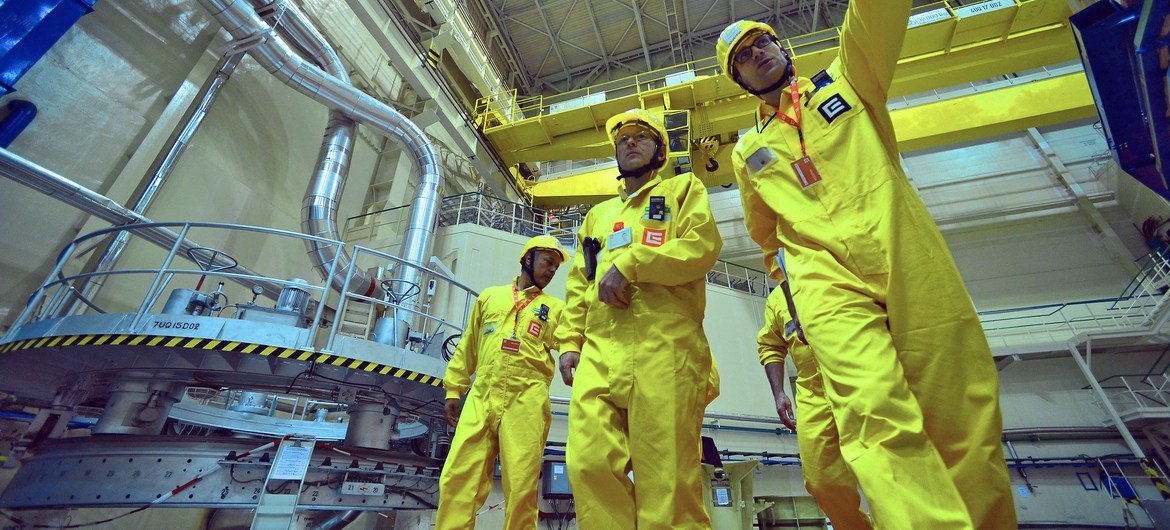
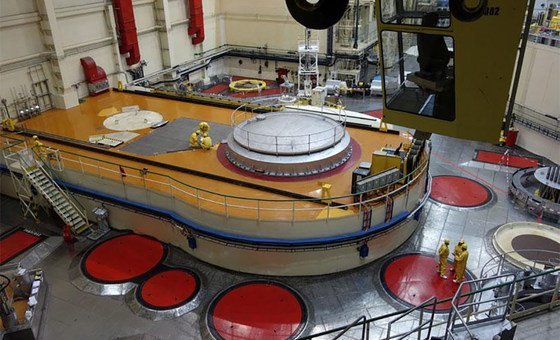
Проверка мирного использования ядерных материалов и технологий на исследовательских реакторах является важной частью работы Международного агентства по атомной энергии (МАГАТЭ). Атомные электростанции сегодня есть только у 30 стран мира. Еще 50 государств имеют установки с исследовательскими реакторами. Эти установки создают определенные сложности, поскольку в отличие от ядерных энергетических реакторов конструкции исследовательских реакторов могут существенно различаться и поэтому при проверке каждого такого исследовательского реактора требуется специальный подход.
Побочным продуктом использования исследовательских реакторов является плутоний — материал, который можно применять в целях ядерной энергетики и исследований, но который также используют в качестве одного из компонентов при производстве ядерного оружия. Каждый отдельный исследовательский реактор производит лишь небольшое количество плутония, но опасность его использования не по назначению сохраняется. «Исследовательские реакторы в основном предназначены для целей здравоохранения и развития, но потенциальная возможность переключения ядерного материала с мирных видов деятельности или использования реактора не по назначению все равно сохраняется», — считает старший инспектор МАГАТЭ Джамель Тадже.
Мы учим наших инспекторов находить любые признаки использования исследовательских реакторов не по назначению
В ходе проверки инспекторы МАГАТЭ учитывают время, необходимое исследовательскому реактору для производства приблизительного количества ядерного материала, который может использоваться для изготовления ядерного взрывного устройства. МАГАТЭ также получает от принимающего государства информацию о конструкции и схеме установки, а также о форме, количестве, местонахождении и перемещении используемого материала. Затем представители Агентства выясняют достоверность и полноту представленной государством информации о конструкции и подтверждают, что установка и ядерный материал на установке используются должным образом.
«Ввиду различий в конструкциях и видах использования исследовательских реакторов не существует единого контрольного перечня, который бы удовлетворял все требования по проверкам таких установок. Мы учим наших инспекторов находить любые признаки использования исследовательских реакторов не по назначению и переключения ядерного материала. Инспекторы должны уметь замечать несоответствия и задавать правильные вопросы», - добавил Джамель Тадже.
Так, многие исследовательские реакторы содержат горячие камеры. Эти защитные камеры отгораживают работников от ядерного излучения — работник стоит снаружи камеры и использует манипуляторы для безопасного обращения с оборудованием и ядерными материалами, находящимися внутри камеры. Горячие камеры чаще всего используются для разделения изотопов в медицинских целях, но они также могут использоваться для экстракции плутония в небольших количествах из облученного топлива, произведенного исследовательским реактором. Инспекторы МАГАТЭ по гарантиям обучаются методам обнаружения экстракции плутония. Инспекторы МАГАТЭ регулярно проводят проверки ядерных объектов в странах-участниках ДНЯО, чтобы убедиться в том, что они используются исключительно в мирных целях.
Инспекторы должны уметь замечать несоответствия и задавать правильные вопросы
В некоторых исследовательских реакторах используется уран, который в высокообогащенном состоянии также может быть использован для производства ядерного оружия. Сегодня многие реакторы, в том числе исследовательские, уже переведены на низкообогащенный уран, который непригоден для производства ядерного оружия. Однако инспекторы МАГАТЭ на всякий случай продолжают проверять весь ядерный материал на исследовательских реакторных установках.
МАГАТЭ не только проверяет ядерные реакторы, но и помогает государствам вести учет и контроль за ядерным материалом. В Агентстве отмечают, что при проверках очень большое значение имеет сотрудничество между государством и МАГАТЭ.
Напомним, что в 1968 году был подписан Договор о нераспространении ядерного оружия. Он закрепил статус ядерных держав за пятью государствами (Великобритания, США, Китай, СССР и Франция) и был призван предотвратить дальнейшее распространение ядерного оружия. Этот договор провозглашает принципы ядерного разоружения и закладывает основы сотрудничества в сфере развития атомной энергетики в мирных целях. Сегодня МАГАТЭ помогает странам использовать ядерные технологии для сокращения масштабов нищеты и голода, выработки электроэнергии, управления водными ресурсами, а также для лечения рака и борьбы с изменением климата.