Избранное сообщение

Показаны сообщения с ярлыком GENERAL ASSEMBLY. Показать все сообщения

вторник, 29 апреля 2025 г.

Marine Biodiversity Treaty Preparatory Commission Concludes First Session, Noting Summer of Work to Come


The commission tasked with preparing for the entry into force of a new treaty on marine biodiversity concluded its first session today, completing its deliberations on issues including governance, the instrument’s Clearing-House Mechanism, financial and procedural rules, subsidiary bodies established by the accord and arrangements to enhance cooperation with other bodies.

The gathering, formally known as the “Preparatory Commission for the Entry into Force of the Agreement under the United Nations Convention on the Law of the Sea on the Conservation and Sustainable Use of Marine Biological Diversity of Areas beyond National Jurisdiction and the Convening of the First Meeting of the Conference of the Parties to the Agreement”, is held from 14 to 25 April in New York.  The Commission is scheduled to hold its second session from 18 to 29 August 2025 and its third session from 23 March to 2 April 2026.

The Agreement under the United Nations Convention on the Law of the Sea on the Conservation and Sustainable Use of Marine Biological Diversity of Areas beyond National Jurisdiction, as it is formally known, was adopted on 19 June 2023.  (Coverage of the Commission’s first session is available here.)

Before the first session began, the Agreement had 112 signatories, 21 of whom had also ratified the accord. Thailand announced on 17 April that it had become the 113th signatory to the Agreement.  Today, the representative of Cameroon announced that his delegation would be signing the Agreement in the coming days.

The Agreement will enter into force 120 days after the date of deposit of the sixtieth instrument of ratification, approval, acceptance or accession thereto.  Pursuant to the Agreement, the first meeting of the Conference of the Parties shall be convened by the United Nations Secretary-General no later than one year after the Agreement’s entry into force.

Commission Co-Chairs Present Oral Summaries of Session’s Deliberations

At the meeting’s outset, the Commission’s Co-Chairs, Janine Coye‑Felson (Belize) and Adam McCarthy (Australia), presented oral reports summarizing discussions to date, highlighting points of convergence and divergence among delegates and presenting the way forward — including further documentation to be produced — ahead of the Commission’s second session in August.

Speakers Urge Recognition of Developing States’ Needs

Later, several delegations — echoing sentiments heard throughout the session — underscored the need to address the special needs of developing States.  Sierra Leone’s representative, speaking for the African Group, said that activities related to the signing, ratification and implementation of the Agreement must be carried out in a way that “maintains the universal confidence, integrity and progress collectively achieved”.  She called for recognition of the unique needs of developing State Parties, including small island developing States, least developed countries, landlocked developing countries and coastal African States.

“The UN system should make sure that the Agreement is enforced with transparency, equity and fairness,” underscored Haiti’s representative.  He appealed for assistance to developing countries to ensure their full participation in the work of the Conference of the Parties and subsidiary bodies established under the Agreement.  Similarly, the representative of Bangladesh urged that the final outcome [of the Commission’s work] reflect developing countries’ interests and priorities.

Tuvalu’s delegate, speaking for the Pacific small island developing States, likewise noted that those countries are “custodians of large ocean spaces”, and their special circumstances must remain central throughout the entire Agreement.  He called for enhanced cooperation to ensuring an accessible and fit-for-purpose financial mechanism, and in designing reporting that is achievable for all. Further, he said that his group looks forward to a second Commission session that delivers an Agreement that is “fair, inclusive and responsive to the needs of all”.

For his part, the observer for the International Indian Treaty Council — an organization representing over 300 Indigenous Peoples — voiced appreciation that  Indigenous Peoples and civil society had the opportunity to contribute meaningfully during the Commission’s first session.

Speakers Also Point to Early Implementation Efforts, Upcoming Events

Delegations also spotlighted their efforts to advance the Agreement.  Chile’s representative said that his country’s “BBNJ First Movers” initiative, which was launched in 2024, aims to develop a portfolio of marine-protected areas in the high seas and to provide for the sharing of information and experiences to accelerate international cooperation.  He invited all delegations — especially those that may be considering specific marine-protected areas in the high seas and therefore have relevant experience — to join in the initiative’s efforts towards early implementation of the Agreement.

In that vein, the representative of the European Union, in its capacity as observer, spotlighted the bloc’s partnership with Seychelles and Palau.  Further, the “High Ambition Coalition on Biodiversity Beyond National Jurisdiction”, launched in Brest, France, in 2022, aims to boost support for the Agreement’s ratification and implementation, she said.  Voicing hope that 60 States will ratify the treaty — the threshold for its entry into force — in time for the 2025 United Nations Ocean Conference in June in Nice, she invited others to join the coalition to ensure that the treaty is implemented rapidly and ambitiously.

Relatedly, the representative of the Republic of Korea announced that the tenth “Our Ocean Conference” will be held in Busan immediately after the Commission’s first session, from 28 to 30 April, on the theme “Our Ocean, Our Action”.  During the conference — an annual event where ocean leaders from around the world gather to discuss how to protect those resources — delegates will discuss ways to “implement actions for the healthy use and conservation of the oceans”, she stated.

The observer for the High Seas Alliance, observing that “a lot of work is still to be done” ahead of the Commission’s second session, also looked forward to further signatures and ratifications before June “to bring this Agreement into force as early as possible”.  Doing so will help address the very real threats to the ocean by achieving the 30-by-30 goal of the Kunming-Montreal Global Biodiversity Framework, which aims to protect 30 per cent of the world’s land and ocean area by 2030.  The Agreement should serve as “the lighthouse of multilateralism”, she stated.

Several delegations — including those of Iraq, speaking for the Group of 77 developing countries and China, and Saint Lucia, speaking for the Caribbean Community (CARICOM) — also took the floor to express their thanks and commend the Commission’s bureau for its leadership and guidance during this first session.

Co-Chairs Deliver Closing Statement, Conclude First Session

Following that, the Commission’s Co-Chairs jointly delivered a closing statement that will be issued as an official document after it is finalized following today’s meeting.

They reported that the relevant trust fund facilitated the participation of 29 delegates from developing countries in the Commission’s work, 19 of whom were from least developed countries, landlocked developing countries or small island developing States.  On behalf of the Commission, they expressed their gratitude to those who donated to the fund — namely, Chile, Cyprus, European Union, Finland, France, Germany, Ireland and Portugal.

Notwithstanding the human and financial constraints posed by the “present and real” liquidity crisis facing the United Nations, they appealed to delegations to “exercise flexibility, demonstrate open-mindedness and contribute creative ideas” on how the Commission can effectively advance its work.  They also thanked participants for their engagement, trust, support, flexibility and cooperation during the Commission’s first session.

And while welcoming points of agreement in various deliberations, “we urge delegations to seek to find ways to bridge divergences” so that the entry into force of the Agreement and the convening of the first meeting of the Conference of the Parties thereto may be realized, they said.

The first session of the Preparatory Commission was then declared closed.  It will hold its second session in New York in August.


https://press.un.org/en/2025/sea2216.doc.htm


https://creativecommons.org/licenses/by/4.0/legalcode

суббота, 5 октября 2024 г.

With World Experiencing Increasing Floods, Hurricanes, Droughts, Sixth Committee Debates Framework for Draft Articles on Protecting Persons in Event of Disasters


Seventy-ninth Session,
5th & 6th Meetings (AM & PM)
GA/L/3717


Amidst ever-more-frequent wildfires, drought, cyclones, flooding, hurricanes and other hazards, the Sixth Committee (Legal) today deliberated over the International Law Commission’s draft articles on the protection of persons in the event of disasters as delegates discussed States’ obligations to their citizens and to each other in the wake of the devastation caused by these events.

“As old and emerging challenges become ever more transnational and complex, it is likely that the world will face events that are increasingly more common, as well as more severe in scale and effects,” said the representative of Portugal.  These will result in “widespread loss of life, great human suffering and distress” and cause “serious disruption of the functioning of society”, he said, quoting the Commission’s draft articles.  In addressing this, the texts strike a “sensible and delicate balance” between the need to protect human rights and facilitate international cooperation on the one hand, and the fundamental principle of State sovereignty and the affected State’s primary role in providing disaster relief on the other, he observed.

Agreeing on the need for such a balance was Canada’s representative, speaking also for Australia and New Zealand.  Welcoming the emphasis on international human-rights law included in the draft articles, he added that “sharing best practices and initiatives under way at the local, national and regional levels can usefully advance reflection and enable swift action”.  Building on that was Germany’s representative, who underlined the need — especially in events of disaster — “to have an agreement on all actors’ rights and obligations laid out in a concise and clear framework in order to act fast and effectively”.

Yet, “despite the urgency on the ground”, Hungary’s representative pointed out that the field of disaster law remains fragmented.  Many current international instruments suffer from limited ratification or focus narrowly on specific aspects of disasters. Thus, the value of the Commission’s approach “seeks to bring coherence and systematization to this fragmented legal landscape”.  While stating that the draft articles are a “good basis for future negotiations”, she noted “several opportunities for improvement” — including further consideration of the impact of disasters on cultural heritage.

The draft articles can serve as a “useful guide for States and others engaged in disaster relief”, said the representative of Singapore, stating that a “laudable aspect” is that they reflect the diversity of State practice. “States, being familiar with their own national contexts, are best placed to determine the necessary measures to reduce the risk of disasters,” she emphasized.  Similarly, the representative of the Netherlands said that the draft articles — in their current form — “are useful as non-binding guidelines that may assist in better protection of persons affected by disasters”.

Other speakers were more critical.  The Russian Federation’s representative said that the draft articles, as they stand, are not a good basis on which to elaborate a convention and proposed that they be sent back to the Commission to be “reworked”. The articles do not consider the obligation of assisting actors — including when assistance is denied for political reasons — nor do they oblige assisting States to obey the law of the affected State throughout the period of assistance.  “The affected State is considered as an object, rather than an equal subject here,” she observed.  Further, she said that it should be a “criminal act” when “the assisting State and its subjects profit from the assistance they extend”.

Egypt’s representative, stating that the draft articles “require significant revision and redrafting”, expressed concern that they could be misconstrued or misapplied in a manner that infringes on States’ sovereignty or territorial integrity.  He also pointed out that they do not provide practical mechanisms to “galvanize international support for developing States in the processes of disaster response and reconstruction”.  As well, he stressed, “The principal impediment to the ability of affected States to address disasters is the lack of capacity in this field.”

“We cannot do it alone,” said the representative of Grenada, speaking for the Caribbean Community (CARICOM), noting that a significant portion of disaster relief and recovery in many small island developing States is supported by external assistance.  For many such States, he added, climate change is not a “hypothetical”, but an “undisputable reality”.  Echoing that, Indonesia’s representative also declared that “no nation — regardless of its preparedness — can confront such challenges alone”.  The draft articles provide “critical legal underpinnings to foster cooperation”.  Further, they ensure that affected individuals receive the necessary assistance, aligned with their dignity and needs. 

Similarly, Guatemala’s representative recalled the devastating effects of hurricanes Eta and Iota and the 2018 eruption of Volcán de Fuego, emphasizing that the consequences of natural disasters often exceed affected States’ resources and overwhelm their capacities to respond. Adding to that, Iraq’s representative, detailing national efforts to concurrently “tackle environmental climate challenges while implementing our development plans”, said that his country is acutely exposed to natural disaster.  This, in turn, prevents efforts to reduce poverty and presents difficulties regarding the use of natural resources. 

Underscoring the importance of ensuring a human-rights approach and a gender perspective as a “central pillar”, Mexico’s representative joined others in expressing support for the elaboration of an international convention based on the draft articles.  While Mexico is party to several bilateral agreements, he observed that — in a world where disasters are becoming more frequent — an international convention is not only necessary, but also the best tool with which to address current challenges. He also said that the most-efficient way to respond to disaster is to prevent it, stressing the need to transition from a reactive approach to a proactive one.

“We must take action to reduce vulnerability and exposure to hazards in advance,” stressed Nepal’s representative, stating that efforts to mitigate climate change and improve disaster preparedness are “crucial to reducing the impact of these events”.  For its part, the Nepalese Government regularly issues early warnings of major hazards, has created a dedicated data portal to provide real-time updates on disaster events and response measures and prioritizes the reconstruction of disaster-affected infrastructure.  While emphasizing that the affected State’s sovereignty must be respected while providing assistance — “even during difficult times” — he said that “utmost priority” must be given to protecting human lives.

El Salvador’s representative, also underlining the need to protect the rights of human beings, quoted Brazilian jurist Antônio Augusto Cançado Trindade:  “As international law evolves, it is moving away from the paradigm of State-centrism in favour of human-centrism, managing to place human beings at the centre and always bearing in mind the problems that affect humanity as a whole.”

The representative of Nigeria, also speaking for the Bahamas, Colombia, Croatia, Italy, Jamaica and Thailand, said that launching the process of negotiating a convention on this topic would be instrumental, and in line with the political commitments made during the midterm review of the Sendai Framework.  While recognizing that there will be different views on the draft articles, she nevertheless stressed that this should not prevent States from establishing an open and inclusive process.  “The draft articles may constitute a foundation, but we should not lose sight that it is for us – States – to build a solid house and to make it comfortable for everyone,” she said.

South Africa’s representative concurred:  “While we appreciate that there are concerns that State practices is not fully settled, States should not shy away from playing a more constructive role in establishing a framework for cooperation.” She cautioned, however, “that we should not get caught in the trap of perpetual discussions about discussions”, underscoring:  “It is crucial that discussions move forward.”

At the outset of the meeting, the Committee concluded its debate on measures to eliminate international terrorism.  During that discussion, Haiti’s representative noted that 19 universal and 36 regional legal instruments exist on this topic. “However, the very fact that we are here today discussing these issues shows us that the challenge remains when it comes to implementing these instruments — and doing so effectively,” he observed.  Ethiopia’s delegate concurred, emphasizing:  “We have come to realize that the absence of peace and stability in our sub-region created a safe haven for international terrorism.”  This reality underscores the need for international cooperation to “defeat both brands of international and domestic terrorism,” he added.


https://press.un.org/en/2024/gal3717.doc.htm


https://creativecommons.org/licenses/by/4.0/legalcode

пятница, 4 октября 2024 г.

Muhammad Abdul Muhith (Bangladesh) Chair of Second Committee


GA/EF/3599


(Based on information provided by the Protocol and Liaison Service)

The Second Committee (Economic and Financial) elected Muhammad Abdul Muhith (Bangladesh) Chair on 6 June.  (See Press Release GA/12605.)

Prior to his appointment in 2022 as Permanent Representative to the United Nations, Mr. Muhith served as his country’s ambassador to Austria with concurrent accreditation to Hungary, Slovenia and Slovakia, as well as Permanent Representative of Bangladesh to the United Nations Offices and International Organisations in Vienna.  From 2015 to 2020, he was Bangladesh’s Ambassador to Denmark with concurrent accreditation to Estonia and Iceland.

Between 2012 and 2015, he was Minister and Deputy Chief of Mission, Embassy of Bangladesh in Washington, D.C.  From 2010 to 2012, he was Director-General (Americas) with occasional additional responsibility as Director-General (Europe), Ministry of Foreign Affairs.  Between 2004 and 2010, he was Counsellor/Minister at the Permanent Mission of Bangladesh to the United Nations in New York.

From 2002 to 2004, he served as Director of the Foreign Secretary’s Office, Ministry of Foreign Affairs, and from 2000 to 2002, he held the position of Counsellor at the Embassy of Bangladesh in Doha.  He also served as Second and First Secretary at his country’s embassy in Rome in 1999 and 2000 and as Third and Second Secretary at the embassy in Kuwait from 1995 to 1999.

Joining the Bangladesh Civil Service in 1993, he was the Assistant Secretary (Legal, Treaty and Maritime) and Assistant Secretary (Protocol) at the Ministry of Foreign Affairs from 1993 to 1995.

He holds both a Master and a Bachelor of Social Science (Sociology) from the University of Dhaka.


https://press.un.org/en/2024/gaef3599.doc.htm


https://creativecommons.org/licenses/by/4.0/legalcode

суббота, 27 апреля 2024 г.

PGA Remarks at the Informal Interactive Dialogue of the General Assembly on Commodity Markets


PGA Remarks at the Informal Interactive Dialogue of the General Assembly on Commodity Markets


 Remarks by the President of the General Assembly,

Mr. Dennis Francis,

at the Informal Interactive Dialogue of the General Assembly on Commodity Markets

26 April 2024

[As Delivered]


Ms. Rebeca Grynspan , Secretary-General of UNCTAD,

Excellencies, Invited Panelists,

Ladies and Gentlemen,

It is a great pleasure to welcome you all to this General Assembly’s informal interactive dialogue on commodity markets, a subject of special importance to so many countries in the Global South, whose development is constrained by the vagaries of global markets for such products.

I am particularly grateful to the United Nations Conference on Trade and Development for their robust support and partnership in organizing this event – a commitment evidenced by the presence with us here today of Ms. Rebeca Grynspan, its distinguished Secretary General, who will contextualize our discussion by delivering a Keynote Address.

Commodities – the basic goods and raw materials that form the bedrock of global trade – are integral to the global economy.

These commodities – ranging from the cereals in our meals to the cotton in our clothes, to the copper in our electronics – underpin production, consumption, and trade worldwide.

While commodity markets are vital to the global economy, excessive dependence on commodities can create adverse consequences for a nation’s economic sustainability and the well-being of its people.

Globally, commodity dependence – defined as a scenario where 60 percent or more of a country’s export revenue depends on basic goods – disproportionately affects developing countries, in particular.

Consider that – according to the most recent UNCTAD State of Commodity Dependence report – only 13 percent of advanced economies, particularly Australia and Norway, are commodity dependent.

By contrast, a staggering 85 percent of the world’s Least Developed Countries are commodity dependent.

A majority of Landlocked Developing Countries and Small Island Developing States also find themselves in similar situations of commodity dependence – rendering their economies vulnerable, and highly susceptible to external shocks.

The fact that the number of commodity-dependent developing countries has increased – from 94 to 99 between  2002/04 and 2020/22 – should sound the alarm bell for us, because, addressing the issue of commodity dependence is key to the implementation of the 2030 Agenda for Sustainable Development and achieving the SDGs.


Excellencies,

Peculiar challenges faced by commodity-dependent economies are many and varied, including that:

  • commodity-dependent countries frequently grapple with issues such as sluggish productivity, income volatility, overvalued exchange rates, and heightened economic and political instability. Such dependence leaves economies vulnerable to external shocks and fluctuations in international market prices.
  • an overwhelming 95 percent of the 20 countries most vulnerable to climate change are commodity-dependent developing countries – further exacerbating their economic and social challenges.

In addition, the devastating impact of commodity dependence – particularly its effect of limiting foreign exchange earnings – remains highly problematic, at a time when global public debt has reached grossly unsustainable levels.

Furthermore – amid global discussions on debt sustainability and the reform of the international financial architecture – it is crucial that we address commodity dependence, with the urgency the matter deserves.

I believe that breaking free from commodity-dependence – while challenging – is achievable.

I say so mindful of the success stories of countries like Costa Rica and Malaysia – which provide examples of viable pathways that can be emulated by other countries.

Costa Rica transitioned from primarily trading bananas and coffee to exporting services and medical instruments.

Similarly, Malaysia shifted from producing mostly rubber and tin to manufacturing electronics.

These cases – among many others – highlight valuable lessons in economic diversification and emphasize the importance of implementing policies that both capitalize on opportunities while managing risks associated with economic transitions.


Excellencies,

Ladies and Gentlemen,

I close by urging you all to take today’s mandated dialogue as an opportunity to take stock of world commodity trends, prospects, and strategies for economic and export diversification – particularly in so far as it affects commodity-dependent developing countries.

I therefore look forward to your deliberations on specific strategies that commodity-dependent countries can adopt to enhance their technological capacity and innovation ecosystems.

I encourage discussions that focus on key sectors and financing mechanisms which hold the greatest potential to drive structural transformation, economic diversification, and resilience in commodity-dependent developing countries.

I am also hopeful that Member States and other stakeholders will consider how the international community can support sustainable and inclusive diversification efforts in commodity-dependent developing countries.

Lastly, I do believe that the great work that agencies like UNCTAD have produced over the years – on enhancing the productive capacity of many vulnerable countries – must be fully leveraged, for the benefit of especially the LDCs.

Together, we can transform challenges into opportunities for diversification, inclusive growth and sustainable development.


I thank you.


https://www.un.org/pga/78/


https://www.un.org/pga/78/2024/04/26/pga-remarks-at-the-informal-interactive-dialogue-of-the-general-assembly-on-commodity-markets/


https://creativecommons.org/licenses/by/3.0/legalcode

четверг, 21 марта 2024 г.

General Assembly adopts landmark resolution on artificial intelligence

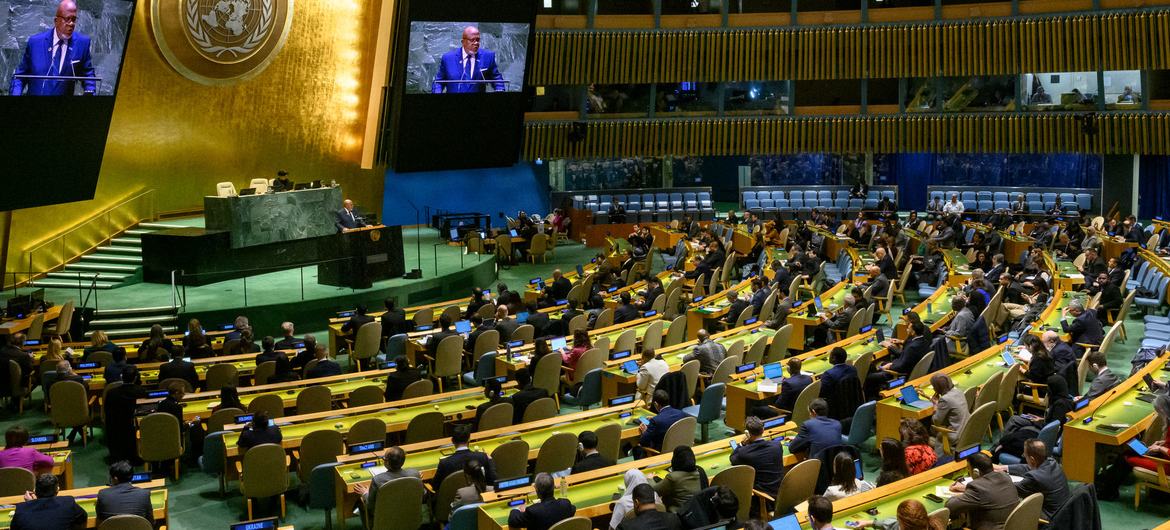
A view of the General Assembly in session. (file)
UN Photo/Loey Felipe
 
A view of the General Assembly in session. (file)


21 March 2024
SDGs

The UN General Assembly on Thursday adopted a landmark resolution on the promotion of “safe, secure and trustworthy” artificial intelligence (AI) systems that will also benefit sustainable development for all.

Adopting a United States-led draft resolution without a vote, the Assembly also highlighted the respect, protection and promotion of human rights in the design, development, deployment and the use of AI.

The text was “co-sponsored” or backed by more than 120 other Member States.

The General Assembly also recognized AI systems’ potential to accelerate and enable progress towards reaching the 17 Sustainable Development Goals.

It represents the first time the Assembly has adopted a resolution on regulating the emerging field. The US National Security Advisor reportedly said earlier this month that the adoption would represent an “historic step forward” for the safe use of AI.

Tweet URL
UN_News_Centre

Same rights, online and offline

The Assembly called on all Member States and stakeholders “to refrain from or cease the use of artificial intelligence systems that are impossible to operate in compliance with international human rights law or that pose undue risks to the enjoyment of human rights.”

“The same rights that people have offline must also be protected online, including throughout the life cycle of artificial intelligence systems,” it affirmed.

The Assembly also urged all States, the private sector, civil society, research organizations and the media, to develop and support regulatory and governance approaches and frameworks related to safe, secure and trustworthy use of AI.

Closing the digital divide

The Assembly further recognized the “varying levels” of technological development between and within countries, and that developing nations face unique challenges in keeping up with the rapid pace of innovation.

It urged Member States and stakeholders to cooperate with and support developing countries so they can benefit from inclusive and equitable access, close the digital divide, and increase digital literacy.

Hope for other sectors

Speaking before the adoption, Linda Thomas-Greenfield, US Ambassador and Permanent Representative to the UN, introduced the draft resolution.

She expressed hope that the “inclusive and constructive dialogue that led to this resolution would serve as a model for future conversations on AI challenges in other arenas, for example, with respect to peace and security and responsible military use of AI autonomy.”

Ms. Thomas-Greenfield noted that the resolution was designed to amplify the work already being done by the UN, including the International Telecommunication Union (ITU), the UN Educational, Scientific and Cultural Organization (UNESCO) and the Human Rights Council.

“We intend for it to complement future UN initiatives, including negotiations toward a global digital compact and the work of the Secretary-General’s high-level advisory body on artificial intelligence,” she said.

We govern AI

Ms. Thomas-Greenfield also highlighted the opportunity and the responsibility of the international community “to govern this technology rather than let it govern us”.

“So let us reaffirm that AI will be created and deployed through the lens of humanity and dignity, safety and security, human rights and fundamental freedoms,” she said.

“Let us commit to closing the digital gap within and between nations and using this technology to advance shared priorities around sustainable development.”


https://news.un.org/en/story/2024/03/1147831


https://creativecommons.org/licenses/by/3.0/legalcode

понедельник, 31 июля 2023 г.

With Overwhelming Support, General Assembly Adopts Two Resolutions on New Oceans Biodiversity Treaty


95TH MEETING (AM)
GA/12520

Organ also Adopts Text Commemorating Anniversary of Permanent Arbitration Court

The General Assembly today adopted two resolutions — including one on entry into force of a previously adopted agreement on the oceans and conservation of biodiversity — while rejecting an amendment proposed by the Russian Federation that would have deleted three critical paragraphs of the text.

The representative of Singapore introduced the draft titled “Agreement under the United Nations Convention on the Law of the Sea on the Conservation and Sustainable Use of Marine Biological Diversity of Areas beyond National Jurisdiction” (document A/77/L.82).  The draft resolution is essentially procedural, he recalled, pertaining to eventual operationalization and implementation of the Agreement adopted at the Biodiversity Beyond National Jurisdiction Intergovernmental Conference — the culmination of nearly two decades of work — and “commended and widely celebrated by members of the international community” as a major milestone in ocean governance.  Calling on all Member States to support it as it has been tabled, he stressed that his delegation would vote in favour and against all proposed amendments in document A/77/L.83 as they seek to delete important elements and are at odds with what the resolution seeks to achieve.

However, before the vote on that text, the representative of the Russian Federation introduced the amendment titled “Agreement under the United Nations Convention on the Law of the Sea on the Conservation and Sustainable Use of Marine Biological Diversity of Areas beyond National Jurisdiction” (document A/77/L.83), which proposed to delete operative paragraphs 1, 5 and 6.  He said that despite viewing the Agreement as “totally unacceptable”, and distancing itself from consensus in the adoption of the resolution, his delegation had shown unprecedented flexibility.  While being presented as a purely technical text, the draft contained numerous elements of a political nature, considering supplementing the agenda item “oceans and the law of the sea” by a sub-item on this new Agreement, which was “completely unacceptable”.  The amendment, he stressed, has only one purpose:  to exclude from the draft the aforementioned politicized elements and return it to a mainly technical domain.

In the ensuing debate, a number of delegates stressed the importance of “L.82” to developing States, especially those dependent on the oceans for their economies and those especially vulnerable to climate change, while soundly rejecting the amendment.

The representative of Belize, speaking on behalf of the Caribbean Community (CARICOM), pointing to “a true victory for multilateralism”, said all negotiating parties arrived at a satisfactory outcome which led to the consensus adoption of the new marine biodiversity treaty in June 2023.  “It is not a perfect document,” he stressed, but “it is a win for oceans and biodiversity”.  He completely rejected the amendment and unequivocally supported the resolution.  The delegate of Seychelles stressed that the special circumstances of small island developing States must be acknowledged and understood as hurdles to their ability to implement the treaty, especially since they are biodiversity hotspots that carry a high conservation burden.  Small island developing States, least developed countries and the Global South must have equitable representation in forthcoming committees, he stressed.

Echoing those sentiments, Palau’s delegate, speaking for the Pacific small island developing States, said the draft resolution represented an important step in turning the Agreement into reality.  He voiced disappointment that an amendment was proposed to delete such elements and indicated his delegation will vote against it. Samoa’s representative, speaking for the Alliance of Small Island States, expressed concern over the potential impact that activities in areas beyond national jurisdiction will have on territorial waters, extended continental shelves and exclusive economic zones that are critical for development.  The text adopted was an accurate reflection of common landing zones reached after a decade of comprehensive negotiations, she stated.

The representative of Spain, speaking for the European Union in its capacity as observer, noted the Agreement marked a historic achievement, providing a legal framework for all activities on the oceans and seas.  Adoption of the resolution shows that the international order “comes up with the goods when it’s most important”, he stressed, and the Union has committed €40 million for the speedy application of the Agreement.

The Assembly first rejected the amendment “L.83” by a recorded vote of 119 against to 4 in favour (Belarus, Nicaragua, Russian Federation, Syria), with 24 abstentions.

The Assembly then adopted resolution “L.82” by a recorded vote of 150 in favour to 2 against (Russian Federation, Syria), with no abstentions.  By its terms, the Assembly requested the Secretary-General to make proposals in the context of the proposed programme budget for 2024 in order to strengthen the capacity of the Division for Ocean Affairs and the Law of the Sea of the Office of Legal Affairs of the Secretariat to promote a better understanding of the Agreement and to prepare for its entry into force.  It further called upon all States and regional economic integration organizations to consider signing and ratifying, approving or accepting the Agreement at the earliest possible date.

In explanation of vote, Colombia’s delegate, also speaking on behalf of Argentina, Brazil, Chile, Costa Rica, Ecuador, El Salvador, Guatemala, Honduras, Mexico, Dominican Republic, Paraguay, Peru and Uruguay — the Latin American Core Group — stressed that the most difficult phase is just beginning.  She called on Member States to ensure that the process until the Agreement’s entry into force is inclusive and as simple as possible and sets out a clear path towards States’ ratification.

The representative of Venezuela noted his delegation had joined the consensus allowing adoption of the Agreement without a vote.  However, its position on “L.82” should not be interpreted as a modification of its traditional position regarding the United Nations Convention on the Law of the Sea, to which it is not a party, and not bound by such rules.

The Assembly then turned to the draft resolution “Commemoration of the 125th anniversary of the Permanent Court of Arbitration” (document A/77/L.90).  The representative of Philippines, also speaking for a core group of countries including Australia, Egypt, Guatemala, Hungary and Thailand, introduced the text, recalling that the Court has evolved into a robust modern international dispute settlement institution with one of the heaviest caseloads of all international courts.  The draft resolution reaffirms the shared mission between the Court and the United Nations in the maintenance of international peace and security, the peaceful settlement of international disputes and the progressive development of international law.  Further, it recalls the Assembly’s invitation for the Court to participate in its sessions and work in the capacity of observer, and recognizes the Court’s important contribution to the peaceful settlement of disputes.

The Assembly then adopted the resolution “L.90” by consensus.  By its terms, it welcomed the 125th anniversary of the establishment of the Permanent Court of Arbitration and encouraged Member States to make use of its services in arbitration, conciliation, mediation, commissions of inquiry and other peaceful means of dispute resolution.  Further, it requested the Secretary-General to bring the present resolution to the attention of Member States, the organizations of the United Nations system and all relevant stakeholders.


https://press.un.org/en/2023/ga12520.doc.htm

https://creativecommons.org/licenses/by/3.0/legalcode

среда, 26 июля 2023 г.

Legality of Acts against Religious Symbols, Books Ignites Contentious Debate as General Assembly Adopts Resolution on Culture of Peace, Five Other Texts


94TH MEETING (AM)
GA/12519

Legality of Acts against Religious Symbols, Books Ignites Contentious Debate as General Assembly Adopts Resolution on Culture of Peace, Five Other Texts

Delegates Also Discuss Establishment of United Nations Youth Office

The General Assembly today adopted three consensus decisions on global health and foreign policy and three consensus resolutions on strengthening of the United Nations system, the impact of rapid technological change on the Sustainable Development Goals, and culture of peace — with the latter surviving an attempt to alter its language and sparking a heated debate on whether acts against religious symbols or books constitute a violation of international law.

By that resolution titled “Promoting interreligious and intercultural dialogue and tolerance in countering hate speech”, the General Assembly called upon Member States to engage with all relevant stakeholders to promote interreligious and intercultural dialogue and respect and acceptance of differences, among other things, to reject the spread of hate speech which constitutes incitement to discrimination, hostility and violence.  It further called on Member States and social media companies to counter hate speech and address its increasing spread, enable research into measures to reduce it and promote users’ access to effective reporting channels. 

The amendment to that text was orally proposed by Spain’s representative who, speaking for the European Union, voiced concern about the reference in preambular paragraph 13 to violent acts against religious symbols and sacred books as a violation of international law.  She emphasized that although such actions are deeply offensive and disrespectful, they do not constitute a violation of international law, and thus proposed the elimination of the reference to “in violation of international law”.

The contentious discussion that followed the vote on the amendment and the consensus adoption of the resolution underscored the division within the Assembly on how such acts should be treated.  Delegations who took the floor include nine who voted in favour of the amendment and nine who voted against it. 

Among the latter was the representative of Malaysia, who said it was unfortunate that the amendment to preambular paragraph 13 was introduced.  He pointed out that several delegations made calls for stronger human rights language during negotiations, yet on violations of holy books, the desire for stronger language on human rights was somewhat subdued.  Voicing strong disagreement with the notion that defamation of religion is not an infringement of human rights, he stressed that the defamation of any religion constitutes a derogation of the right to freedom of religion or belief, noting his vote against the amendment presented.

On the other hand, Denmark’s representative — speaking also for Finland, Iceland, Norway and Sweden — echoed other speakers who stressed that burning the Qur’an or any other holy book is offensive, disrespectful and a clear act of provocation.  Her bloc condemns such acts and strongly disassociates from them, she said, noting, however, that their countries also stand for the right to freedom of opinion and expression.  Freedom of religion or belief does not prohibit the criticism of religions or beliefs, she pointed out, noting that while her bloc has joined consensus with those clarifications, it disassociates itself from the reference to violation of international law in preambular paragraph 13.

At the outset of the meeting, the Assembly took up the report of the Secretary-General on the United Nations Youth Office, with Member States lauding the achievements of the Secretary-General’s Envoy on Youth and welcoming the new Youth Office and the progress in the transition under way.  Several delegations also highlighted their national efforts to promote the empowerment of meaningful participation of youth, while others outlined recommendations to ensure the Youth Office’s mandate is implemented effectively.

Egypt’s representative said that his country together with Guyana facilitated intergovernmental negotiations on the establishment of the Youth Office.  Highlighting that there are more than 1.2 billion young people worldwide, he said the Office appointment process will reflect a balance between different age groups and geographical representation.  Pointing to the use of youth terminology which does not enjoy international consensus, he voiced hope that the Office’s establishment will prevent the recurrence of such use and instead promote the use of language that unites global youth. 

The speaker for Guyana said the Office is likely to be operating by year’s end. “The functions of the new Youth Office are ambitious as they should be,” she underscored, pointing to the cross-cutting issues that affect young people.  However, she noted that the Office’s ultimate success will depend on the resourcing of its operations.

Pakistan’s representative, on that note, underscored that to enhance the Office’s outcomes, adequate funds must be made available for developing countries to enable their youth to participate in youth-led and youth-oriented United Nations processes more effectively and efficiently.  Like other speakers, she said the recruitment of its staff must consider adequate geographical representation for a more inclusive and diverse workforce.   

Namibia’s delegate highlighted that African youth today are shaping their future, noting that young people in Africa are expected to comprise 42 per cent of global youth by 2030.  In Namibia, young people are empowered and included in decision-making, he reported, pointing to the increased youth representation in both houses of the country’s bi-cameral Parliament as constituency representatives.  “Involving young people in politics and society is not merely a question of inclusion, but one that is vital for economic growth, innovation, peace and security,” he stressed.

The Assembly also adopted by consensus a resolution calling for support to the United Nations International School to enhance international education and promote multicultural interaction, as well as a text on addressing the impact of rapid technological change on the achievement of the Sustainable Development Goals and targets. 

Taking up global health and foreign policy, the Assembly adopted three draft decisions without a vote, by which it decided to approve the participation of the non-governmental and other organizations set forth in the annexes thereto, respectively, on upcoming high-level meetings on universal health coverage; the fight against tuberculosis; and on pandemic prevention, preparedness and response.

Report of United Nations Youth Office

THIBAULT CAMELLI, representative of the European Union, in its capacity as observer, said the United Nations youth agenda and the formation of the Office will give youth voices their rightful place at the heart of the United Nations system.  Commending the progress made and the milestones achieved thus far, he welcomed the focus on consultations with youth, youth-led and youth-serving civil society organizations and networks.  Echoing the need for accountability within the system to ensure youth’s meaningful participation, he noted that the Organization’s youth strategy is permeating its work across the world, and country teams are taking up meaningful youth engagement.  His bloc looks forward to the role that the new Youth Office will play in strengthening policies and coordinating processes and platforms on youth engagement across the United Nations system, he said.

“When it comes to youth affairs, the EU [European Union] is walking the talk,” he emphasized, noting that its first Youth Action Plan aims to foster strong partnerships with young people worldwide to empower and enable them to shape solutions for the problems that affect them.  This includes the bloc’s Youth and Women in Democracy Initiative, which is growing the engagement and impact of young people and women in democratic processes; its Youth Empowerment Fund to support and finance youth-led initiatives on the Sustainable Development Goals; and the Africa-Europe Youth Academy, which aims at advancing learning opportunities and exchange between young people in Africa and the European Union.  As the work to operationalize the United Nations Youth Office continues, he called on the international community to be guided by the principle that “nothing should be about young people without young people”.

MOHAMED OMAR ELFAROUK HASSAN (Egypt) said his country together with Guyana facilitated intergovernmental negotiations on the establishment of the Youth Office.  Noting that there are more than 1.2 billion young people worldwide, he underscored the importance of considering their priorities.  He said he looked forward to the Youth Office appointment process, as it will reflect a balance between different age groups and geographical representation and will take into consideration the increased number of young people in the developing world.  He, however, pointed to the use of some youth terminology which does not enjoy international consensus, expressing hope that the establishment of the Youth Office will prevent the recurrence of such use and will promote the use of terminology that unites global youth.  “We cannot achieve [a] prosperous future without youth,” he underscored, recalling that Egypt declared 2016 the “Year of Youth” and established an international forum to that end.

MARITZA CHAN VALVERDE (Costa Rica) said her country has taken measures to encourage and promote young people’s participation in public affairs and in their communities, as well as abroad.  To make the United Nations more inclusive and connected, she said the United Nations Youth Office should reflect the global community’s diversity and ensure gender parity and non-discrimination in its composition. She recommended the appointment of another woman to head the Youth Office and encouraged the Office to focus on promoting and facilitating dialogue, cooperation and intergenerational solidarity through its connection to agendas related to aging and the demographic transition.  Moreover, the Youth Office should aim to build up its strategic and programmatic agenda, for example, by strengthening a network of focal points in the system and its synergies with regional bodies.  She further highlighted the importance of supporting and advising developing countries and small missions in promoting greater involvement of youth at all levels.

ANA PAULA ZACARIAS (Portugal) said:  “We need to deliver more for young people with young people.”  For this, the establishment of the Youth Office, as the first concrete deliverable of Our Common Agenda, is a key development, she emphasized, spotlighting Portugal’s role in this process.  She said she looked forward to the staff recruitment process for the new Office, which she expects to be represented by an “agile team, leveraging on the rich capacity and technical expertise of the United Nations system as a whole”, while taking stock of the experience brought by the current Secretary-General’s Envoy on Youth.  Recalling that in the Declaration on the Commemoration of the Seventy-Fifth Anniversary of the United Nations Member States made a commitment to listen to and to work with youth, she said she was confident that the Youth Office would realize this commitment and turn it into reality, while supporting youth engagement at the upcoming Sustainable Development Goal (SDG) Summit. 

ANDREAS HADJICHRYSANTHOU (Cyprus), associating himself with the European Union, said the Youth Office should continue to lead high-level advocacy and serve as the anchor for the United Nations system coordination and accountability on youth matters.  It is imperative to address young people’s priorities and challenges to realize their full potential at the local, national, regional and international level, he stressed, noting that the implementation of the World Programme of Action for Youth and the 2030 Agenda for Sustainable Development must be top priorities.  His country is implementing programmes and specific actions on how to strengthen youth participation.  Among them is the youth project “Youth Parliament of Cyprus”, an initiative by two youth non-governmental organizations that has been institutionalized by the Council of Ministers of Cyprus, providing a permanent space for the country’s youth to present their ideas and proposals to policy making and decision-making structures.

NEVILLE GERTZE (Namibia), noting that by 2030, young people in Africa are expected to comprise 42 per cent of global youth, said that today African youth are shaping their future.  In Namibia, young people are empowered and included in decision-making, he reported, pointing to the increased youth representation in both houses of the country’s bi-cameral Parliament as constituency representatives.  Young people must be offered funding and education, and decision-making process must be accessible for them, without coercion and discrimination, he said.  To that end, the Youth Office must strengthen capacity to host professional development opportunities for young people at the national and regional levels, while also including those from marginalized communities and eliminating digital barriers. “Involving young people in politics and society is not merely a question of inclusion, but one that is vital for economic growth, innovation, peace and security,” he stressed. 

SULAFA HAMID I. MOUSA (Saudi Arabia), welcoming the establishment of the Youth Office, said her country supports all efforts towards the empowerment of young people in the United Nations system.  These efforts are consistent with the priorities of her country where young people under the age of 30 make up more than 63 per cent of the population.  Saudi Arabia has led the efforts of the Group of Twenty (G20) through its presidency in 2020 and adopted a road map which sets out to reduce marginalized youth in the labour market by 2025.  It is important to build efforts in a comprehensive manner, taking into consideration young people’s aspirations in all their diversity, their different economic, social and cultural specificities, and diverse social values.  Her delegation looks forward to the promising role of the Youth Office and its global impact, she said.

CAROLYN RODRIGUES-BIRKETT (Guyana), recalling that her delegation facilitated resolution 76/306, establishing the Youth Office, together with Egypt, said that the two tracks of the Office’s transition process will ultimately advance the youth agenda.  The Office is likely to be operating by year’s end.  “The functions of the new Youth Office are ambitious as they should be,” she underscored, pointing to the cross-cutting issues that affect young people.  As the Office moves forward, it will be necessary to prioritize such matters to effect real and positive change at the country level and throughout the United Nations system, while being mindful to regional and national needs, she observed.  While the Youth Office establishment demonstrates Member States’ commitment to engage youth in achieving the Sustainable Development Goals, the Office’s ultimate success will depend on the resourcing of its operations, she noted.

GALA PASTORA MATOS MENÉNDEZ (Dominican Republic), noting that youth are essential partners to find effective solutions to challenges, said the work carried out over a decade by the Secretary-General’s Envoy on Youth was fundamental to the youth agenda of the United Nations and youth around the world, and leaves a valuable and admirable legacy.  The new Youth Office must build on the achievements of the Office of the Youth Envoy; it should include current activities and serve as a key centre for issues facing young people.  She voiced hope that the Secretary-General’s future reports will continue to include youth-related progress and challenges and ensure cohesion and effectiveness in the actions that are carried out by the Organization.

ZHANG SISI (China) said that the international community should listen to young people’s voices and create conditions for them to realize their potential.  To that end, she called for amplifying youth’s role in the realization of the 20230 Agenda and creating a broader platform for young people from developing countries to participate in the United Nations activities.  She encouraged the Youth Office to consolidate existing resources, employ innovative working methods and provide more and equal opportunities for young people in United Nations internships and employment, including through the Young Professional’s Programme.  She also expressed hope that the composition of the Youth Office will be geographically balanced.  China has organized the World Youth Development Forum and launched the International Initiative on Priority Youth Development and the Global Action Plan on Youth Development. 

HADEEQA QURESHI (Pakistan), noting that almost 68 per cent of her country’s population is under 30 years, said the Government thus launched the Prime Minister Youth Programme in 2013, focused on education, employment, engagement and environment.  To enhance the outcomes of the United Nations Youth Office, she said recruitment of its staff must consider adequate geographical representation for a more inclusive and diverse workforce.  Adequate funds must be made available for developing countries to enable their youth to participate in youth-led and youth-oriented United Nations processes more effectively and efficiently.  United Nations communication and outreach must be enhanced to increase developing countries’ participation so that their youth can also avail themselves of internships and youth-relevant events and sessions.  Country teams in the South could include the youth in the region in briefings on United Nations youth strategy and bilateral support for the Sustainable Development Goals, she added.

REEM MOHAMED SALEH YESLAM ALAMERI (United Arab Emirates) said the importance of youth in the Middle East and North Africa cannot be understated, as 55 per cent of the population is less than 30 years old.  Youth have emerged as a catalysing force for positive change, driving towards a more prosperous and stable future for themselves and their communities.  “Young people will have to bear the consequences of our actions today,” she warned, adding that planning and decision-making cannot afford to ignore their interests or exclude them from the conversation.  “If young people are able to meaningfully contribute to these processes, then together we can build a better world for them and for generations to come,” she stressed.  In February 2016, the United Arab Emirates appointed its first Minister of Youth, who at the time was 22 years old and one of the youngest ministers in the world.  The Government also enacted a national youth strategy and continues to engage youth in Government through its Federal Youth Circles.......


https://press.un.org/en/2023/ga12519.doc.htm

https://creativecommons.org/licenses/by/3.0/legalcode